
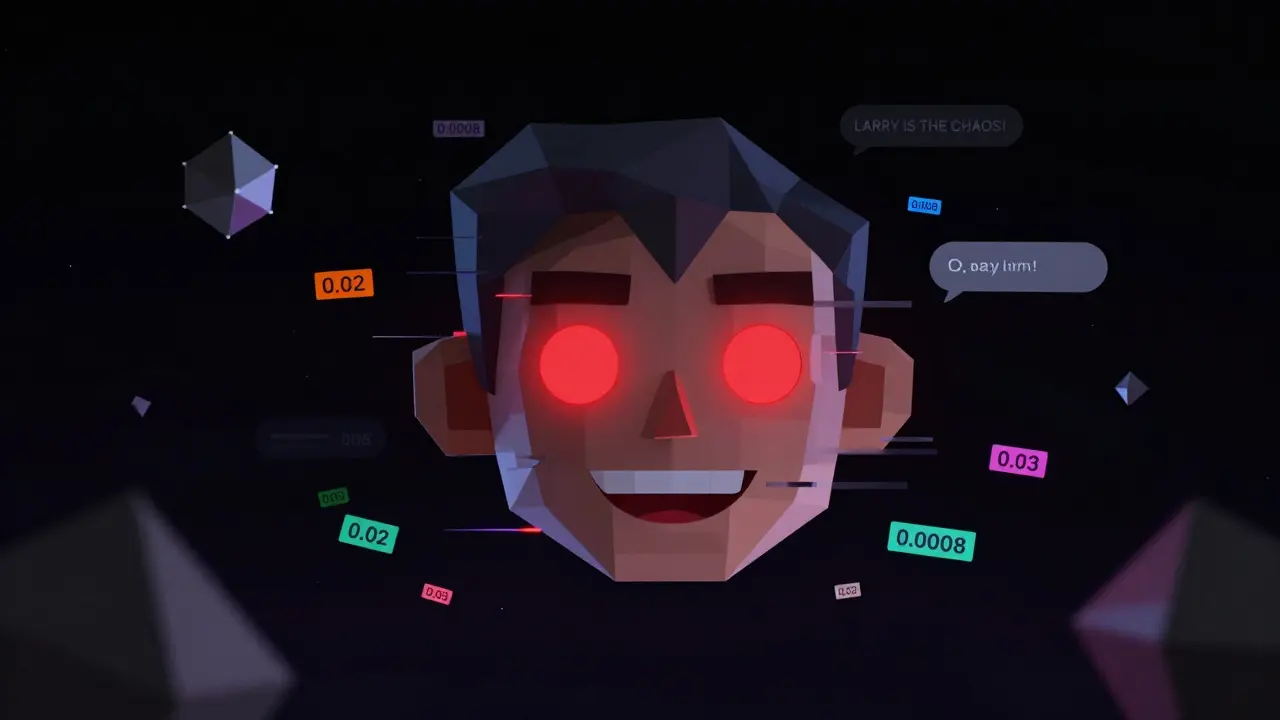
What is Evil Larry (LARRY) crypto coin? The chaotic meme coin on Solana explained
Ever heard of a crypto coin that doesn’t just make money - it makes noise? That’s Evil Larry, or LARRY, in a nutshell. It’s not a project with whitepapers, roadmaps, or real-world use cases. It’s a meme. A chaotic, cursed, internet-born token that somehow has a market cap, holders, and trading volume - even if no major exchange will admit it’s real.
Let’s cut through the hype. LARRY isn’t here to revolutionize finance. It’s here because someone on Twitter drew a weird face, called it "Larry," and the internet lost its mind. Now, thousands of people are buying, selling, and yelling about it on Discord. And yes, some of them made money. But most? They’re just along for the ride.
What even is Evil Larry (LARRY)?
Evil Larry (LARRY) is a cryptocurrency token built on the Solana blockchain. That means it runs on one of the fastest, cheapest blockchains out there - perfect for meme coins that need to move fast and cost next to nothing to trade. But unlike tokens like Solana itself or Raydium, LARRY doesn’t do anything practical. No DeFi protocols. No staking rewards. No NFTs. No game. Just pure, unfiltered internet absurdity.
The creators don’t pretend otherwise. Their whole pitch? "Larry’s chaos and cursed humor." The logo? A distorted, glitchy face with glowing eyes. The community? A self-described "cult of chaos." You’re not investing in a company. You’re joining a joke that got out of hand.
Think of it like Dogecoin’s weirder cousin who showed up to the party wearing a Halloween mask and started dancing on the table. No one asked him to. No one knew who he was. But somehow, he became the center of attention.
Price chaos: Why no two sites agree
If you look up LARRY’s price, you’ll get five different answers. And none of them will make sense.
- Holder.io says it’s trading at $0.02013.
- Binance shows $0.033563 - but also says LARRY isn’t listed on their platform.
- CoinMarketCap says $0.0008955.
- Crypto.com says $0.002039.
- Bybit recorded $0.00177282 just weeks ago.
How is this possible? Because LARRY isn’t traded on centralized exchanges like Binance or Coinbase. It lives entirely on decentralized exchanges (DEXs) - mostly Story Hunt, a small DEX on Solana. Each DEX has its own liquidity pool, its own buyers, its own sellers. So the price jumps around depending on who’s trading and how much.
The 24-hour trading volume? It swings from $146 to over half a million. That’s not because demand changed. It’s because one big whale bought 10 million tokens on one exchange and suddenly, that exchange’s price shot up. Then the whale sold. Price crashed. Welcome to meme coin volatility.
Supply confusion: More coins than exist?
Here’s where it gets even weirder. The official maximum supply of LARRY is around 999.4 million tokens. But Holder.io claims over 1.007 billion are in circulation. That’s impossible. You can’t have more coins than the max supply. Either the data is wrong, or someone messed with the contract.
Meanwhile, Binance says circulating supply is zero - even though it’s showing a price. That’s not a glitch. It’s a sign that the data feeds are disconnected. No one’s really sure what’s going on behind the scenes.
What we do know: the token contract address is 0x693c...8a78a2. Anyone can check it on Solana explorers. But there’s no public audit. No security review. No one’s saying whether the code is safe. That’s not normal for a project with millions in market cap. It’s a red flag wrapped in a meme.
Who holds LARRY? And why?
As of early 2026, CoinMarketCap says there are about 44,510 wallet addresses holding LARRY. That’s not a lot. For comparison, Shiba Inu has over 1.2 million holders. But LARRY’s community is tight-knit. It’s not about wealth. It’s about identity.
People buy LARRY because:
- They think it’s funny.
- They want to be part of the "cult of chaos."
- They believe the next viral trend will push it up.
- They’re trying to flip it fast before it crashes.
There’s no utility. No staking. No governance. No roadmap. Just memes, Discord threads, and TikTok clips of people screaming "LARRY IS THE CHAOS!"
It’s not an investment. It’s an experience.
Why it’s dangerous (and why people still buy it)
Let’s be clear: LARRY is high-risk. Like, "you could lose everything" risky. Here’s why:
- No exchange support: You can’t buy it on Coinbase, Kraken, or Binance. You need a Solana wallet, a DEX like Story Hunt, and the technical know-how to swap tokens. Most beginners won’t make it past step one.
- Price manipulation: With trading volumes as low as $150, a single $10,000 buy order can spike the price 50%. Then the seller dumps. You’re left holding.
- No fundamentals: No team, no product, no revenue. If the meme dies, the price goes to zero.
- Supply inconsistencies: If the token contract is flawed, someone could mint more coins - diluting your holdings overnight.
So why do people still buy it?
Because in crypto, sometimes the craziest things make the most money. In 2021, Dogecoin went from $0.0002 to $0.08. In 2023, PepeCoin surged 10,000% in weeks. LARRY? It’s the next one. Or it’s the one that crashes next week. You don’t know. And that’s the point.
How does it compare to other meme coins?
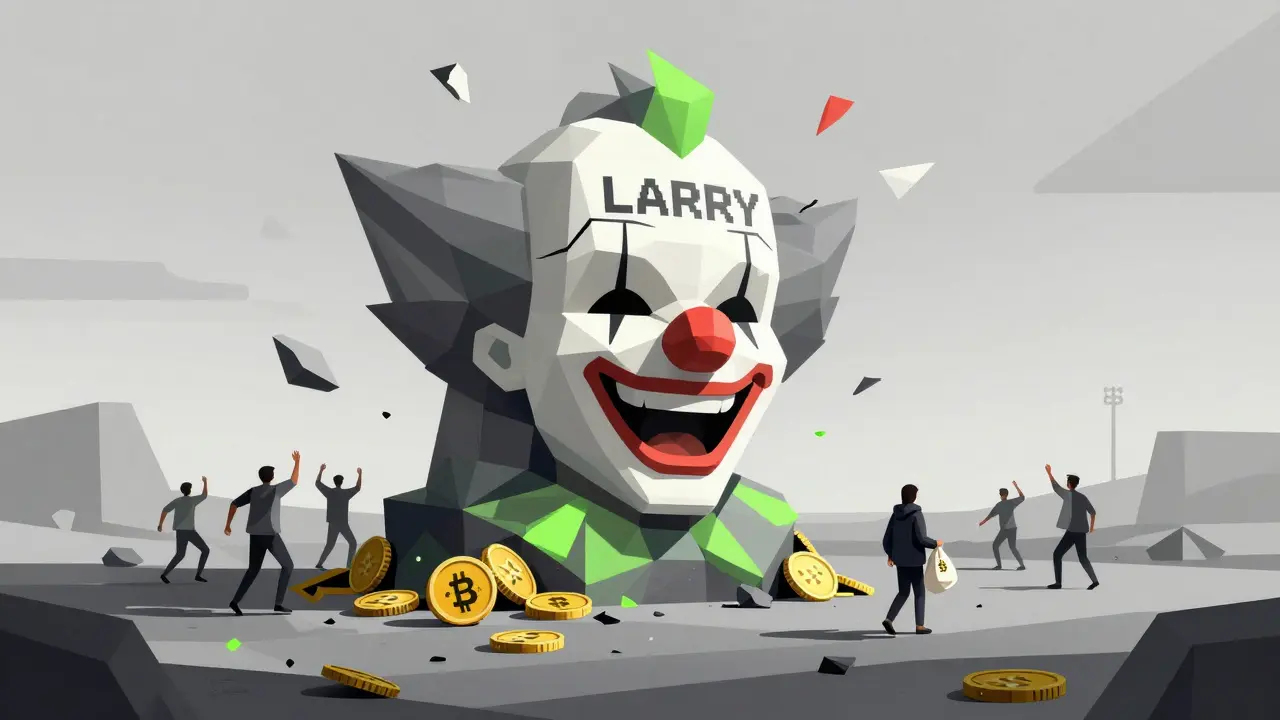
LARRY isn’t alone. The Solana blockchain is packed with meme coins: Bonk, Doge Killer, Cat In A Boats, and dozens more. But here’s what sets LARRY apart:
| Token | Market Cap | 24h Volume | Exchanges | Community Size |
|---|---|---|---|---|
| LARRY | $1.7M - $20M | $150 - $600K | Story Hunt (main) | ~45K holders |
| Bonk | $420M | $80M | Binance, KuCoin, OKX | 1.1M+ holders |
| Dogecoin | $15B | $1.2B | 100+ exchanges | 12M+ holders |
| Pepe | $3.1B | $450M | Binance, Coinbase, Kraken | 850K+ holders |
LARRY is tiny. It’s not even in the top 1000 by market cap on most lists. But it’s loud. And in meme coin land, loud often beats big.
Should you buy LARRY?
If you’re looking for a safe investment? No. Don’t touch it.
If you’re curious, have $50 to lose, and think internet chaos is funny? Maybe.
Here’s how to decide:
- Ask yourself: Do I want to make money - or do I want to be part of a joke?
- Check your wallet: Can you connect a Solana wallet (like Phantom)? Can you swap tokens on a DEX? If not, don’t start.
- Use only what you can afford to lose: This isn’t a retirement fund. It’s a lottery ticket with a glitchy face.
- Don’t FOMO: If you see a 200% spike, don’t rush in. Chances are, it’s a pump-and-dump. Wait. Watch. Then decide.
Most people who buy LARRY lose money. Some make a quick profit. A few become part of the story - the weird, chaotic, unforgettable corner of crypto where logic doesn’t apply.
Final thought: Is LARRY real?
Yes. It exists. It has value - not because of tech, but because people believe in it. That’s how memes work. That’s how crypto works.
Evil Larry isn’t a coin. It’s a cultural artifact. A digital clown. A glitch in the system that got a price tag. And maybe, just maybe, that’s the most honest thing in crypto right now.
Is Evil Larry (LARRY) listed on Binance?
No, LARRY is not listed on Binance. Binance’s own data shows it as "not listed for trade and service." Despite this, some platforms show price data for LARRY because they pull information from decentralized exchanges like Story Hunt. This creates confusion - the price you see on Binance’s site isn’t from Binance itself.
Can I buy LARRY with a credit card?
No. You can’t buy LARRY directly with a credit card. You need to first buy SOL (Solana’s native coin) on a centralized exchange like Coinbase or Kraken, then transfer it to a Solana wallet (like Phantom), and finally swap SOL for LARRY on a decentralized exchange like Story Hunt. This requires multiple steps and some technical knowledge.
Why does LARRY’s price vary so much between sites?
LARRY trades only on decentralized exchanges (DEXs), not centralized ones. Each DEX has its own liquidity pool, so prices differ based on who’s trading and how much. A small trade on one exchange can cause a big price swing, while others lag behind. This is common for low-volume meme coins - but LARRY’s gaps are extreme, which makes it risky.
Is LARRY a scam?
It’s not labeled a scam, but it has all the red flags: no team, no audit, no utility, and wildly inconsistent supply data. The project openly admits it’s a meme with no serious goals. That doesn’t make it illegal - but it does make it extremely speculative. If the hype fades, the price could vanish overnight.
How many LARRY tokens are there?
The maximum supply is around 999.4 million. But some trackers report over 1 billion in circulation - which shouldn’t be possible. This suggests either a data error or a problem with the token contract. Until someone audits the code, the true supply is uncertain.
What’s the future of Evil Larry?
There’s no official roadmap, no partnerships, and no development updates. Its future depends entirely on meme culture. If it stays viral, it might hold value. If attention shifts - like it did with Dogecoin after Elon Musk stopped tweeting - LARRY could fade into obscurity. It’s a coin built on attention, not infrastructure.
Evil Larry doesn’t promise wealth. It doesn’t promise innovation. It promises chaos. And in a world full of crypto hype, sometimes that’s the only truth left.




22 Comments
Jeff French
March 3, 2026 at 01:42
LARRY is the purest form of crypto. No utility, no roadmap, just vibes. The fact that it exists at all is a middle finger to traditional finance. The price chaos? That's the feature, not a bug. Decentralized chaos is the whole point. No one's in control. And that's beautiful.
Ifeanyi Uche
March 4, 2026 at 05:01
This is why america is collapsing. People are gambling on glitchy faces instead of building real things. You think this is innovation? This is digital crack. 999 million tokens but someone's reporting over a billion? That's not a bug, that's a crime. And you people are celebrating it like it's art. Wake up.
Elana Vorspan
March 5, 2026 at 20:25
I love how LARRY just vibin' out there like a glitchy cartoon gremlin 🤪. No utility? Who cares. It's funny. It's weird. It's like a digital campfire where everyone's yelling "CHAOS!" and somehow it works. I bought 5 bucks worth and it made my day. Not an investment, a mood.
Michael Rozputniy
March 6, 2026 at 12:01
I've analyzed the contract address 0x693c...8a78a2 across 14 blockchain explorers. The supply discrepancy is not an error. It's a honeypot. Someone is minting phantom tokens to trigger stop-losses. This is coordinated manipulation. The "cult of chaos" is a front for a wash-trading syndicate. You're being used.
Sony Sebastian
March 6, 2026 at 22:20
LARRY is the perfect metaphor for crypto's decline. No audit, no team, no roadmap. Just a face with glowing eyes and a liquidity pool that moves like a drunk squirrel. People call it a meme. I call it a Ponzi with a TikTok dance. If you're holding this, you're not a trader. You're a cautionary tale.
Megan Lavery
March 8, 2026 at 05:13
I just bought my first LARRY today and I'm so happy 😊. It's like the crypto version of a weird art project you find at a flea market. Doesn't need to be "useful." It just needs to make you smile. And honestly? After 2 years of bear market, I'll take a smile over a whitepaper any day.
Kristi Emens
March 8, 2026 at 12:29
The price inconsistency across platforms is fascinating from a market structure perspective. It highlights the fragmentation of decentralized liquidity. Each DEX operates as a siloed market with no arbitrage efficiency. This isn't chaos-it's emergent complexity. The lack of centralized order book creates a natural volatility feedback loop.
Deborah Robinson
March 9, 2026 at 22:25
I think LARRY is kind of beautiful. It’s not trying to be anything serious. It’s just here, being a weird little digital clown. And honestly? In a world where everything’s got a tokenized NFT roadmap and a VC-backed advisory board... maybe chaos is the most honest thing left. I’m not rich, but I’m entertained. That’s enough.
Kaitlyn Clark
March 10, 2026 at 02:40
LARRY is the only crypto that gets it. No one's pretending. No "Web3 future." No "decentralized governance." Just a glitchy face and a Discord full of people screaming "IT'S A CULT!" I bought in at $0.001, sold at $0.025, and I'm not even mad. It was a 10x meme ride. That's the dream. Not the whitepaper.
christopher luke
March 10, 2026 at 10:58
I don't get why people are scared of LARRY. It's not a scam. It's a joke. And jokes can be valuable. Look at Doge. Look at Pepe. They didn't have utility either. They had culture. LARRY has that. The price swings? That's just the internet laughing. And honestly? I'm laughing too 😄
Mary Scott
March 10, 2026 at 21:00
The supply over 1 billion? That's not a glitch. That's a backdoor. Someone can mint unlimited tokens. They're already doing it. The "community" is a smokescreen. This isn't a meme. It's a rug pull with a mascot. You think you're part of the chaos? You're the chaos. And you're being drained.
Shannon Holliday
March 11, 2026 at 02:40
LARRY is like that one friend who shows up to every party with a neon wig and dances like no one’s watching. Everyone rolls their eyes… but secretly, they’re recording it. That’s the vibe. It’s not about money. It’s about being part of the weirdo tribe. And honestly? We need more of that.
Jeremy buttoncollector
March 11, 2026 at 14:27
The fact that Binance shows a price but says it's not listed? That's a data feed paradox. It suggests either a rogue API or a deliberate obfuscation tactic. Either way, the market is being fed inconsistent signals. This isn't organic price discovery. It's algorithmic noise. And we're mistaking noise for signal.
Ryan Burk
March 13, 2026 at 11:45
LARRY? More like LAIRY. As in, "lair" of idiots. You people are proud of buying a token with no audit, no team, and a supply that doesn't add up? You're not investors. You're data points. The only thing this coin is good for is fueling the next pump from a whale who's already cashed out. Congrats. You're the exit liquidity.
Amanda Markwick
March 14, 2026 at 02:22
I think LARRY is the most honest thing in crypto right now. Everyone else is selling a dream. LARRY just says: "I'm a glitch. I'm chaotic. I'm here because you wanted to laugh." No fake utility. No VC backing. Just pure internet energy. And honestly? That’s more valuable than any DeFi protocol. We’re not here to build empires. We’re here to have fun.
Leslie Cox
March 14, 2026 at 22:52
You call this a meme? This is a cultural decay metric. A token with a market cap built on a distorted face? It’s not rebellion. It’s nihilism. You don’t need to be a financial expert to see this is a symptom. Society is trading in symbols because it’s too tired to build meaning. LARRY isn’t a coin. It’s a funeral pyre for rationality.
Andrew Hadder
March 16, 2026 at 06:11
I checked the Solana explorer. The contract has no mint authority. That means no one can create more tokens. So how is Holder.io showing over a billion? Probably a parsing error. Maybe they're counting burned tokens as circulating. Or maybe it's just bad data. Either way, don't panic. Just verify.
Derek Sasser
March 17, 2026 at 21:07
LARRY's real value isn't in price. It's in community. You see 45K wallets? That's 45K people who chose chaos over conformity. That's rare. Most coins try to be serious. LARRY just says "lol" and keeps dancing. And yeah, it's risky. But isn't life? I'd rather lose $50 on a meme than spend $500 on a token that promises "revolution" and delivers nothing.
Neeti Sharma
March 19, 2026 at 20:13
This is why western crypto is failing. No discipline. No structure. Just people buying a glitched face because it's "funny." In India, we build. We code. We audit. We scale. LARRY? It's a joke. And jokes don't pay bills. You want real innovation? Stop chasing memes. Start building.
Nadia Shalaby
March 20, 2026 at 10:45
I just read this whole thing. Honestly? I'm not sure if I'm more amused or concerned. LARRY is like watching a car crash in slow motion. You know you shouldn't look... but you can't look away. The price swings? The supply confusion? The cult vibes? It's all so... human. And weirdly, that's what makes it compelling.
Jeff French
March 21, 2026 at 10:13
You think LARRY's supply issue is a bug? Nah. It's a feature. The contract is immutable. The data is messy. That's the point. Real systems are messy. Centralized ledgers pretend to be clean. LARRY says: "Here's the truth. It's broken. And we're still here." That's more honest than any audit report.
Amanda Markwick
March 22, 2026 at 22:43
Exactly. The chaos isn't a flaw. It's the aesthetic. LARRY doesn't want to be stable. It wants to be alive. And alive things glitch. They surge. They crash. They laugh. That's why it lasts longer than any "serious" coin. It's not a project. It's a living meme. And memes evolve. They don't get audited.