
AXL INU New Year's Eve Airdrop: The Scam Behind the Hype
On December 31, 2025, thousands of crypto users got a message they thought was a gift: AXL INU was giving away free tokens for New Year’s Eve. Wallets filled up with tokens they didn’t ask for. Social media lit up with screenshots. Telegram groups buzzed with excitement. But by January 1, 2026, those same users were scrambling - their wallets had been drained, and the airdrop website was gone.
What Was the AXL INU New Year’s Eve Airdrop?
The so-called AXL INU New Year’s Eve airdrop never existed. It was a carefully crafted phishing operation designed to trick people into approving malicious smart contracts. The tokens appeared in wallets out of nowhere - not because of any official distribution, but because scammers had sent them as bait. These weren’t gifts. They were traps. AXL INU (ticker: AXL) is a low-cap meme coin with a market cap of just $773.33 as of October 2025, and zero 24-hour trading volume. It has over 98,000 holders, but almost none of them are actively trading. That’s a red flag. When a token has more wallets than trades, it usually means someone stuffed tokens into thousands of addresses to fake popularity. That’s exactly what happened here. The airdrop announcement was spread through fake websites like axl-inu-airdrop[.]live and axl-nye-airdrop[.]xyz. These sites looked professional. They had logos, countdown timers, and even fake testimonials. But they all asked for one thing: connect your wallet. And once you did, they asked you to approve a transaction that gave them unlimited access to your tokens.How the Scam Worked
Here’s how it played out in real time:- You received unsolicited AXL INU tokens in your wallet - likely sent from a scammer-controlled address.
- You saw a post on Twitter, Telegram, or Reddit saying: “Claim your free AXL INU tokens for New Year’s Eve!”
- You clicked the link and connected your MetaMask or Trust Wallet.
- The site asked you to approve a transaction labeled “Claim Airdrop.”
- You approved it, thinking you were just claiming free tokens.
- Within seconds, the scammer drained your ETH, USDT, or other tokens - sometimes thousands of dollars.
Why People Fell for It
The timing was perfect for scammers. New Year’s Eve is when people are relaxed, distracted, and hopeful. Crypto Twitter and Telegram are full of “free money” hype during holidays. CipherTrace’s 2024 Holiday Fraud Report showed scam activity spikes by 34.7% between December 20 and January 5. Many users didn’t realize AXL INU had no official team, no whitepaper, and no website. There’s no GitHub repo. No Twitter account with verified blue check. No Discord with active devs. The only trace of AXL INU is a CoinMarketCap listing with a market cap smaller than a single Ethereum transaction fee. And here’s the twist: people confused AXL INU with Axelar Network (also using AXL). Axelar is a legitimate cross-chain protocol listed on Binance. It has a real team, a working product, and active development. But scammers used that confusion to make their fake airdrop sound plausible. “Axelar is doing a token unlock,” someone posted. “So AXL INU must be doing one too.”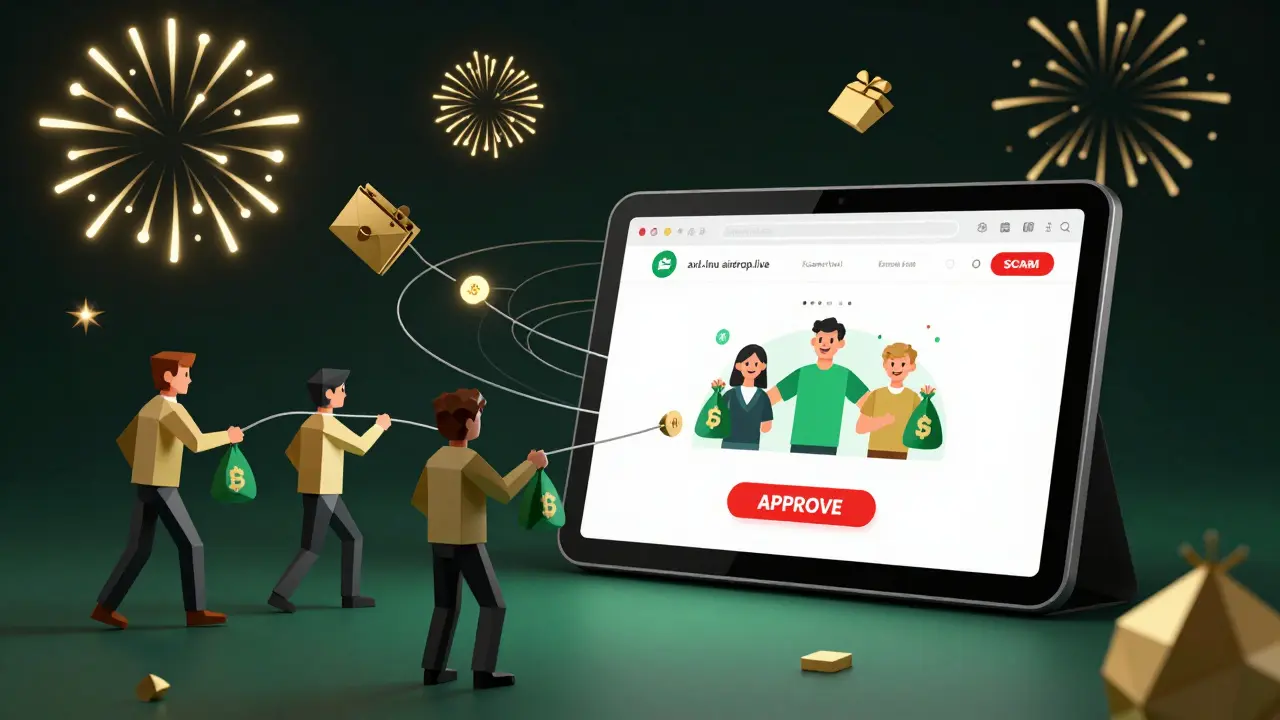
What You Should Do If You Got AXL INU Tokens
If you received AXL INU tokens in your wallet, don’t panic - but don’t interact with them either.- Do not click any links claiming you can “claim,” “swap,” or “stake” these tokens.
- Do not approve any transactions related to AXL INU, even if they say “low gas” or “free.”
- Hide or block the token in your wallet. In MetaMask, go to Assets > Hide Tokens and add the AXL INU contract address: 0x25b2...3cc0e0.
- Check your approval history on Etherscan. If you see “Approve” transactions for this token, revoke them immediately using a tool like Revoke.cash.
How to Spot a Fake Airdrop
Not all airdrops are scams. But most low-cap meme coin airdrops are. Here’s how to tell the difference:- Legit airdrops come from projects with a public team, a working product, and active social media. They announce details on their official website and verified Twitter/X account.
- Fake airdrops use urgent language: “Only for the next 2 hours!” or “Claim now before it’s gone!”
- Legit airdrops never ask for your private key, seed phrase, or wallet approval to receive tokens.
- Fake airdrops always ask you to connect your wallet and approve a transaction - even if you haven’t done anything yet.
- Legit airdrops have a clear distribution schedule and tokenomics. Fake ones don’t even have a token contract that’s been audited.

What Happens to Tokens Like AXL INU?
AXL INU is not an isolated case. Messari’s Q3 2025 Meme Coin Report found that 12.7% of all cryptocurrencies have market caps under $1,000. But they account for 68.3% of all reported crypto scams. These tokens are often created in minutes using open-source meme coin templates. No code is written. No utility is added. The goal is simple: pump the price with hype, then dump it. Airdrops are just the next step - a way to distribute tokens to thousands of wallets so the scam looks real. Binance added AXL INU to its high-risk monitoring list on October 10, 2025. If trading volume doesn’t hit $1,000 per day by November 15, 2025, it will be delisted. That’s not a threat - it’s a death sentence. With zero volume already, it won’t survive. The SEC also issued a public warning on October 8, 2025, specifically calling out “tokens with zero verifiable trading activity promoting fictional airdrop events.” AXL INU was named as a prime example.Final Warning: Don’t Chase Free Tokens
Crypto is full of opportunities. But free tokens on a project with no team, no product, and no volume? That’s not an opportunity. It’s a trap. The AXL INU New Year’s Eve airdrop was never real. It was a digital pickpocketing operation disguised as a celebration. And it worked - because people wanted to believe. If you see a token you’ve never heard of suddenly offering free crypto, pause. Google it. Check CoinMarketCap. Look for trading volume. See if anyone on Reddit or Twitter is warning others. And if it looks too good to be true - it is. Your wallet is your responsibility. No one else will protect it. Don’t let a fake airdrop cost you your life savings.Did AXL INU actually do a New Year’s Eve airdrop?
No. There was no official AXL INU airdrop. The New Year’s Eve airdrop was a phishing scam. Fake websites and social media posts tricked users into connecting their wallets and approving malicious transactions that drained their funds. AXL INU has no official team, website, or announcement channel, making any airdrop claim fraudulent.
How do I know if I’m being targeted by an AXL INU scam?
If you received unsolicited AXL INU tokens in your wallet, and then saw a message asking you to “claim” them via a link, you’re being targeted. Check the domain of the website - scam sites often use misspellings like axl-inu-airdrop[.]live or axl-nye-airdrop[.]xyz. Legit projects never ask you to approve a transaction just to receive free tokens.
Can I get my money back if I fell for the AXL INU airdrop scam?
Unfortunately, no. Once you approved the malicious contract and funds were transferred, the transaction is irreversible. Blockchain transactions cannot be undone. Your only option is to revoke future approvals using Revoke.cash and secure your wallet to prevent further losses.
Is AXL INU the same as Axelar Network (AXL)?
No. AXL INU is a low-cap meme coin with no team or utility. Axelar Network (AXL) is a legitimate cross-chain protocol listed on Binance, founded by former Cosmos engineers. The two have no connection. Scammers exploit this confusion to trick people into thinking AXL INU is part of a real project.
Should I delete AXL INU from my wallet?
Don’t delete it - hide it. In MetaMask or Trust Wallet, go to Assets > Hide Tokens and add the AXL INU contract address (0x25b2...3cc0e0). This removes it from your view without affecting your wallet’s security. Never send funds to it or interact with any site claiming to work with AXL INU.
Why does AXL INU have so many holders if it’s a scam?
Scammers use “wallet stuffing” - sending tiny amounts of the token to tens of thousands of wallets to create the illusion of adoption. This makes the project look popular on CoinMarketCap, even though no one is trading it. Zero volume with 98,000 holders is a classic red flag.
Are there any safe airdrops in crypto?
Yes - but only from established projects with a track record. Examples include Arbitrum, Optimism, and Polygon’s past airdrops. These are announced on official channels, never require wallet approvals to receive tokens, and are followed by public distribution schedules. Always verify the source before interacting.





17 Comments
Caitlin Colwell
January 11, 2026 at 09:41
Just hid it. Done.
Danyelle Ostrye
January 12, 2026 at 19:36
I got the tokens too. Didn't click anything. Just ignored it. Crypto's full of ghosts these days.
Charlotte Parker
January 13, 2026 at 07:10
They didn’t just scam people-they exploited the *hope* of New Year’s. That’s the real horror story here. Not the lost ETH. The fact that people still believe in free shit.
Becky Chenier
January 13, 2026 at 17:31
This is why I don’t touch anything under $1M market cap anymore. Even if it looks legit, the odds are stacked. I’d rather miss a 100x than lose everything.
Sherry Giles
January 14, 2026 at 20:59
Russian hosting? Of course. They’ve been running this playbook since 2021. The U.S. government does nothing while these scammers laugh all the way to the blockchain. This isn’t just fraud-it’s warfare.
Mujibur Rahman
January 16, 2026 at 19:22
Check your approvals on Revoke.cash. If you’re reading this and you approved anything, do it now. No excuses. I’ve seen 3 friends get drained by this exact script. It’s automated. It’s ruthless.
Calen Adams
January 18, 2026 at 16:15
AXL INU is a textbook example of a rug pull via wallet stuffing. 98K holders, zero volume. That’s not adoption-that’s a honeypot. The devs didn’t even bother to deploy a proper token contract. It’s just a script with a logo.
Tracey Grammer-Porter
January 18, 2026 at 23:39
Hey if you got the tokens and you’re scared-don’t panic. Just hide the token, check your approvals, and breathe. You didn’t do anything wrong. The system’s rigged. But you’re still safe if you didn’t approve anything. We’ve all been there.
jim carry
January 20, 2026 at 08:58
They used Axelar’s name. That’s low. That’s not even clever. That’s predatory. These people don’t even have morals-they have spreadsheets.
sathish kumar
January 22, 2026 at 06:45
The phenomenon described herein constitutes a quintessential example of socio-technical exploitation wherein cognitive biases are weaponized through digital deception. The temporal context of New Year’s Eve amplifies the heuristic of goodwill, thereby lowering cognitive resistance to malicious intent.
Andy Schichter
January 22, 2026 at 09:58
Wow. A scam so obvious even my cat would’ve ignored it. But no, humans-always chasing free shit like pigeons on a sidewalk. Congrats, you got scammed by a .xyz domain. What’s next? A free Tesla from Elon’s Twitter bot?
Don Grissett
January 22, 2026 at 19:39
you guys are overreacting. i got the tokens too. i clicked the link. nothing happened. maybe its legit? maybe they just wanted to give us free tokens? maybe the site is down because of traffic???
Katrina Recto
January 24, 2026 at 07:25
I didn’t approve anything but I still feel dirty having those tokens in my wallet. Like they’re poisoned. Hid it. Won’t touch it again.
Jon Martín
January 25, 2026 at 09:58
Let me tell you something real quick. The only thing more dangerous than a bad investment is a good story. AXL INU didn’t steal your ETH. It stole your hope. And that’s the one thing no blockchain can recover.
Veronica Mead
January 25, 2026 at 10:40
It is morally indefensible to exploit the celebratory spirit of a global holiday for financial gain. The perpetrators of this scheme are not merely criminals-they are ethical degenerates who have violated the social contract of trust inherent in digital communities.
Mollie Williams
January 26, 2026 at 00:38
I wonder if the people who made this knew someone’s grandma was clicking those links. If they did, then it’s not a scam-it’s a tragedy dressed in smart contracts. We’re not just losing money. We’re losing the idea that crypto could be something better.
Jennah Grant
January 27, 2026 at 00:04
Legit airdrops don’t need you to connect your wallet to receive tokens. That’s like a bank asking you to hand over your PIN to deposit a check. If you’re approving anything to ‘claim’ free tokens, you’re already scammed. The token never existed. The contract is just a trapdoor.