
Coexistence of Fiat and Digital Currencies: How Traditional Money and Blockchain Assets Are Sharing the Same System
For decades, money meant cash in your wallet or a balance in a bank account backed by a government. That’s changing. Today, you can send money across borders in seconds using a digital token, while still paying for groceries with paper bills. This isn’t science fiction - it’s happening right now. The coexistence of fiat and digital currencies is no longer a debate. It’s the new reality. Governments, banks, and tech companies are all playing a role, and the way we use money is being rewritten - slowly, but surely.
Why This Shift Is Happening
The 2008 financial crisis cracked open the door. People lost trust in banks. Bitcoin appeared as a decentralized alternative. But it wasn’t just about replacing banks. It was about speed, cost, and access. Cross-border payments used to take days and cost a chunk of your money. Now, a stablecoin like USDC can settle in under 30 seconds for less than a dime. MoneyGram started using USDC for remittances in 2022. The result? Transfer times dropped from three days to under 10 minutes. Fees fell from over 6% to under 2%. That kind of improvement doesn’t go unnoticed. At the same time, central banks saw the writing on the wall. If private companies were going to control digital money, governments could lose control over monetary policy. So, they started building their own digital currencies - Central Bank Digital Currencies, or CBDCs. By 2025, 90% of the world’s central banks were working on them. Four countries had already launched retail CBDCs: the Bahamas with the Sand Dollar, Jamaica with JAM-DEX, Nigeria with the e-Naira, and Zimbabwe with ZiG. China’s digital yuan is in pilot mode across 26 regions, with over 261 million users and $26.4 billion in transactions processed. This isn’t a test. It’s a transition.How They’re Different - And How They Work Together
Not all digital money is the same. CBDCs and stablecoins look similar on the surface - both are digital, both can be used for payments. But their foundations are worlds apart. CBDCs are issued and controlled by central banks. They run on permissioned blockchains - closed networks where only approved institutions can validate transactions. This gives governments full oversight. The Bahamas’ Sand Dollar uses a two-tier system: the central bank holds the core ledger, while commercial banks interact with customers. It even supports offline payments via NFC cards. This design prioritizes control, security, and regulatory compliance. Stablecoins like USDC and USDT are different. They’re issued by private companies, backed 1:1 by real-world assets (usually U.S. dollars held in reserve), and operate on public blockchains like Ethereum or Solana. Transactions are fast, cheap, and open to anyone. USDC transactions cost an average of $0.05 and settle in seconds. Compare that to SWIFT, which takes 1-5 business days and charges 3-5% in fees. Stablecoins are the workhorse of global commerce. In June 2025, they processed $30 billion in daily transactions - up 107% from the year before. The key to their coexistence? They serve different needs. CBDCs are for domestic payments, monetary control, and financial inclusion. Stablecoins are for cross-border trade, enterprise payments, and speed. Nigeria’s e-Naira reached 11.3 million users - 17% of adults - by early 2025. But it’s stablecoins that let a small business in Lagos pay a supplier in Dubai without waiting three days or paying 8% in fees.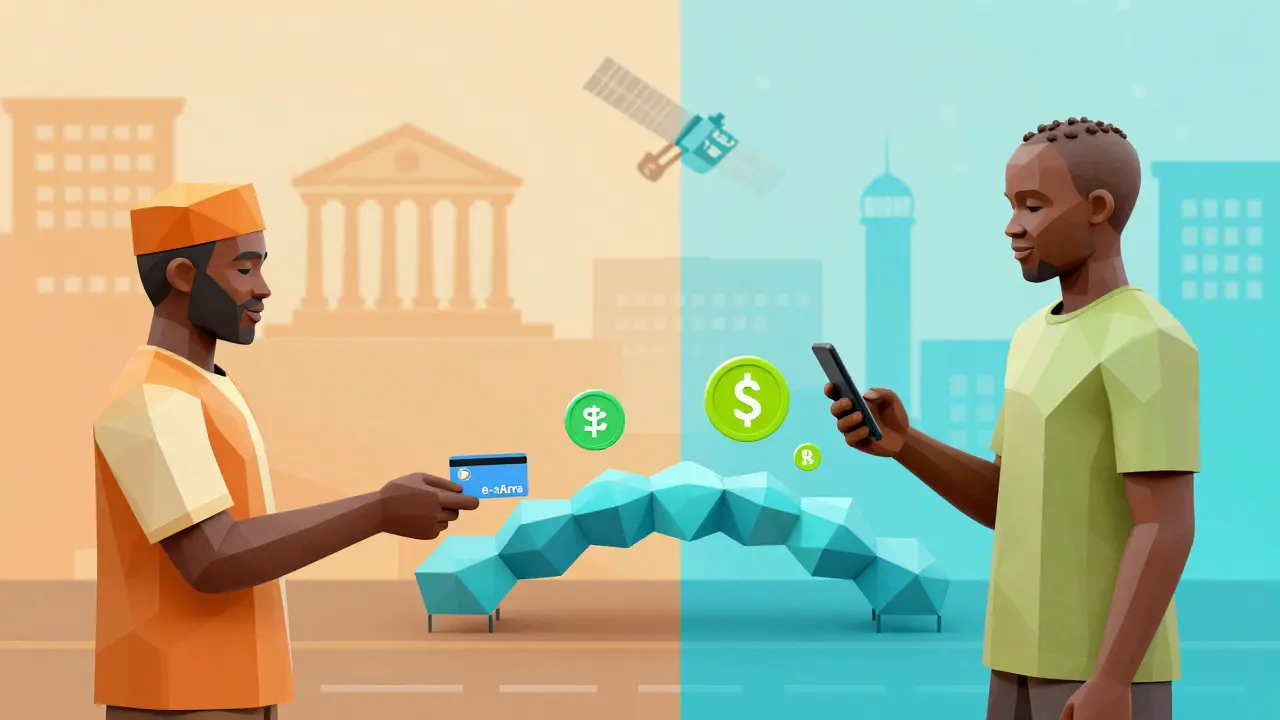
The Real-World Challenges
It’s not smooth sailing. Adoption is uneven. In Jamaica, 63% of consumers registered for JAM-DEX, but only 42% of merchants accept it. Why? Installing a payment terminal costs $280 on average. Small shops can’t afford it. The technology works, but the rollout doesn’t. Regulation is another minefield. The EU’s MiCA framework forces stablecoin issuers to prove daily that their reserves are fully backed. The U.S. has no federal law yet. That creates chaos. A company like Circle, which issues USDC, must comply with 64 different national rules. That’s expensive. And risky. If one country cracks down, it affects global operations. CBDCs aren’t perfect either. Nigeria’s e-Naira had poor developer documentation - rated 2.8 out of 5. Central bank staff needed 172 hours of training just to manage their own system. That’s nearly double the time needed for traditional payment infrastructure. Complexity is a silent killer of adoption. Then there’s the big fear: bank runs. The Bank of England warned in May 2025 that if people suddenly moved their savings from banks into stablecoins during a crisis, it could drain 15-25% of bank deposits. That’s not theoretical. It’s modeled. If people lose confidence in banks, they might flee to digital money faster than regulators can react.Where This Is Headed
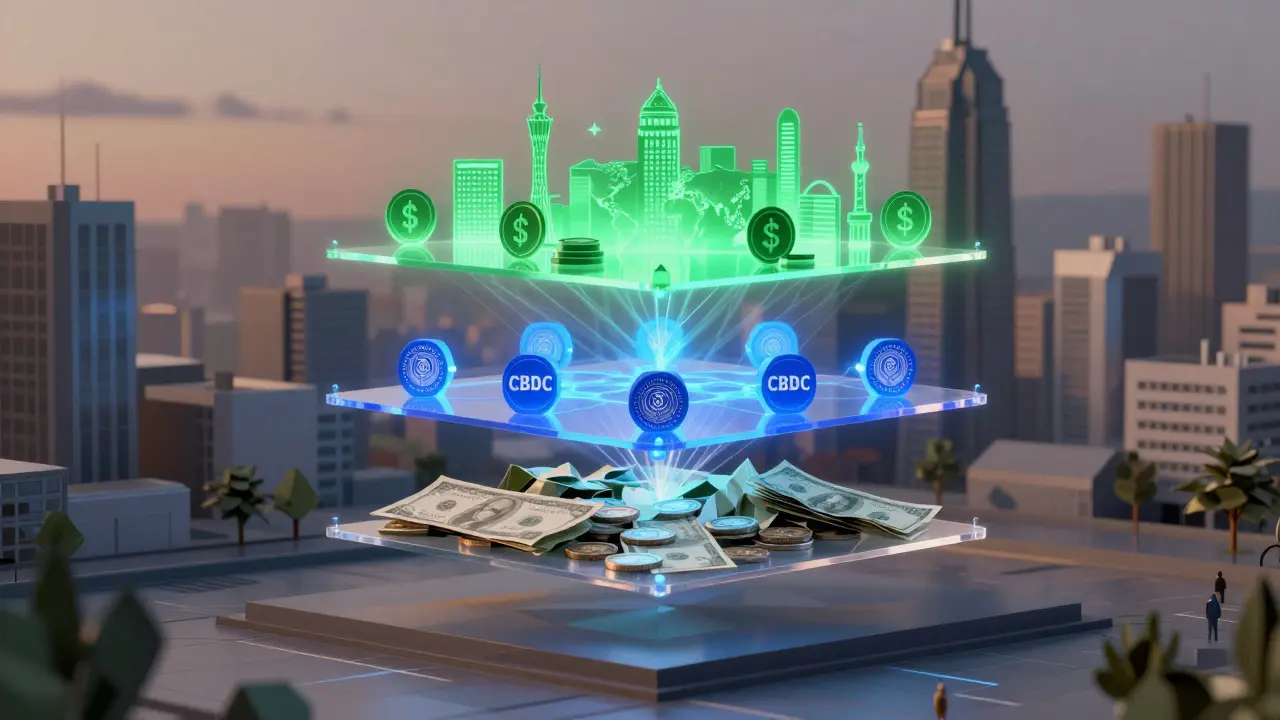
The future isn’t about one replacing the other. It’s about layers. By 2027, experts predict three distinct layers will emerge:- Layer 1: CBDCs - Used by governments to implement monetary policy, distribute stimulus, and ensure financial inclusion. Think of them as the backbone of national money.
- Layer 2: Regulated Stablecoins - Used by businesses, remittance services, and global traders. They’ll be the go-to for fast, low-cost cross-border payments.
- Layer 3: Traditional Fiat - Still around, but fading. Used in cash-heavy economies, older populations, or places with weak digital infrastructure.
Who Wins? Who Loses?
Consumers win. Faster, cheaper payments. More access. Remittances that don’t eat up half your paycheck. Businesses win. Cross-border trade becomes simpler. Supply chains get more fluid. Companies like OpenPayd added stablecoin support after 78% of their clients asked for it. Governments? It’s complicated. CBDCs give them control. But they also mean more surveillance. China’s digital yuan can be programmed to expire if not spent within a certain time - a tool for targeted stimulus. Some see that as smart policy. Others see it as financial repression. Banks are in a tough spot. They’re losing deposits to digital alternatives. They’re also losing transaction fees. But they’re not disappearing. Many are becoming intermediaries - holding CBDC wallets for customers or managing stablecoin reserves. The role is changing, not vanishing.What’s Next?
The transition will take years - probably until 2030. But the direction is clear. The IMF says CBDCs could boost financial inclusion by 15-20 percentage points in emerging markets. That’s millions of people getting access to formal finance for the first time. The Basel Committee just mandated that stablecoin reserves must be held in high-quality liquid assets. That’s a win for safety. It’ll cut issuance costs by 0.8-1.2%, making stablecoins even more competitive. And the technology keeps evolving. Nigeria’s e-Naira got a major upgrade in April 2025, adding offline functionality and loyalty programs. Monthly active users jumped 37% in one quarter. The coexistence of fiat and digital currencies isn’t about choosing sides. It’s about using the right tool for the job. Cash for the local market. CBDCs for national control. Stablecoins for global trade. And for the first time in history, all three can operate side by side - not in conflict, but in complement.Can fiat currency disappear completely?
Not anytime soon. Cash still dominates in many countries, especially among older populations and in rural areas. Even in digital-heavy economies like Sweden, cash use hasn’t vanished. CBDCs and stablecoins are designed to complement, not replace, physical money. The transition will take decades, and even then, cash will likely remain as a backup.
Are CBDCs the same as Bitcoin?
No. Bitcoin is decentralized, anonymous, and not backed by any government. CBDCs are issued and controlled by central banks. They’re traceable, regulated, and designed to work within existing financial systems. Bitcoin is an alternative. CBDCs are an upgrade.
Why do stablecoins need to be backed 1:1?
Because their value depends on trust. If USDC wasn’t backed by real U.S. dollars, its price could crash. That’s what happened with TerraUSD in 2022. To prevent chaos, regulators now require issuers to hold real reserves and prove them daily. This keeps the system stable and protects users.
Can I use a CBDC to pay for things abroad?
Not yet - but that’s changing. Most CBDCs today are designed for domestic use. Cross-border use is still experimental. Projects like mBridge are testing how CBDCs from different countries can interact. By 2027, we may see CBDCs used for international payments, but for now, stablecoins are the only practical option.
Is this coexistence safe?
It’s safer than it was five years ago. Regulations are tightening. Reserve requirements are clearer. But risks remain. A sudden mass shift to stablecoins could destabilize banks. Poorly designed CBDCs could enable surveillance. The system is evolving, and oversight is still catching up. The goal is stability - but it’s not guaranteed.




24 Comments
Nicolette Lutzi
March 24, 2026 at 04:09
This whole 'coexistence' narrative is a distraction. The Fed and the ECB are already laying groundwork to phase out cash entirely. CBDCs aren't about inclusion - they're about control. You think Nigeria's e-Naira is helping the people? It's tracking every transaction. They're building a digital panopticon and calling it progress. Don't be fooled.
Jeannie LaCroix
March 25, 2026 at 09:21
I just want to say - this is the most exciting financial shift since the invention of credit cards. Imagine a farmer in Kenya getting paid in USDC from Germany, no bank, no middleman, no waiting. That’s freedom. That’s power. And yeah, I cried a little when I saw the numbers. This isn’t just tech - it’s justice.
To the haters: you’re clinging to paper because you’re afraid of change. Growth hurts.
Sam Harajly
March 26, 2026 at 06:53
The article does a decent job outlining the structural differences between CBDCs and stablecoins. But it glosses over one critical point: interoperability. If CBDCs operate on permissioned ledgers and stablecoins on public ones, how do they actually communicate? The mBridge project is promising, but it’s still a prototype. We’re years away from seamless cross-border settlement without third-party bridges. And those bridges? They’re the new banks.
Pradip Solanki
March 27, 2026 at 14:54
Stablecoins are just crypto with a corporate veneer. USDC backed by dollars? Sure. But who audits those reserves? Who’s to stop Circle from laundering money through shell entities? And CBDCs? More surveillance. The whole system is rigged. The 1% want digital control so they can freeze your account if you say the wrong thing. Wake up.
Brad Zenner
March 28, 2026 at 13:48
I’ve worked in fintech for 12 years. The real story here isn’t CBDCs or stablecoins - it’s infrastructure. Most developing economies don’t have the mobile networks or ID systems to support digital money. You can’t roll out a CBDC if 40% of the population can’t get a SIM card. The tech is ready. The social infrastructure? Not even close.
Tony Phillips
March 28, 2026 at 17:20
I’ve been using USDC for freelance work for two years now. No more waiting 3 weeks for PayPal to clear. No more fees eating 5% of my income. I sent $800 to my sister in Manila last month - took 12 seconds, cost 12 cents. That’s not magic. That’s just better.
People who say this is 'too fast' are the same ones who said online banking was a fad. The future’s not coming. It’s already here.
Sarah Terry
March 28, 2026 at 19:48
The key to this transition isn’t technology - it’s trust. People don’t fear blockchain. They fear being locked out. If CBDCs feel like government surveillance and stablecoins feel like gambling, people will stick with cash. The real win is making digital money feel safe, simple, and human.
Shayne Cokerdem
March 29, 2026 at 08:32
they say cash is dying but my grandma still pays for her meds with bills. and you think she’s gonna start using a phone app? lol. the whole thing is a tech bro fantasy. the real world still runs on paper and people who don’t know what a wallet is
kavya barikar
March 29, 2026 at 18:26
The coexistence model is elegant in theory. But in practice, regulatory fragmentation creates friction. A stablecoin compliant in the EU is illegal in India. A CBDC designed for domestic use cannot be easily adapted for international settlement. Without global standards, we’re building parallel systems that will never truly integrate.
Andrea Zaszczynski
March 30, 2026 at 00:42
I just read this and I’m so angry. Why are we letting private companies like Circle control USDC? That’s not money - that’s a corporation with a blockchain logo. And CBDCs? They’re just state-run PayPal. Neither is real decentralization. Why aren’t we building something open? Something public? This whole thing is a scam designed to keep you dependent.
Cordany Harper
March 31, 2026 at 03:42
I’ve lived in three countries - US, Japan, India. The way people use money changes with culture. In Japan, cash is still king because of trust in physical systems. In India, UPI works because it’s simple. In the US? We’re stuck between legacy banks and flashy crypto. The solution isn’t one-size-fits-all. We need local adaptation, not global mandates.
DarShawn Owens
April 1, 2026 at 19:57
I really appreciate how this breaks down the layers. It’s not about replacing cash. It’s about adding tools. Like having a hammer, a screwdriver, and a wrench in your toolbox. You don’t throw out the hammer just because you got a new drill. You use what works for the job.
Andy Green
April 2, 2026 at 14:56
Let’s be real - this isn’t innovation. It’s capitulation. The world is surrendering to tech giants and central planners because we’re too lazy to fix the real problems. Why not fix SWIFT? Why not reform banking? No, let’s just slap a blockchain on it and call it progress. This is tech-washing disguised as financial evolution.
Ananya Sharma
April 3, 2026 at 06:51
CBDCs are not the enemy. Poor implementation is. The e-Naira’s 2.8/5 documentation score shows this isn’t a policy failure - it’s a governance failure. Governments need engineers, not bureaucrats, to build this.
Florence Pardo
April 3, 2026 at 23:30
I’ve been thinking about this a lot lately. The real tragedy isn’t the loss of cash - it’s the loss of anonymity. When every transaction is traceable, when every purchase can be flagged, when every dollar can be programmed to expire - we’re not just changing money. We’re changing behavior. People start self-censoring. They stop buying books on certain topics. They avoid protests. They don’t donate to controversial causes. Money is power, yes - but it’s also privacy. And we’re giving that up without even realizing it.
Alicia Speas
April 5, 2026 at 10:50
The most overlooked aspect of this transition is education. Most people don’t understand what a stablecoin is, let alone how to secure a private key. If we roll out digital money without financial literacy infrastructure, we’re setting up a new class divide - those who understand the system and those who are trapped by it.
Kevion Daley
April 5, 2026 at 20:13
I mean… USDC settled $30B/day? That’s wild. But let’s be honest - most of that is just laundering through DeFi. The real economy? Still runs on banks. This is just casino money with a blockchain sticker on it. 🤷♂️
Tammy Stevens
April 6, 2026 at 18:16
I work in fintech compliance. Let me tell you - MiCA is a nightmare. We have to submit daily proof of reserves, audit trails, KYC logs, and transaction mapping. It’s not just expensive - it’s unsustainable for small players. The big players will survive. The innovators? They’ll get crushed. This isn’t regulation. It’s consolidation.
Justin Credible
April 7, 2026 at 20:29
yall act like stablecoins are magic but theyre just digital dollars with extra steps. if the dollar crashes, usdc crashes. if circle goes under, usdc goes poof. its not decentralized its just a new kind of bank. stop drinking the koolaid
Dheeraj Singh
April 9, 2026 at 17:30
CBDCs are a tool for authoritarian regimes. Look at China. They already use it to limit spending on 'non-productive' activities. If your government can control your money, they can control your life. This isn't finance. It's social engineering.
Mike Yobra
April 11, 2026 at 07:39
So we’re going from 'cash is king' to 'digital tokens are king'... and we’re calling this progress?
Meanwhile, the people who actually build things - the plumbers, the teachers, the nurses - are still waiting for their third stimulus check. But hey, at least we can send USDC in 12 seconds. What a time to be alive.
Mansoor ahamed
April 12, 2026 at 10:04
In rural India, mobile wallets changed everything. No bank branch? No problem. UPI works on basic phones. The same tech can bring CBDCs to millions. This isn’t about fancy blockchains. It’s about access. And that’s worth fighting for.
Domenic Dawson
April 13, 2026 at 14:33
I’ve seen this movie before. The internet was supposed to democratize information. Then Google and Facebook took over. Now we have data monopolies. Crypto was supposed to be decentralized. Now we have Circle, Tether, and Coinbase. The system doesn’t change - it just gets more polished. We need open protocols, not corporate-controlled tokens.
Nicolette Lutzi
April 14, 2026 at 06:27
You think the Fed cares about your privacy? They’re already testing CBDCs with programmable money - meaning they can restrict what you buy. Want to buy a gun? Blocked. Want to donate to a protest? Frozen. This isn’t innovation. It’s control dressed up as convenience.