
Curve DAO Token (CRV): Complete Guide to the DeFi Crypto Coin
veCRV Locking Calculator
veCRV Locking Calculator
Calculate your veCRV balance and reward boost based on CRV amount and lock time.
Quick Summary
- Curve DAO Token (CRV) powers the Curve Finance DEX and its governance.
- CRV is an ERC‑20 token on Ethereum with a hard cap of 3.03 billion.
- Holders can lock CRV as veCRV to boost rewards and vote on protocol changes.
- Liquidity mining, fee sharing, and cross‑chain expansion are the main use cases.
- Key risks include token‑omics complexity, regulatory scrutiny, and competition from other stablecoin DEXs.
What Is Curve DAO Token (CRV)?
Before we dive into the nitty‑gritty, let’s set the stage. Curve DAO Token (CRV) is the native governance and utility token of Curve Finance, a decentralized exchange (DEX) built on Ethereum. Launched in August 2020, CRV gives its holders a say in protocol upgrades, fee distribution, and new pool launches.
The token is a standard ERC‑20 asset, meaning it works with any wallet that supports Ethereum, such as MetaMask. Its primary purpose isn’t price speculation (although it trades on secondary markets); it’s designed to align incentives between liquidity providers, traders, and the DAO.
How CRV Powers Governance and Incentives
Curve’s core innovation is the stableswap algorithm-a hybrid of constant‑sum and constant‑product market makers that keeps slippage under 0.05 % for stablecoin swaps. CRV ties into this system in two ways:
- Fee Sharing: A portion of the protocol’s trading fees is sent to a pool that rewards CRV holders.
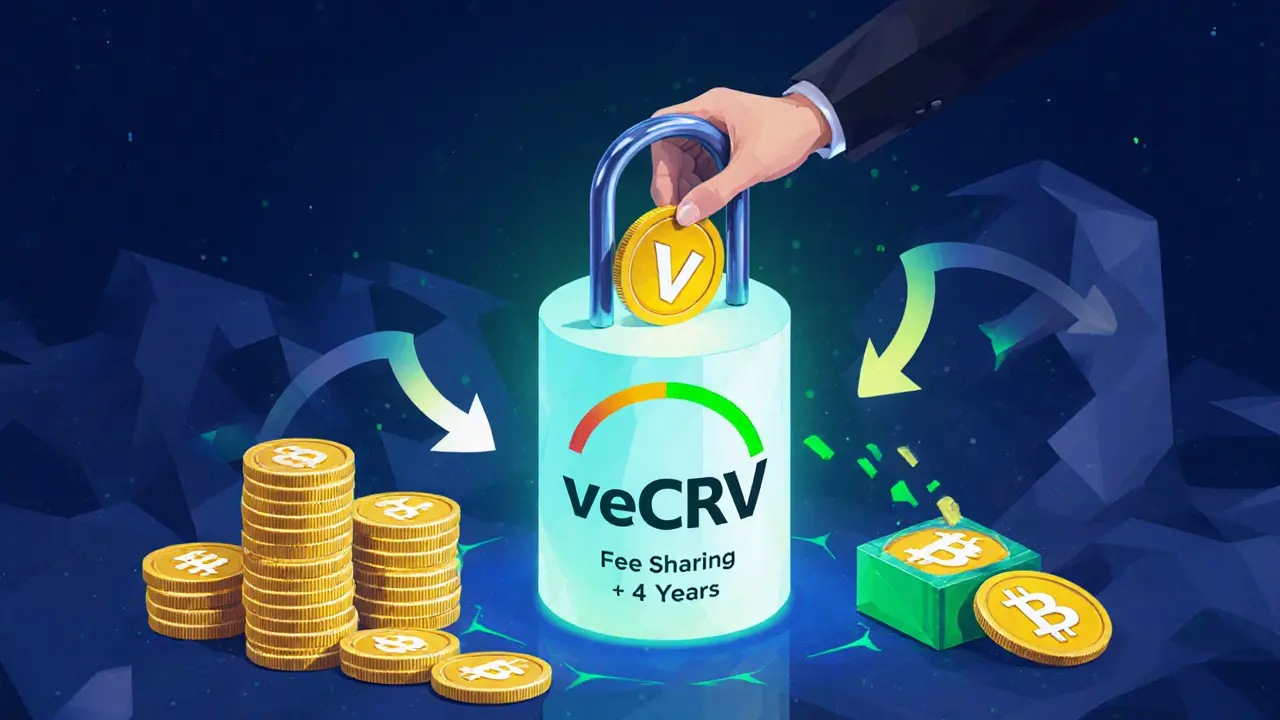
- veCRV Locking: Users lock CRV for anywhere between 1 day and 4 years. The longer the lock, the more voting power and boost they receive. The formula is veCRV = CRV × (lock time ÷ 4 years). Locked tokens can amplify liquidity mining rewards by up to 2.5 ×.
This dual‑layer design encourages long‑term commitment while giving short‑term stakers a way to earn modest yields. It also creates a governance hierarchy: the bigger your veCRV balance, the greater your influence over proposals such as adding new stablecoin pools or adjusting fee structures.
Tokenomics at a Glance
CRV has a fixed maximum supply of 3.03 billion tokens. The allocation looks like this:
| Recipient | Percentage | Purpose |
|---|---|---|
| Liquidity Providers | 62 % | Incentivize pool growth |
| Founders & Team | 30 % | Vesting over 2‑4 years |
| Curve DAO Treasury | 8 % | Future development & grants |
Because most tokens go to LPs, early participants can earn sizable APY through liquidity mining. However, the vesting schedule means a steady drip of new tokens reaches the market, which can dilute price if demand stalls.
Core Use Cases
- Liquidity Mining: Provide assets to a stablecoin pool (e.g., USDC‑DAI‑USDT) and earn CRV rewards.
- veCRV Staking: Lock CRV to gain voting rights and boost your mining rewards.
- Governance Voting: Propose or vote on fee changes, new pool additions, and cross‑chain integrations.
- Fee Redistribution: A share of the daily $1.2 billion trading volume flows back to CRV holders.
How to Acquire and Store CRV
Getting CRV is straightforward:
- Set up a MetaMask wallet on the Ethereum mainnet.
- Buy CRV on a major exchange (e.g., Binance, Coinbase) or on a DEX like Uniswap.
- Transfer the tokens to your wallet address. Verify the contract address: 0xD533a... (standard ERC‑20).
- Optionally, bridge to a layer‑2 network (Polygon, Arbitrum) to save gas.
Because CRV resides on Ethereum, you’ll pay gas fees for any transaction-approval, staking, or veCRV lock-so keep some ETH on hand.
Comparing CRV to Other DEX Tokens
| Metric | CRV | UNI (Uniswap) | BAL (Balancer) |
|---|---|---|---|
| Primary Use | Stablecoin governance & fee share | General DEX governance | Custom pool governance |
| TVL Share (stablecoin DEX) | ~70 % | ~15 % | ~5 % |
| Typical APY (liquidity mining) | 12‑28 % | 4‑10 % | 6‑12 % |
| Lock‑up Mechanism | veCRV (up to 4 years) | None | None |
| Cross‑Chain Support | 11 networks (Polygon, Avalanche, Fantom) | Multiple via bridges | Limited |
CRV’s specialization in stablecoins gives it an edge on slippage, but it also means the token’s upside is tied to stablecoin demand. Tokens like UNI have broader use cases but suffer higher slippage on stable pairs.

Risks and Challenges
Every crypto token carries risk; CRV is no exception. Here are the top three you should watch:
- Regulatory Exposure: The SEC’s 2023 guidance flagged governance tokens with fee‑sharing features as potential securities. Curve has added compliance checks, but legal risk remains.
- Complex Tokenomics: veCRV locking formulas and reward schedules can confuse newcomers. Mistiming a lock or withdrawing early may erode yields.
- Competition: New stablecoin DEXs (e.g., Solidly, Synthetix’s stableswap) are experimenting with lower fees and novel incentive models, which could chip away at Curve’s market share.
Staying informed-reading governance proposals, monitoring TVL trends, and using analytics dashboards-helps mitigate these risks.
Recent Developments and Future Outlook
Curve has been busy since the launch of v2 in 2022. Key milestones:
- Cross‑chain expansion to 11 networks (Polygon, Avalanche, Fantom) completed in Q1 2023, boosting TVL by 47 %.
- Launch of Curve v3 (still in development) aims to add concentrated liquidity similar to Uniswap V3, potentially increasing capital efficiency.
- Partnerships with Convex Finance and StakeDAO simplify veCRV management for retail users.
Analysts from Standard.io project a market cap of $4.2 billion for CRV by 2025, assuming the protocol captures more of the growing stablecoin trading volume. Conversely, Messari’s more conservative estimate places the price under $1 by 2031, citing regulatory headwinds.
Bottom line: if you believe stablecoins will stay a core part of DeFi, CRV is positioned to remain a key governance token. Keep an eye on DAO votes, fee‑share parameters, and the upcoming v3 upgrade.
Quick Checklist for New CRV Users
- Secure a MetaMask wallet with ETH for gas.
- Buy CRV on a reputable exchange.
- Provide liquidity to a stablecoin pool you trust.
- Decide between immediate staking (12‑15 % APY) or veCRV locking (higher boost, longer lock).
- Monitor DAO proposals weekly to protect your voting power.
- Consider using Convex or StakeDAO if you want a hands‑off approach.
Frequently Asked Questions
What does CRV stand for?
CRV is the ticker symbol for Curve DAO Token, the governance token of Curve Finance.
How can I earn rewards with CRV?
Earn rewards by supplying stablecoins to Curve pools, staking the resulting CRV, or locking CRV as veCRV to boost your mining yields.
Is CRV a security?
The SEC has flagged governance tokens with fee‑sharing features as potential securities. Curve has taken steps to comply, but the legal status remains uncertain.
What’s the difference between CRV staking and veCRV?
Standard staking locks CRV for a short period and gives a base APY. veCRV requires a longer lock (up to 4 years) and grants voting power plus a reward multiplier.
Can I use CRV on layer‑2 networks?
Yes. CRV is bridged to Polygon, Arbitrum, Optimism and several other layer‑2 solutions, allowing cheaper transactions while retaining governance rights.


23 Comments
mike ballard
October 22, 2025 at 02:17
Yo, if you’re eyeing CRV you gotta understand the veCRV lock‑up curve-it's basically a liquidity‑elastic scaling function where lock duration multiplies your voting weight and reward boost. The math is simple: longer lock = higher veCRV = bigger slice of fee revenue. 🙌 Plus, the tokenomics allocate a hefty 62% to LPs, so early liquidity mining can net 12‑28% APY. Don’t forget the cross‑chain bridges; moving CRV to Polygon slashes gas fees dramatically. And always keep ETH on hand for transaction costs, otherwise you’ll get stuck on confirmations. 🚀
Molly van der Schee
October 30, 2025 at 00:11
It's fascinating how the governance model aligns incentives-by locking CRV you not only boost yields but also gain a voice in the protocol's future. This dual benefit encourages a community‑first mindset, which can lead to more sustainable growth. Remember to periodically review proposal forums; staying informed helps protect your voting power.
Mike Cristobal
November 6, 2025 at 23:06
People keep treating CRV like a get‑rich‑quick scheme, oblivious to the ethical implications of fee‑sharing tokens flirting with securities law. If you ignore the regulatory risks, you’re essentially endorsing a potential Ponzi‑like structure. 🙄 Stay cautious.
Tom Glynn
November 14, 2025 at 22:01
Think of veCRV as a philosophical commitment: the longer you stay, the more you shape the ecosystem’s destiny. 🌱 Locking isn’t just about yields; it’s about stewardship. Keep an eye on upcoming v3 features-they might redefine capital efficiency.
Johanna Hegewald
November 22, 2025 at 20:55
CRV is an ERC‑20 token. You can buy it on big exchanges, move it to MetaMask, and lock it if you want higher rewards. Just make sure you have some ETH for gas.
PRIYA KUMARI
November 30, 2025 at 19:50
The so‑called "stablecoin DEX" narrative is a smokescreen. Curve’s fee‑share model is a high‑risk bet on regulatory acceptance, and the competition is sprinting ahead with lower fees. Anyone still bullish is either naïve or directionally wrong.
Jessica Pence
December 8, 2025 at 18:44
For newcomers: start by buying CRV on Coinbase, then transfer to your MetaMask. When you lock, you’ll see your boost in the Curve UI. Also, watch out for the vesting schedule-new tokens keep dripping in.
johnny garcia
December 16, 2025 at 17:39
In formal terms, the governance architecture of Curve embodies a delegated proof‑of‑stake paradigm whereby veCRV functions as a weighted voting token. 📊 Consequently, participants who commit capital for extended durations accrue proportional influence over protocol amendments. This mechanism, while intricate, aligns stakeholder incentives with network stability. 🗳️
Andrew Smith
December 24, 2025 at 16:33
Really excited about Curve’s upcoming v3! The new concentrated liquidity could make APYs even sweeter. Let’s keep the optimism high and support the DAO proposals that push innovation.
Ryan Comers
January 1, 2026 at 15:28
Oh please, another "game‑changing" upgrade? Curve’s been riding the hype train forever. 🚂 If they don’t fix the fee structure soon, they’ll be left in the dust by newer rivals. 🙄
Prerna Sahrawat
January 9, 2026 at 14:22
Allow me to elucidate the nuanced tapestry that is Curve’s tokenomics, for the uninitiated and the intellectually curious alike. The veCRV mechanism, at its core, is a sophisticated amalgamation of temporal commitment and quadratic voting power, wherein the duration of lock-spanning from a mere day to a sumptuous four‑year term-exponentially amplifies one’s influence over governance decisions. This is not a trivial construct; it is a deliberate design to incentivize long‑term stewardship, thereby mitigating the pernicious effects of short‑term speculation. Moreover, the allocation matrix-62% to liquidity providers, 30% to the founding cadre, and the residual 8% to the DAO treasury-reflects a calibrated balance between rewarding contributions and preserving developmental capital. The fee‑share paradigm, wherein a proportion of the prodigious $1.2 billion daily trading volume is redistributed, further entrenches the symbiotic relationship between token holders and market participants. Yet, one must remain vigilant of the vesting cadence, for the perpetual drip of newly minted tokens possesses the latent propensity to dilute value absent commensurate demand. The inexorable march toward cross‑chain integration, spanning eleven networks, augurs well for liquidity expansion, albeit it simultaneously introduces vectorized risk vectors pertaining to bridge security. As the v3 initiative looms, the prospect of concentrated liquidity portends a paradigm shift in capital efficiency, drawing tantalizing parallels to the Uniswap V3 model, albeit within the stablecoin niche. In summation, Curve DAO Token epitomizes a confluence of governance innovation, economic incentive alignment, and strategic diversification-a veritable crucible for DeFi evolution, provided its custodians navigate the regulatory maelstrom with sagacity.
Joy Garcia
January 17, 2026 at 13:17
When you stare into the abyss of DeFi, you realize that CRV isn’t just a token-it’s a lighthouse guiding the ship of stablecoin arbitrage through foggy regulatory waters. The veCRV lock‑in is like a secret pact with the cosmos, granting you both power and protection. Yet, the shadows whisper of hidden agendas; perhaps the DAO is a front for unseen hands. Stay vigilant.
Erik Shear
January 25, 2026 at 12:11
Look at the data trends the fee share climbs while the vaults grow. Keep eyes on the proposals. Vote wisely
del allen
February 2, 2026 at 11:06
Hey! Just wanted 2 say that CRV is pretty cool :) make sure u read the lock time terms bc they can be confusing lol
Jon Miller
February 10, 2026 at 10:00
Wow, the drama around Curve never ceases! It's like watching a reality show where the stakes are billions of dollars. Keep it entertaining.
Rebecca Kurz
February 18, 2026 at 08:55
Interesting, well‑written, thorough, insightful, comprehensive.
Nikhil Chakravarthi Darapu
February 26, 2026 at 07:49
From a regulatory perspective, the fee‑sharing attribute of CRV may be classified as a security under prevailing statutes. Consequently, compliance measures must be instituted to mitigate legal exposure.
Tiffany Amspacher
March 6, 2026 at 06:44
Honestly, the whole CRV hype feels like a circus-clowns juggling fees while the audience watches in awe. But hey, if you enjoy the show, grab your popcorn.
Ryan Steck
March 14, 2026 at 05:39
CRV is a scam, you cant trust any of this. They woudl never survive.
James Williams, III
March 22, 2026 at 04:33
Just a heads‑up: the veCRV boost can really stack if you’re patient. It’s a solid play for the long‑haul, especially with the upcoming v3 upgrades. Keep an eye on the DAO votes.
Patrick Day
March 30, 2026 at 04:28
They’re hiding something big, trust no one. The whole thing is a front for a shadow network.
Jenna Em
April 7, 2026 at 03:22
One could argue that CRV embodies the duality of modern finance-both a tool and a narrative. Its evolution will reflect broader market sentiments.
Stephen Rees
April 15, 2026 at 02:17
Maybe the truth is hidden, maybe it’s plain. Either way, we keep watching.