
Curve Finance Ethereum Exchange Review: Best for Stablecoin Swaps in 2026
When you’re trading stablecoins on Ethereum, speed and cost matter. A 0.5% slippage on a $10,000 swap isn’t just a number - it’s $50 gone. Most decentralized exchanges (DEXs) like Uniswap weren’t built for this. They handle ETH to BTC or LINK to SOL just fine, but when you try to swap DAI for USDC or USDT for FRAX? Slippage spikes, fees climb, and your trade feels like dragging a brick through molasses. That’s where Curve Finance is a decentralized exchange built specifically for trading stablecoins and other similarly priced assets with near-zero slippage. Also known as Curve DEX, it launched in 2020 and has since become the backbone of stablecoin liquidity in DeFi.
By Q1 2025, Curve processed $35 billion in trades. That’s not a typo. That’s more than half of all stablecoin volume on DeFi. Why? Because Curve doesn’t use the same math as other DEXs. While Uniswap uses a constant product formula (x*y=k) that works great for volatile pairs, Curve invented a new kind of algorithm - one that bends the curve to match assets that should trade at 1:1. Think of it like a specialized tool: you wouldn’t use a hammer to thread a needle. Curve is the needle-threader for stablecoins.
How Curve Works: Less Math, More Magic
Curve’s secret isn’t secrecy - it’s specialization. Most AMMs (automated market makers) assume assets move wildly in price. But stablecoins? They’re supposed to stay pegged to $1. Curve knows this. So it uses a bonding curve that flattens out near the 1:1 price point. The result? A $10,000 swap between USDC and DAI costs you 0.02% in slippage - sometimes less. On Uniswap? You’d likely pay 0.3% or more. That’s 15x better.
Curve pools are built for pairs like:
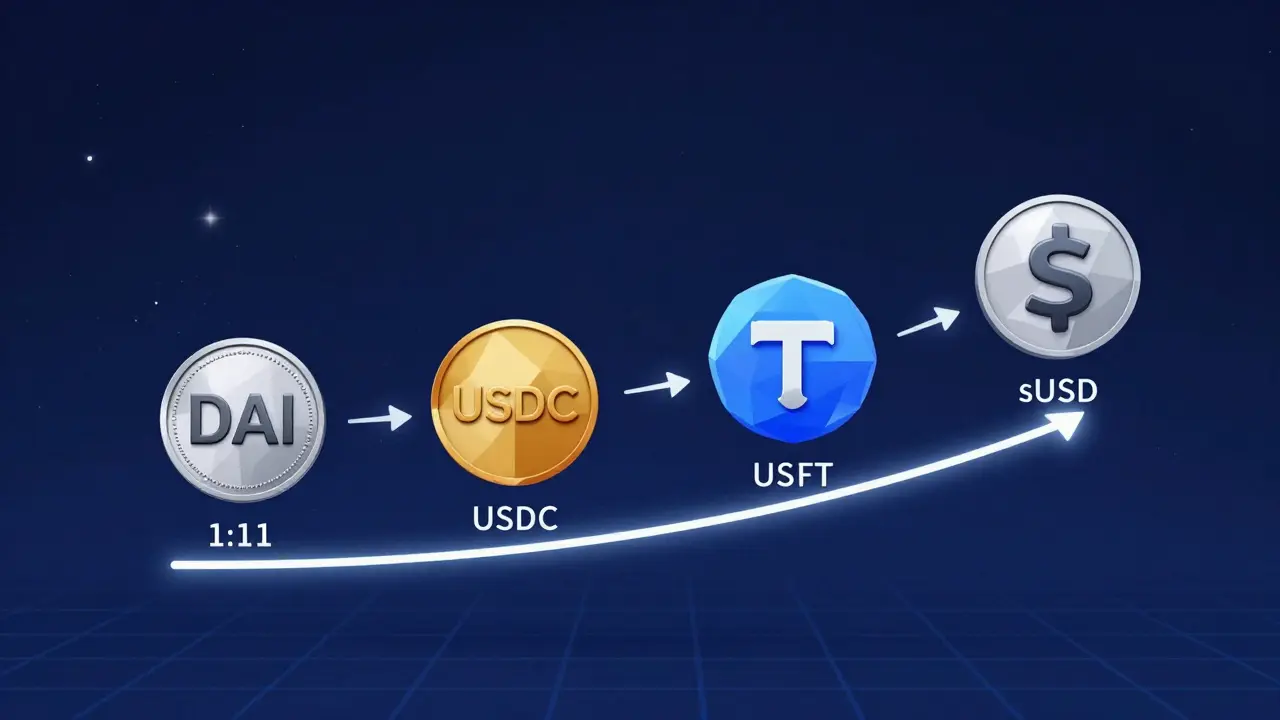
- DAI, USDC, USDT, sUSD (four stablecoins in one pool)
- wBTC, renBTC, sbtc (wrapped Bitcoin variants)
- frax, crvUSD, USDe (newer stablecoins)
Each pool has its own algorithm tuned to the assets inside. No guesswork. No overcompensation. Just smooth, cheap swaps.
In 2024, Curve introduced crvUSD is a native over-collateralized stablecoin built on Curve’s own PegKeepers system. Unlike other stablecoins that rely on centralized reserves, crvUSD uses dynamic collateral ratios and liquidation thresholds to stay pegged. By early 2026, over $120 million in crvUSD is circulating - and it’s already being used inside Curve’s own pools as a trading pair. That’s a big deal. It means Curve now controls its own liquidity fuel.
Why Curve Beats Other DEXs for Stablecoins
Let’s cut through the noise. Here’s how Curve stacks up against the competition:
| Feature | Curve Finance | Uniswap v3 | SushiSwap |
|---|---|---|---|
| Slippage on $10k USDC/DAI | 0.01% - 0.03% | 0.2% - 0.8% | 0.15% - 0.6% |
| Fees per trade | 0.02% - 0.04% | 0.05% - 0.3% | 0.05% - 0.25% |
| Supported stablecoin pairs | 12+ multi-asset pools | Manual LP creation only | 5-7 pools |
| Multi-chain support | Ethereum, Arbitrum, Optimism, Polygon, Avalanche, Fantom | Mainly Ethereum | Mainly Ethereum |
| Integration with lending protocols | Aave, Compound, Yearn | Limited | Basic |
| CRV token rewards | Yes - direct LP incentives | No | SUSHI rewards (lower yield) |
Curve wins on every metric that matters for stablecoin traders: lower fees, less slippage, more pools, and better rewards. Uniswap is great for swapping ETH for a new memecoin. Curve is the only choice if you’re moving $50,000 between USDC and DAI before a yield farm opens.
Who Uses Curve - And Why
Curve isn’t for beginners. But it’s perfect for:
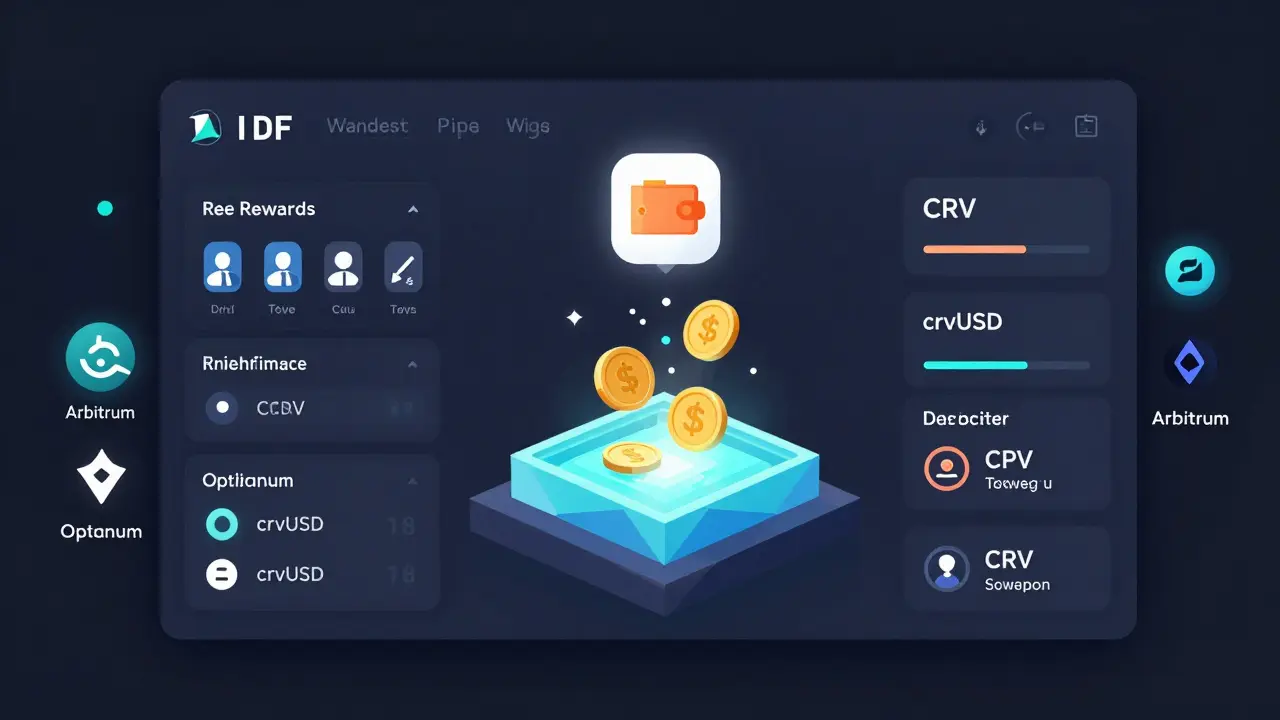
- Liquidity providers - If you deposit stablecoins into a Curve pool, you earn trading fees + CRV tokens. Some pools offer over 15% APY in CRV rewards alone. In 2025, top liquidity providers earned over $120,000 in CRV rewards annually.
- Arbitrageurs - When USDT trades at $0.998 on one exchange and $1.001 on another, Curve’s low slippage lets traders capture the spread with minimal risk.
- DeFi power users - Curve is the engine behind complex strategies. You might swap USDC to crvUSD, deposit it into Aave to borrow ETH, then use that ETH to stake in a new protocol. Curve makes the first step seamless.
- Institutional players - BlackRock’s tokenized fund BUIDL now routes liquidity through Curve. That’s not a coincidence. Institutions need predictable, low-cost swaps. Curve delivers.
Curve’s 2025 UI overhaul made things easier. The new DAO dashboard lets you see your LP positions, voting power, and rewards in one place. No more juggling 10 different screens. Even so, if you’ve never used a wallet like MetaMask or connected to a DEX before, start with a simple stablecoin swap on a centralized exchange first.

The Downsides - And What’s Changing
Curve isn’t flawless.
- No volatile pairs - You can’t trade ETH for SOL here. That’s intentional. If you need to swap between wildly different assets, use a DEX like Uniswap or Pangolin.
- Gas fees on Ethereum - Swapping on Ethereum mainnet can cost $15-$40 in gas. That’s why Curve expanded to Arbitrum and Optimism. On those chains, swaps cost under $0.50.
- Complex governance - CRV holders vote on pool incentives, fee splits, and protocol upgrades. But voting requires locking CRV for up to four years. It’s powerful - but not for casual users.
Curve is fixing these gaps fast. By late 2026, the platform plans to merge its lending and swapping interfaces into one unified dashboard. That means you’ll be able to borrow against your stablecoin deposits without leaving Curve. It’s a move that could turn Curve into the first all-in-one DeFi hub for stable assets.
Is Curve Right for You?
If you’re trading stablecoins - especially at scale - Curve is the best option on Ethereum. It’s faster, cheaper, and more reliable than anything else. If you’re a liquidity provider, it’s one of the highest-yielding opportunities in DeFi.
But if you’re new to crypto, or you want to swap ETH for a new token? Skip Curve. Use a centralized exchange or a general DEX. Curve isn’t a Swiss Army knife. It’s a scalpel. And when you need precision, nothing else comes close.
With $1.8 billion locked in its pools and crvUSD gaining traction, Curve isn’t slowing down. It’s becoming the standard. And in DeFi, standards become infrastructure.
Is Curve Finance safe to use?
Curve’s smart contracts have been audited multiple times by top firms like CertiK and Trail of Bits. No major exploits have occurred since launch. However, all DeFi protocols carry smart contract risk. Always use a non-custodial wallet like MetaMask, never deposit funds you can’t afford to lose, and avoid interacting with unofficial websites. Stick to curve.fi and verified integrations.
Can I trade Bitcoin on Curve?
Not native Bitcoin. But you can trade wrapped versions like wBTC, renBTC, and sbtc - all pegged 1:1 to BTC. These are ERC-20 tokens that represent Bitcoin on Ethereum. Curve has dedicated pools for swapping between these wrapped assets, making it one of the best places to move between Bitcoin equivalents with minimal slippage.
How do I earn CRV tokens on Curve?
Deposit stablecoins or wrapped assets into a Curve liquidity pool. As traders swap between those assets, you earn a share of the trading fees. On top of that, Curve distributes CRV tokens as incentives to liquidity providers. The amount depends on the pool’s activity and governance votes. Some pools offer over 20% APR in CRV alone.
What’s the difference between crvUSD and USDC?
USDC is a centralized stablecoin backed by cash and short-term U.S. treasuries. crvUSD is a decentralized, over-collateralized stablecoin built on Curve’s own PegKeepers system. It doesn’t rely on a company’s balance sheet - instead, it uses dynamic collateral ratios and liquidation triggers to maintain its $1 peg. crvUSD is designed to be used inside Curve’s ecosystem, but it’s also being adopted by other DeFi protocols.
Do I need to use Ethereum mainnet to use Curve?
No. Curve operates on Ethereum, Arbitrum, Optimism, Polygon, Avalanche, and Fantom. For low-cost swaps, use Arbitrum or Optimism - gas fees are under $0.50. Only use Ethereum mainnet if you’re interacting with protocols that require it. Most users prefer the cheaper chains for daily trading.
Can I use Curve without owning CRV tokens?
Yes. You can swap stablecoins on Curve without owning any CRV. The CRV token is only needed if you want to vote on governance proposals or boost your liquidity rewards. For basic trading, CRV isn’t required.
Is Curve better than centralized exchanges for stablecoins?
For large trades, yes. On centralized exchanges, slippage can be high for large orders. Curve’s low-slippage pools handle $100k+ swaps with less than 0.05% price impact. Plus, you keep full control of your funds. On CEXs, you’re trusting a company to hold your money. Curve gives you custody - and better rates.
Curve Finance isn’t flashy. It doesn’t run ads or hype memecoins. It just works - quietly, efficiently, and at scale. In a DeFi world full of noise, that’s the real innovation.





22 Comments
Ross McLeod
March 20, 2026 at 07:12
Let’s be real - Curve isn’t some magical unicorn. It’s a hyper-specialized tool that works brilliantly for one thing: stablecoin swaps. But people act like it’s the only DEX that matters. Meanwhile, Uniswap v4 is coming with concentrated liquidity for stable pairs too. Curve’s edge is shrinking. And don’t get me started on how bloated their governance has become. CRV tokenomics are a circus. I’ve seen liquidity providers get wiped out because a single vote shifted incentives overnight. This isn’t finance - it’s political theater with gas fees.
Billy Karna
March 21, 2026 at 04:08
Actually, Curve’s algorithm is the closest thing we’ve got to a mathematical proof for low-slippage swaps. The stableswap invariant isn’t just a tweak - it’s a paradigm shift. Most AMMs assume volatility. Curve assumes stability. That’s why it works. And yes, gas on Ethereum is brutal - but that’s why Arbitrum and Optimism exist. If you’re still doing $50k swaps on mainnet, you’re doing it wrong. Curve’s multi-chain expansion is the real story here. Also, crvUSD? That’s not a side project - it’s the future. A decentralized stablecoin built by the people who know liquidity best? That’s not innovation. That’s inevitability.
Cheri Farnsworth
March 22, 2026 at 19:41
Curve is the quiet giant of DeFi. No fanfare. No memes. No influencer shoutouts. Just cold, efficient, math-driven liquidity. I’ve watched institutions quietly shift their entire stablecoin routing through Curve over the last 18 months. BlackRock, Fidelity, even some hedge funds - they don’t care about hype. They care about slippage under 0.03% and predictable fee yields. That’s why Curve dominates. It’s not flashy. It’s foundational. Like TCP/IP for DeFi. You don’t notice it until you try to build without it.
Gene Inoue
March 22, 2026 at 21:13
LOL you guys act like Curve is some genius invention. It’s just a glorified stablecoin sandwich. Any idiot with a whitepaper could’ve done this. The real scam is how they’re pushing CRV as a governance token when 90% of the voting power is held by whales and DAO bots. And don’t even get me started on the crvUSD ‘decentralized’ stablecoin - it’s still overcollateralized by ETH and USDC. That’s not decentralized. That’s just a fancy way of saying ‘we’re still using centralized assets.’ Wake up.
Ricky Fairlamb
March 24, 2026 at 02:20
Curve’s success is not a testament to innovation - it’s a testament to systemic failure. The fact that we need a specialized DEX to swap USDC for DAI without losing 0.5% is proof that Ethereum’s DeFi ecosystem is fundamentally broken. Uniswap, Sushi, even Balancer - they all failed to solve the most basic problem in crypto: low-volatility asset trading. Curve didn’t invent anything. It just filled the vacuum left by incompetence. And now, because it works, everyone treats it like a deity. The irony? It’s built on the same flawed, overpriced, gas-guzzling infrastructure that made this necessary in the first place.
Arlene Miles
March 25, 2026 at 05:21
Curve isn’t just a tool - it’s a philosophy. It says: ‘Don’t overcomplicate what should be simple.’ Most DeFi projects chase complexity - new derivatives, layered vaults, AI-driven arbitrage bots. Curve says: ‘Let’s make swapping USDC for DAI feel like tapping a button on your bank app.’ And it does. It’s not sexy. But it’s necessary. To everyone who says ‘this isn’t innovation’ - innovation doesn’t always look like a rocket ship. Sometimes it looks like a perfectly calibrated scale. And right now, Curve is the only one that doesn’t wobble.
Lucy de Gruchy
March 25, 2026 at 18:01
Curve is a honeypot. The ‘low slippage’ is a mirage. Behind the scenes, the pools are manipulated by front-running bots and MEV harvesters. Every time you think you’re getting 0.01% slippage, you’re actually paying 0.15% in hidden sandwich fees. And the CRV rewards? They’re inflated by the DAO to lure in retail. Once you’re locked in, the incentives drop. This isn’t DeFi. It’s a casino with a whitepaper. The real innovation? How they convinced everyone this was science.
Lauren J. Walter
March 27, 2026 at 06:44
Wow. A DEX that doesn’t explode every time someone swaps 10k USDC. Who even thought of that?
Carol Lueneburg
March 27, 2026 at 10:27
YES! 🙌 Curve is the quiet hero we don’t talk about enough. I’ve used it for 2 years now - no drama, no drama, just smooth swaps. Even my grandma (yes, she’s in DeFi now 😄) uses it for her USDC/DAI moves. And crvUSD? It’s like a little spark of true decentralization. We need more of this. Less hype. More function. 💫
Brenda White
March 27, 2026 at 10:40
so curve is just for stablecoins?? like u cant swap eth for btc?? that seems so limiting. why not just use binance if ur only doing stablecoins anyway. also crvusd sounds like a scam name. who names a coin crvusd??
Taylor Holloman.
March 29, 2026 at 09:24
I’ve been watching Curve for years. It’s not flashy. It doesn’t have a viral token. It doesn’t sponsor podcasts. But every time I need to move large amounts of stablecoins - whether it’s for a yield farm, a liquidity shift, or just rebalancing - I go to Curve. It’s the only place where I don’t have to second-guess the price. No surprises. No slippage panic. Just… work. That’s rare. And honestly? That’s worth more than any meme coin’s 1000x.
Bryan Roth
March 31, 2026 at 07:05
Curve is the unsung MVP of DeFi. People forget that liquidity isn’t sexy - but it’s everything. Without Curve, DeFi would be a house of cards. Every time you swap DAI for USDT without losing $50, you’re indirectly using Curve’s math. And crvUSD? That’s the next chapter. It’s not just another stablecoin - it’s a self-sustaining ecosystem. You don’t need to own CRV to benefit from it. You just need to use it. And that’s the beauty.
Sahithi Reddy
April 1, 2026 at 12:01
Curve is the real deal. I use it daily. No drama. No gas wars. Just smooth swaps. crvUSD is the future. Simple. Clean. Powerful.
Prakash Patel
April 3, 2026 at 11:57
Curve is overrated. All this talk about ‘low slippage’ - but have you seen the liquidity depth on Arbitrum? Or the new DEXs on Solana? Curve is stuck in 2021. Ethereum is dead. And if you’re still using it for anything other than nostalgia, you’re behind.
Zachary N
April 4, 2026 at 04:37
For anyone new to DeFi - don’t skip Curve. It’s not for trading memecoins. But if you’re moving stablecoins - even $1k - it saves you money. And the UI update? Huge. I used to hate juggling pools and rewards. Now it’s one dashboard. I’ve even convinced my crypto-averse friend to use it for his payroll stablecoin savings. That’s impact.
Elizabeth Kurtz
April 5, 2026 at 01:41
As someone who’s lived in three countries and used DeFi across continents, Curve’s multi-chain support is revolutionary. I’ve swapped stablecoins on Polygon, Arbitrum, and Optimism - all from one interface. No need to juggle wallets or bridges. That’s accessibility. And crvUSD? It’s the first truly global stablecoin - not tied to U.S. dollars or U.S. banks. That’s not just innovation. That’s sovereignty.
Marc Morgan
April 7, 2026 at 00:12
Curve is like that one friend who never shows up to parties but always has the best snacks. You don’t notice them until you’re starving. Then you realize - they’ve been feeding everyone quietly for years. No drama. No flexing. Just solid, reliable, delicious liquidity. And yeah, I’m still using it. Even after the ‘crypto winter.’
Anastasia Thyroff
April 8, 2026 at 00:11
I used to think Curve was boring… until I lost $300 on Uniswap swapping USDC for DAI. Now I only use Curve. It’s not glamorous. But it’s the only thing that didn’t make me cry.
Kira Dreamland
April 8, 2026 at 23:08
crvUSD is wild. I didn’t even know it existed until last week. Now I’m using it for my daily stablecoin swaps. It’s like using a new kind of money - one that doesn’t need a bank. Mind blown. 🤯
Shreya Baid
April 10, 2026 at 07:08
Curve’s architecture is a masterpiece of economic design. The stableswap invariant is elegant, mathematically sound, and computationally efficient. It represents a paradigm shift in AMM design, moving from volatility-based pricing to peg-stabilized equilibrium. The integration with lending protocols is not merely functional - it is systemic. This is not a tool. It is infrastructure.
Christopher Hoar
April 10, 2026 at 13:26
curve is just a glorified converter. why do ppl act like its the only thing? i can swap usdc for dai on binance in 2 secs for free. this whole ‘decentralized’ thing is just a buzzword. also crvusd? sounds like a crypto scam name. who names a coin like that??
Robert Kunze
April 12, 2026 at 12:21
just used curve for the first time. swapped 15k usdc to dai. gas was $12 on eth but only $0.23 on arbitrum. slippage was 0.01%. i thought i was gonna get ripped off. nope. just worked. kinda amazing. i’ll be back.