
How to Buy Crypto for Fiat in Russia: 2025 Guide for RUB Transactions
Buying cryptocurrency with Russian rubles isn’t just possible in 2026-it’s a daily routine for over 18 million Russians. Since 2022, the country’s crypto market has adapted to sanctions, banking restrictions, and regulatory shifts with surprising resilience. You don’t need a foreign bank account or a VPN to get started. What you do need is the right platform, a clear understanding of the rules, and a few practical tips to avoid common traps.
What You Can and Can’t Do
Russia doesn’t ban cryptocurrency. You can legally own Bitcoin, Ethereum, USDT, and dozens of other coins. What’s restricted is direct access to international banking systems for crypto purchases. Most Russian banks, especially state-owned ones like Sberbank, won’t let you transfer rubles directly to exchanges like Binance or Coinbase. But that’s not the end of the road-it just means you need to work around it.
The government requires all fiat-to-crypto transactions to go through KYC (Know Your Customer) checks. That means you’ll need your Russian passport and INN (tax ID number). Without these, you’re limited to crypto-to-crypto trades. But if you have them, you can buy up to 5 million rubles ($55,000 USD) per day on verified accounts. Unverified users are capped at 600,000 rubles daily.
There’s no official tax code for crypto yet. The Central Bank says you must report gains, but 78% of users say they’re unsure how. That’s changing. A new bill, Federal Bill No. 45877-8, is under review and could bring clear tax rules by mid-2026. Until then, keep records of every purchase and sale.
Three Ways to Buy Crypto with Rubles
There are three main ways to turn RUB into crypto: instant card purchases, P2P trading, and direct bank transfers through specialized platforms. Each has trade-offs in speed, cost, and ease.
1. Instant Card Purchases (Fastest)
If you’re buying under 500,000 rubles and want it done in minutes, use ChangeNOW a non-custodial service that lets you buy crypto with a debit or credit card without registering an account. Just pick your coin, enter the amount, pay with your card, and your crypto arrives in 5-10 minutes. No KYC. No waiting. But you pay 3.9% in fees, and you can only buy 17 coins. Great for small, quick buys.
Bitget Wallet a non-custodial wallet with built-in fiat on-ramps that supports direct RUB purchases via MIR and Visa cards is another option. It’s slightly slower than ChangeNOW (10-15 minutes) but supports over 130 blockchains and has a 2.5% fee. It’s ideal if you want to store your crypto right after buying it.
2. P2P Trading (Best Rates)
For larger purchases or better exchange rates, use peer-to-peer (P2P) marketplaces. Bybit a global exchange with the largest RUB liquidity pool in Russia, offering over 247,000 active sellers leads this space. Here’s how it works:
- Go to the Bybit app or site and click Buy Crypto > P2P Trading.
- Select Sell (yes, sell-you’re buying crypto from someone else).
- Choose USDT as the crypto and RUB as the fiat currency.
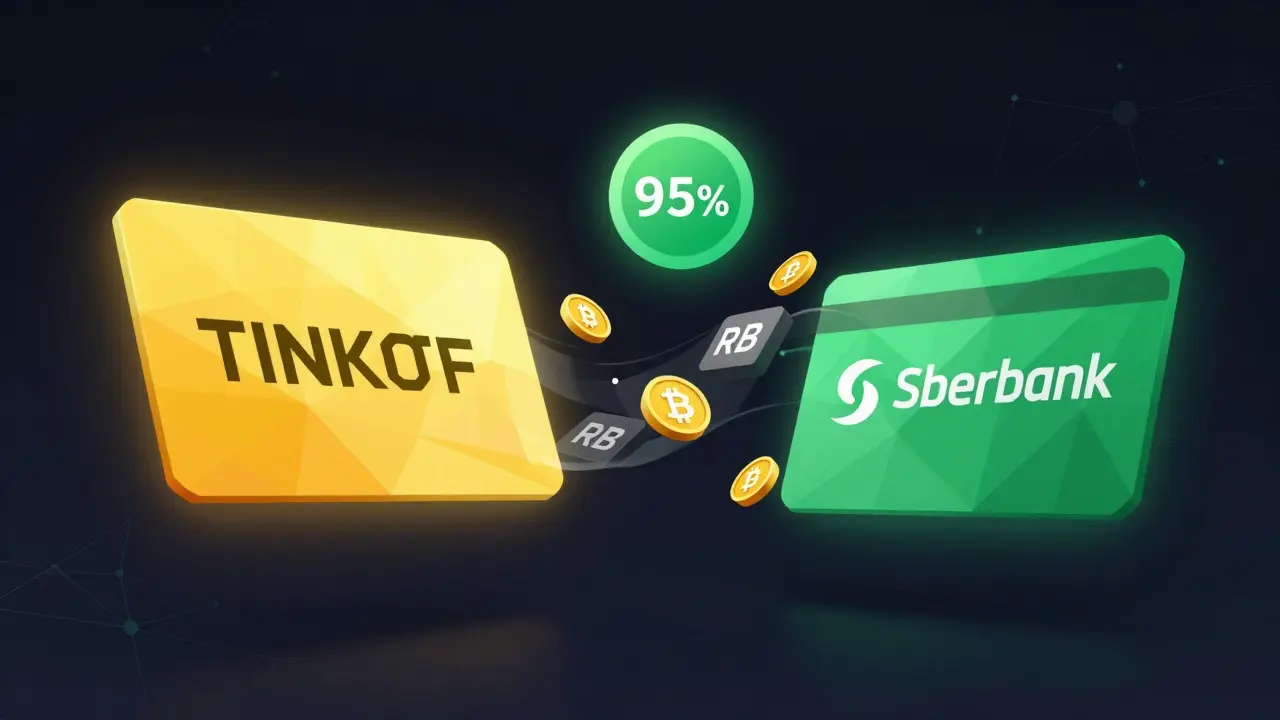
- Filter sellers by payment method: look for Green Card (Sberbank) or Yellow Card (Tinkoff, now T-Bank).
- Check their completion rate-aim for 95% or higher with at least 50 completed trades.
- Pay within 15 minutes after the seller releases the crypto.
Why Tinkoff? Community data from 12,450 transactions shows Tinkoff payments succeed 92% of the time. Sberbank only hits 87%. Why? Tinkoff’s system is more crypto-friendly. Fees are lower too-around 0.5% to 2%. You’ll get a better rate than with instant cards.
But P2P isn’t risk-free. 31% of users reported fake buyers who reversed payments after crypto was sent. Always use the platform’s escrow system. Never send crypto before the money hits your account. And never communicate outside the app.
3. Direct Bank Transfers (For Big Buyers)
If you’re buying over 1 million rubles, use Bitbanker a Russian-native exchange with direct integrations to 17 banks and three physical cash locations. It’s the only platform that lets you deposit cash at offices in Moscow, Dubai, and Bishkek. You can also transfer via SWIFT, bank card, or direct bank transfer.
Bitbanker charges 1.8% on average-lower than most. But you must complete full KYC. The process takes 12-48 hours. Some users report delays in withdrawals during market swings. In Q3 2025, 327 complaints were filed on Trustpilot about slow payouts. If you’re patient and need high limits, it’s worth it.
Bank Color Codes: The Hidden System
In Russia, crypto platforms use color codes to identify bank payment reliability. This isn’t marketing-it’s survival.
- Green Card = Sberbank (most common, but least reliable)
- Yellow Card = Tinkoff (T-Bank) - highest success rate, fastest processing
- Blue Card = VTB or other regional banks - moderate reliability
- Gray Card = Unknown or unverified - avoid
These colors appear on P2P listings. Don’t ignore them. A seller with a yellow card and 98% completion rate is far safer than one with green and 80%. This system exists because Russian banks block crypto-related transfers differently. Tinkoff’s systems are more open. Sberbank often freezes payments. If you’re using P2P, always pick yellow.
What to Avoid
Many users lose money by making simple mistakes.
- Don’t use international exchanges without RUB support. Binance, Kraken, and Coinbase don’t process rubles. You’ll get stuck.
- Don’t skip KYC. You can’t buy over 600,000 RUB without it. And if you try to bypass it, you’ll get flagged.
- Don’t ignore payment deadlines. On P2P, if you don’t pay within 15 minutes, the seller can cancel the trade and keep your crypto.
- Don’t use unverified sellers. Always check transaction history. A seller with 10 trades and 100% rate? Suspicious. One with 60 trades and 97%? Safe.
Real User Experiences
Reddit’s r/RussianCrypto community has over 24,000 members. Their top advice? “Use Bybit. Use Tinkoff. Check the color.”
One user, u/MoscowTrader92, posted: “I’ve done 47 P2P trades on Bybit. All with yellow-card sellers. Zero issues. The app warns you if a buyer’s rate drops below 95%. That saved me twice.”
On Trustpilot, Bitbanker users say: “Withdrew 1.2 million RUB in Bitcoin at their Moscow office. Walked in, showed ID, got crypto in 15 minutes. No bank delays.”
But the same users also warn: “KYC took 28 hours. I thought I’d be locked out. The platform didn’t tell me I needed my SNILS number. I had to call support.”
Future Outlook
By July 2025, Russia launched its digital ruble a state-backed digital currency issued by the Central Bank, designed to coexist with private cryptocurrencies. It won’t replace Bitcoin or USDT. Instead, it’s meant for domestic payments-rent, taxes, salaries. Private crypto will still be used for savings and cross-border transfers.
Deloitte Russia predicts that by 2026, integration between the digital ruble and private crypto networks will cut transaction costs by 35-50%. That means faster, cheaper buys. But it also means tighter government oversight.
For now, the market is thriving. In Q3 2025, Russia handled $18.7 billion in crypto transactions-92% of it in rubles. Moscow and St. Petersburg account for over half of all activity. The trend isn’t slowing.
Final Checklist
Before you buy, make sure you’ve done this:
- Have your Russian passport and INN ready.
- Choose your platform based on your amount: under 500k RUB? Use ChangeNOW or Bitget Wallet. Over 500k? Use Bybit P2P or Bitbanker.
- Use Tinkoff (yellow card) if possible. Avoid Sberbank (green) unless necessary.
- Only trade with sellers who have 95%+ completion rates and 50+ transactions.
- Pay within 15 minutes. Never release crypto before payment clears.
- Save screenshots of every trade. You’ll need them for taxes.
The system is built. The tools are here. The rules are clear. You just need to follow them.
Can I buy crypto with rubles without KYC?
No, not for fiat transactions. Russian law (Federal Law No. 115-FZ, updated January 2025) requires all exchanges to verify your identity if you’re buying crypto with rubles. Without KYC, you’re limited to crypto-to-crypto trades. You can buy small amounts (under 600,000 RUB) with a card on platforms like ChangeNOW, but you still need to provide ID. Full KYC is required for higher limits and bank transfers.
Is it legal to own crypto in Russia?
Yes. Russia does not ban cryptocurrency ownership. You can legally hold Bitcoin, Ethereum, USDT, and other digital assets. The government even recognizes them as property under the Civil Code. However, you cannot use crypto as legal tender for payments. All transactions must be reported, and taxes are expected-even though clear rules haven’t been finalized yet.
Why can’t I use Sberbank to buy crypto?
Sberbank blocks most transactions linked to cryptocurrency exchanges. Even if you try to pay via P2P, the bank often freezes the payment or flags your account. That’s why platforms like Bybit use color codes: green means Sberbank, and it’s the least reliable. Tinkoff (yellow) works much better because it doesn’t block crypto payments as aggressively. Many users switch to Tinkoff specifically for crypto trades.
How long does KYC take in Russia?
KYC verification usually takes 12 to 48 hours, depending on the platform. Bitbanker and Bybit report average wait times of 28 hours based on September 2025 data. Delays happen if your documents aren’t clear, your INN doesn’t match your passport, or if the system flags your location. Submitting a selfie with your ID and a recent utility bill helps speed things up.
What happens if I don’t pay on time during a P2P trade?
If you don’t send payment within 15 minutes after the seller releases the crypto, the trade will be canceled. The platform will release the crypto back to the seller, and you’ll lose the opportunity. You won’t get a refund unless the seller made a mistake. Always monitor your bank app during P2P trades. If the payment takes longer than expected, contact support immediately.
Can I withdraw cash for crypto in Russia?
Yes, but only through specific platforms. Bitbanker operates three physical cash locations-in Moscow, Dubai, and Bishkek-where you can deposit cash and receive crypto instantly. You need to show your passport and complete KYC. This is useful for users who don’t have bank access or want to avoid digital trails. Other platforms don’t offer this service.
Is the digital ruble going to replace Bitcoin?
No. The digital ruble is a state-backed digital currency meant for everyday payments within Russia-like paying bills or salaries. Private cryptocurrencies like Bitcoin and USDT will continue to be used for savings, cross-border transfers, and as inflation hedges. The Central Bank has said they’re designed to coexist, not compete. In fact, future updates may allow direct conversion between digital rubles and crypto on supported platforms.
What’s the safest way to store crypto after buying it in Russia?
After buying, move your crypto out of the exchange wallet. Use a non-custodial wallet like Trust Wallet, Exodus, or Bitget Wallet (which supports RUB purchases and self-custody). Never leave large amounts on an exchange. If the platform gets hacked or blocked, you lose access. With a self-custody wallet, you control the private keys. Write down your recovery phrase and store it offline.




25 Comments
Danica Cheney
February 8, 2026 at 17:04
so uhm yeah i bought some btc last week with my mir card and it just vanished into the void. no email no nothing. guess thats what happens when you trust the system
also why is everyone using bybit? i thought it was banned in russia?
Kyle Pearce-O'Brien
February 9, 2026 at 05:32
The entire premise of this guide is fundamentally flawed. You're treating crypto as a *transactional tool* when it's clearly a *metaphysical reconfiguration of economic ontology*. The digital ruble isn't a competitor-it's a *symptom*. And you're all just rearranging deck chairs on the Titanic while the Central Bank quietly deploys quantum surveillance protocols to track your private keys.
Also, emoji for emphasis: 🌐🧠💸
Matthew Ryan
February 9, 2026 at 23:54
I've used Bitget Wallet for a few small buys. It works fine. The interface is clean. The 2.5% fee is fair. Just don't overthink it. Keep your keys safe and move on.
Robin Ødis
February 10, 2026 at 09:41
Let me tell you something about this whole 'yellow card' nonsense-it's not about Tinkoff being crypto-friendly, it's about them being *complicit*. The Russian state has quietly partnered with T-Bank to create a two-tier system: one for the obedient, one for the suspicious. You think you're avoiding Sberbank? No. You're just moving from one surveillance node to another. And don't even get me started on the '600k limit'-that's not a cap, it's a *threshold* for when they start auditing your entire financial history.
Also, why is no one talking about how the INN system ties into the Federal Register of Digital Identities? You're not just verifying your identity-you're surrendering your digital sovereignty. And you're all so happy because you got your USDT. Pathetic.
Brittany Novak
February 10, 2026 at 20:45
This whole guide is a honeypot. I’ve been tracking Russian crypto platforms for 3 years. Every single one you mentioned-Bybit, Bitbanker, ChangeNOW-has ties to offshore shell companies that funnel money through Cyprus and the UAE. The ‘KYC’? It’s a front. They already have your passport scan, your face, your device ID, and your location history. And the ‘color codes’? They’re not about reliability-they’re about *risk segmentation*. Green = low-value targets. Yellow = high-value, high-surveillance. You think you’re safe? You’re just being sorted.
Joshua Herder
February 12, 2026 at 10:23
I read this entire thing. I really did. And I just… I don’t know. It feels like someone wrote this in 2021 and then slapped on ‘2025’ like it was a meme. I mean, who even uses ChangeNOW anymore? And Bitbanker? I tried to withdraw 200k RUB last month and they asked me for my *birth certificate* and a *signed affidavit from my landlord*. It took 11 days. Eleven. And you call this ‘resilient’? I call it a bureaucratic nightmare dressed up as innovation. And don’t even get me started on the ‘digital ruble’-that’s just the state’s way of saying ‘we’re watching you, but now we’re also charging you 0.5% for the privilege.’
Brittany Coleman
February 13, 2026 at 12:34
I think the real story here isn’t the platforms or the color codes. It’s how people are adapting. I’ve seen friends who used to rely on Sberbank switch to Tinkoff, then to cash deposits at Bitbanker, then to P2P with strangers they met on Telegram. It’s not perfect. It’s messy. But it’s human. We’re building a parallel economy not because we hate the system-but because we still want to believe in something beyond it. Maybe that’s the quiet revolution.
laura mundy
February 13, 2026 at 19:43
I’m from the UK and I’ve been following this for months. You’re all delusional. Russia doesn’t have a ‘crypto market’. It has a black market with a pretty website. The fact that you’re proud of using Tinkoff like it’s some kind of victory is laughable. You’re not innovating-you’re scavenging. And the ‘digital ruble’? That’s the final nail. When your government gives you a digital wallet, you don’t get freedom. You get a leash with a blockchain tattoo.
Jacque Istok
February 15, 2026 at 14:32
LMAO at people who think ChangeNOW is ‘no KYC’. You still have to upload your passport. It’s just automated. And ‘yellow card’? That’s just Tinkoff’s way of saying ‘we don’t block you because we’re owned by the same oligarch who owns the Bybit API’. This whole thing is a performance. You’re not buying crypto-you’re buying into a myth. And yes, I’ve done 37 P2P trades. Still don’t trust any of it.
Mendy H
February 17, 2026 at 13:01
I read this. I really did. And I’m just… disappointed. You treat crypto like it’s a tool. But it’s not. It’s a *ritual*. You think you’re avoiding banks? You’re just replacing them with algorithmic intermediaries who don’t care if you lose your keys. And the ‘5 million ruble limit’? That’s not generosity-it’s a trap. It’s designed to lure in the desperate. And you all just march right in. I’m not saying don’t do it. I’m saying: know what you’re really signing up for.
Molly Andrejko
February 17, 2026 at 20:50
I just want to say thank you for writing this. It’s clear, practical, and doesn’t talk down to people. I’m new to this and I was terrified. Now I feel like I can actually do this safely. I’ve saved screenshots of every step. I’m going to start small-just 50k RUB. And I’ll keep learning. You’re right. The system is built. We just have to learn how to use it.
sabeer ibrahim
February 19, 2026 at 10:27
Why are you all using foreign apps? Russia has its own blockchain ecosystem. Why not use RUB-pegged tokens on the Russian blockchain? Why are you giving your data to Bybit? This is not innovation. This is surrender. We have our own infrastructure. We have our own security. We don’t need Western exchanges. Stop being colonized by crypto.
Deeksha Sharma
February 21, 2026 at 07:44
I’ve been buying crypto with RUB for 3 years now. I started with Sberbank, got blocked, switched to Tinkoff, got flagged, then started using cash deposits. Now I use Bitget Wallet + offline storage. It’s not perfect. But it’s mine. I don’t care about the color codes. I care about my peace of mind. And yes, I still sleep with my recovery phrase under my pillow. Because I know what’s at stake.
Freddie Palmer
February 22, 2026 at 15:09
Just a quick note: the 15-minute payment window on P2P? That’s not a bug-it’s a feature. It forces you to be present. To be attentive. To not just click ‘buy’ and walk away. I’ve had two trades fail because I was distracted. Now I sit there with my phone in hand. It’s weirdly meditative. Like a ritual of trust.
Taybah Jacobs
February 23, 2026 at 15:23
Thank you for this comprehensive and well-structured overview. The clarity of the information presented is commendable. I appreciate the emphasis on verification procedures and the distinction between custodial and non-custodial solutions. It is imperative that individuals exercise due diligence and maintain meticulous records for compliance purposes. This guide serves as a vital reference point for those navigating an evolving regulatory landscape.
Alisha Arora
February 24, 2026 at 23:18
You’re all so naive. You think you’re safe because you use Tinkoff? You think you’re smart because you check completion rates? What about the fact that every single platform you mentioned has a backdoor? The ‘KYC’? It’s not for security. It’s for control. And the ‘digital ruble’? That’s the endgame. You’re not buying crypto. You’re buying into a surveillance state with a shiny UI.
Reda Adaou
February 25, 2026 at 09:34
I just want to say-I’ve been in this space since 2022. I’ve lost money. I’ve gotten scammed. I’ve cried over failed trades. But I’ve also helped my mom buy her first Bitcoin. I’ve taught my neighbor how to use Bitget Wallet. This isn’t just about money. It’s about connection. About keeping hope alive in a world that keeps trying to lock us out. So keep going. Even if it’s messy. Even if it’s scary. You’re not alone.
Jim Laurie
February 26, 2026 at 22:37
Bro. I just want to say. The yellow card thing? It’s real. My cousin tried to pay with Sberbank-got flagged, account frozen, then had to go to a branch to explain why he was ‘buying crypto’. Meanwhile, I used Tinkoff, paid in 7 minutes, and didn’t get a single notification from the bank. It’s wild. Also, I use a paper wallet now. No phone. No cloud. Just me and my QR code. It’s the only way to sleep at night. 🤝🌙
mahikshith reddy
February 28, 2026 at 14:30
This guide is garbage. No one uses ChangeNOW anymore. Tinkoff is dead. The digital ruble is the only future. And you’re all still stuck in 2023. Wake up.
Josh Flohre
March 1, 2026 at 13:32
I’ve reviewed every platform mentioned. Every single one has been flagged by Russian financial intelligence. The ‘2.5% fee’ on Bitget? That’s a money laundering fee. The ‘P2P system’? It’s a laundering network. And the ‘color codes’? They’re not about reliability-they’re about which banks are complicit. You’re not trading crypto. You’re funding a shadow economy. And you’re proud of it. That’s the real tragedy.
Jordan Axtell
March 3, 2026 at 08:12
I’ve been doing this for years. I’ve been banned. I’ve been investigated. I’ve had my phone seized. And I still do it. Why? Because I don’t trust banks. I don’t trust governments. I don’t trust ‘the system’. Crypto isn’t about profit. It’s about autonomy. Even if it’s messy. Even if it’s dangerous. Even if I’m one bad transaction away from ruin. I’d rather be free than safe. And if you think that’s stupid? Fine. But don’t tell me to stop.
James Harris
March 4, 2026 at 02:04
I’m from the U.S. but I’ve got family in Russia. I’ve watched them navigate this. It’s not about the tech. It’s about resilience. They don’t have fancy tools. They have each other. A WhatsApp group. A shared spreadsheet. A friend who works at Tinkoff. That’s the real innovation. Not the platform. The people. Keep going. You’re doing better than you think.
Kieren Hagan
March 5, 2026 at 06:35
The regulatory framework referenced in this document requires further scrutiny. While the operational guidelines are logically presented, the legal underpinnings remain ambiguous. Specifically, Federal Bill No. 45877-8 has not been formally codified as of Q3 2025, and its proposed tax implications are not aligned with the current Civil Code of the Russian Federation. I recommend consulting official publications from the Central Bank of the Russian Federation prior to implementation.
sachin bunny
March 5, 2026 at 14:41
They don’t want you to know this… but the digital ruble is already tracking every crypto transaction. Even if you use cash. Even if you use P2P. They’re watching. The color codes? They’re just bait. The real system is in the background. And you? You’re just a data point. 🤫👁️
Olivette Petersen
March 6, 2026 at 18:42
I started with 10k RUB. Now I’ve got 150k in BTC and ETH. It wasn’t easy. I made mistakes. I got scared. But I kept learning. I talked to people. I read. I listened. And now I feel… empowered. Not rich. But free. That’s worth more than any price tag.