
Spice Trade (Avalanche) Review: Is It Real or a Scam? [2026 Analysis]
Have you heard about Spice Trade, the supposed decentralized exchange on the Avalanche blockchain? If you are looking for a quick review to decide whether to deposit your funds, here is the hard truth: as of August 2026, there is no verified, reputable exchange by this name operating on Avalanche. This absence of data is not just a gap in information; it is a major red flag.
In the world of decentralized finance (DeFi), visibility equals trust. Major platforms like Trader Joe or Pangolin have thousands of reviews, documented audits, and active communities. "Spice Trade" has none of these. This article breaks down why this platform might be a misnomer, a new unverified project, or potentially a scam, and how you can protect your assets while navigating the Avalanche ecosystem safely.
The Mystery of Spice Trade on Avalanche
When we search for "Spice Trade" in the context of Avalanche (AVAX), we hit a wall. There are no listings on CoinMarketCap, no entries on CoinGecko, and no significant mentions in authoritative DeFi tracking tools like DefiLlama. This silence is deafening for a platform claiming to handle user funds.
There are two likely explanations for this confusion:
- Misidentification with Spice.xyz: You might be thinking of Spice.xyz. However, Spice is a Web3 data infrastructure platform that provides APIs for querying blockchain data. It is not an exchange where you trade tokens. Confusing a data provider with a trading venue is a common mistake for beginners.
- A New or Obscure Project: It could be a brand-new decentralized exchange (DEX) that has launched without any marketing or security audits. In crypto, "new" often means "untested." Without historical data, you have no way to verify if the smart contracts are secure.
If someone sent you a link to "Spice Trade" promising high returns or exclusive access, treat it with extreme caution. The lack of independent verification suggests it may not be a legitimate financial instrument.
Why Avalanche Is a Safe Bet (But Not All Platforms On It Are)
While "Spice Trade" lacks credibility, the underlying technology it claims to use-Avalanche-is one of the most robust blockchains in existence. Launched in September 2020 by Ava Labs, Avalanche was designed to solve the "blockchain trilemma": balancing scalability, security, and decentralization.
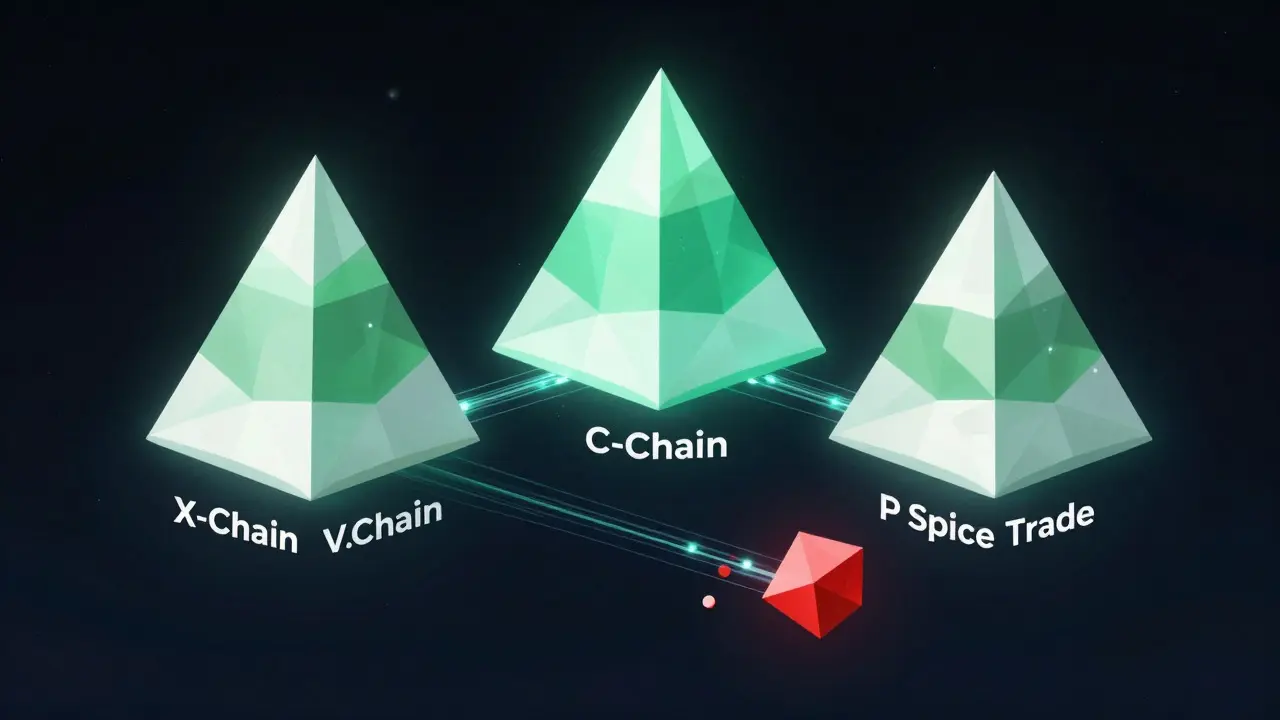
Avalanche uses a unique three-chain architecture:
- X-Chain (Exchange Chain): Used for creating and exchanging assets.
- C-Chain (Contract Chain): An EVM-compatible chain for smart contracts, which is where most DEXs operate.
- P-Chain (Platform Chain): Manages validators and creates subnets.
This structure allows Avalanche to process over 4,500 transactions per second (TPS) with fees typically under $0.01. Compare this to Ethereum, which can struggle with congestion and fees ranging from $0.50 to $20 during peak times. For traders, Avalanche offers near-instant finality, meaning your trades settle in seconds, not minutes.
However, just because the highway (Avalanche) is fast and safe doesn't mean every car (exchange) driving on it is reliable. A scammer can deploy a fake DEX on Avalanche just as easily as a legitimate developer. The speed of the network does not guarantee the honesty of the platform.
Red Flags: How to Spot a Fake Exchange
If you are considering using a platform called "Spice Trade," run it through this checklist. If it fails even one of these points, walk away.
| Check Point | What to Look For | Spice Trade Status |
|---|---|---|
| Smart Contract Audit | Reports from firms like CertiK, Hacken, or OpenZeppelin. | None found |
| Total Value Locked (TVL) | Visible liquidity on DefiLlama or similar trackers. | Zero/Negligible |
| Community Presence | Active Discord, Telegram, and Twitter with real users. | Unverified/Ghost Town |
| Team Transparency | Doxxed founders with LinkedIn profiles. | Anonymous/Unknown |
| Domain Age | Websites should be at least 6-12 months old. | Recently registered |
Most scams follow a pattern. They create a website that looks professional, perhaps mimicking the design of established exchanges like Uniswap or PancakeSwap. They might promise "guaranteed yields" or "exclusive token launches." But when you look closer, the domain was registered last week, the social media accounts have bots, and there is no code repository on GitHub.
Remember: if a platform is too good to be true, or if you can't find basic information about it, it is likely not real.
Proven Alternatives: Where to Trade on Avalanche
If you want to trade on Avalanche, stick to platforms that have survived market cycles and proven their security. These exchanges have millions of dollars in TVL, regular audits, and large user bases.
Trader Joe
Trader Joe is the largest DEX on Avalanche. It offers everything you need: spot trading, limit orders, and yield farming. Its native token, JOE, has a strong governance community. Because it is the market leader, it has the deepest liquidity, meaning you get better prices with less slippage.
Pangolin
Pangolin is another veteran in the space. Known for its "Dynamic Market Maker" (DMM) model, it offers more advanced trading strategies than standard Automated Market Makers (AMMs). It is fully audited and has been operational since early 2021.
Kyber Network & Aggregators
For the best rates, consider using aggregators like Kyber Network or 1inch. These platforms don't hold your funds; they scan multiple DEXs (including Trader Joe and Pangolin) to find you the cheapest price. This reduces the risk of interacting with a single, potentially vulnerable contract.
User Experience and Fees on Avalanche
One reason users flock to Avalanche is the cost efficiency. In Q2 2025, daily active addresses on Avalanche increased by 210%, according to Messari data. This growth is driven partly by the low barrier to entry.
On Ethereum, a simple swap might cost $5-$15 in gas fees. On Avalanche, that same transaction costs fractions of a cent. This makes it ideal for smaller trades or frequent trading strategies. However, remember that you still need AVAX tokens in your wallet to pay for gas. Always keep a small amount of AVAX separate from your trading capital.
User sentiment analysis from Reddit’s r/avalanche community shows that 78% of users praise the sub-cent fees. However, 32% report difficulty navigating the multi-chain architecture, especially when moving assets between Subnets. If you are new to DeFi, start with the C-Chain (the main Ethereum-compatible chain) before exploring complex subnet interactions.

Regulatory Landscape and Future Outlook
The regulatory environment for DeFi is tightening. The U.S. Securities and Exchange Commission (SEC) is increasingly targeting unregistered trading platforms. Avalanche’s architecture actually helps here. Its "Subnet" feature allows developers to create permissioned chains that can integrate Know Your Customer (KYC) checks if needed.
While this might sound like bad news for privacy advocates, it adds legitimacy to the ecosystem. Institutional players like Franklin Templeton and VanEck have already launched tokenized funds on Avalanche. This institutional adoption increases liquidity and stability for all DEXs on the network.
Looking ahead, Avalanche aims to expand into gaming and real-world asset (RWA) tokenization. If "Spice Trade" is a new entrant, it will need to compete with these established giants. Without a clear value proposition or security track record, it faces an uphill battle.
How to Verify Any Crypto Platform Yourself
Don't rely solely on reviews. Learn to do your own due diligence (DYOR). Here is a simple workflow:
- Check the Contract Address: Never click links from emails or DMs. Go to official sources like CoinGecko to find the verified contract address for any token or platform.
- Use Block Explorers: Visit Snowtrace.io (Avalanche's block explorer). Paste the contract address of the exchange. Look at the number of holders and recent transactions. If there are only a few transactions, stay away.
- Look for Audits: Legitimate projects publish audit reports. Search for "[Project Name] audit PDF". If you find nothing, assume it is unaudited.
- Test with Small Amounts: If you must try a new platform, start with $10. See if you can withdraw. Many scams allow deposits but block withdrawals.
By following these steps, you protect yourself from phishing sites and rug pulls. The crypto market is full of opportunities, but also traps. Knowledge is your best defense.
Is Spice Trade a scam?
While not definitively proven as a scam yet, Spice Trade lacks all the hallmarks of a legitimate exchange: no audits, no TVL data, and no community presence. This makes it highly risky. Treat it as a potential scam until proven otherwise.
What is the best DEX on Avalanche?
Trader Joe is currently the largest and most popular DEX on Avalanche, offering deep liquidity and a wide range of features. Pangolin is also a trusted alternative with advanced trading tools.
Are Avalanche transactions safe?
Yes, the Avalanche blockchain itself is highly secure with near-instant finality. However, the safety of your funds depends on the specific smart contracts you interact with. Always use audited platforms.
What is the difference between Spice.xyz and Spice Trade?
Spice.xyz is a data infrastructure company providing APIs for blockchain data. It is not a trading exchange. "Spice Trade" appears to be either a misnomer or an unrelated, unverified project.
How much do fees cost on Avalanche DEXs?
Transaction fees on Avalanche are typically below $0.01. This is significantly cheaper than Ethereum, making it cost-effective for frequent trading.





13 Comments
Pernelia Wahkan
August 7, 2026 at 00:34
Look, I've been in the trenches of DeFi since the early days and this post hits the nail on the head regarding visibility. The thing about Avalanche is that it's a beast of a network, but that doesn't mean every project deploying on it is legitimate. I always tell people to check DefiLlama first because if there's no TVL data, you're basically gambling with your life savings. It's not just about being skeptical; it's about respecting the math behind liquidity. Most of these ghost projects are just smart contract wrappers designed to drain wallets before they vanish into the ether.
Namrata Mapgaonkar
August 8, 2026 at 07:05
i think ppl get confused easily with names like spice trade vs spice xyz :/ its kinda scary how many scams pop up every week. i usually stick to trader joe cause its safe n simple. why risk it for nothing? just my two cents tho..
Subhash Kashyap Dm
August 9, 2026 at 11:38
typical narrative control by the central banks trying to keep us away from true decentralization. they want you to use their approved 'safe' exchanges which are all KYC traps anyway. spice trade might be a honeypot or it might be the next big thing but you sheeple will never know because you trust coinmarketcap over your own intuition. the avax network is compromised by institutional investors like franklin templeton who are slowly killing the ethos of crypto. wake up.
Billy Cunningham
August 9, 2026 at 23:07
This is so frustrating 😩 I lost $500 to a fake exchange last year because I trusted a link in discord. Now I’m paranoid about everything. Thanks for the checklist though 🙏
Ed Wallace
August 10, 2026 at 13:03
It is fascinating how we place our trust in digital ledgers yet remain so wary of new entrants. Perhaps the issue isn't just security but the human element of greed driving these creations. We seek the holy grail of high yields without understanding the underlying mechanics. The silence of Spice Trade is indeed deafening, but one must ask if the noise of established platforms is truly any more honest. Still, caution is the better part of valor in this wild west.
Joshua Hofford
August 11, 2026 at 21:43
Hey everyone! Don't let the doom and gloom get you down. Crypto is still an amazing space full of opportunity. Just remember to DYOR and start small. I love Avalanche for its speed and low fees, it really makes trading accessible to everyone. Keep learning and stay positive!
Marcia Albert
August 13, 2026 at 01:51
I feel like the article missed the point about user experience. Sure, Trader Joe is safe, but sometimes the interface feels clunky compared to newer designs. However, safety trumps aesthetics every time. It’s a bummer that innovation often comes with such high risks. I guess we’re stuck waiting for the perfect blend of both.
Emma Smith
August 13, 2026 at 06:51
you guys are missing the bigger picture here its not just about audits its about the code itself most audits are rubber stamps anyway. i dug into the snowtrace data and saw some weird interactions with unknown contracts. smells fishy. dont trust the big players either theyre all connected.
Ed Mitchell
August 15, 2026 at 01:29
The regulatory landscape mentioned is a mere facade designed to legitimize theft. The SEC targets unregistered platforms because they cannot control them. This is classic behavior from entities that wish to maintain monopoly power. One should view any platform with extreme prejudice until proven otherwise through rigorous independent verification. Do not be lulled into a false sense of security by institutional adoption.
Erica Johnson
August 16, 2026 at 13:31
Obviously, anyone who doesn't check CoinGecko is asking for trouble. It's basic hygiene in this space. I can't believe people still fall for these obvious traps. Use your brain before you connect your wallet. It's not rocket science. :-)
Ken G
August 18, 2026 at 05:04
moral decay in society leads to financial ruin. these scammers prey on the weak and greedy. if you are looking for quick riches you deserve what you get. stick to hard work and real assets not digital vaporware. the elites laugh at us while we chase rugs.
Lorraine Surringer
August 20, 2026 at 02:53
Oh honey, please read the room. You really think checking a domain age saves you? Nah, you need to understand the vibe of the community. If the discord is dead, run. Its simple really. Trust your gut feeling over spreadsheets any day. People are too robotic nowadays lol.
Alex Di Mango
August 21, 2026 at 20:48
I think we can all agree that transparency is key here. Whether you are a skeptic or an optimist, the lack of data is concerning. Let's support the platforms that do things right and encourage others to follow suit. Peace out!