
What is Maker (MKR) Crypto Coin? A Complete Guide to Governance, DAI, and Risks
Imagine owning a share in a bank, but instead of a CEO making decisions, thousands of people vote on every rule change. That is essentially what holding Maker (MKR) is about. It is not just another cryptocurrency you buy hoping it goes up; it is the key that unlocks control over one of the most important systems in decentralized finance: the Maker Protocol, which manages the DAI stablecoin.
If you are wondering why MKR exists, how it keeps its value, or whether it is worth your attention in 2026, this guide breaks it down without the jargon. We will look at how the system works, who actually controls it, and the real risks involved.
The Core Function: Governance and Stability
At its heart, Maker (MKR) is an ERC-20 token on the Ethereum blockchain. But calling it just a "token" misses the point. Its two main jobs are governance and recapitalization.
Think of MKR holders as the board of directors for a massive, automated financial institution. This institution is called MakerDAO, a decentralized autonomous organization. When you hold MKR, you get a say in how the protocol runs. You can vote on things like:
- Which assets can be used as collateral to borrow money.
- How much interest borrowers must pay (known as the Stability Fee).
- What rewards savers earn for locking up their DAI (the Dai Savings Rate).
Each MKR token equals one vote, but only if you lock it into a voting contract. This ensures that people with skin in the game make the decisions. If the system ever faces a shortfall-meaning there isn't enough collateral to cover the DAI that has been issued-the protocol can mint new MKR tokens and sell them to raise funds. This process, called recapitalization, protects the stability of DAI by spreading losses across MKR holders rather than letting the system collapse.
How Maker Creates DAI: The Vault System
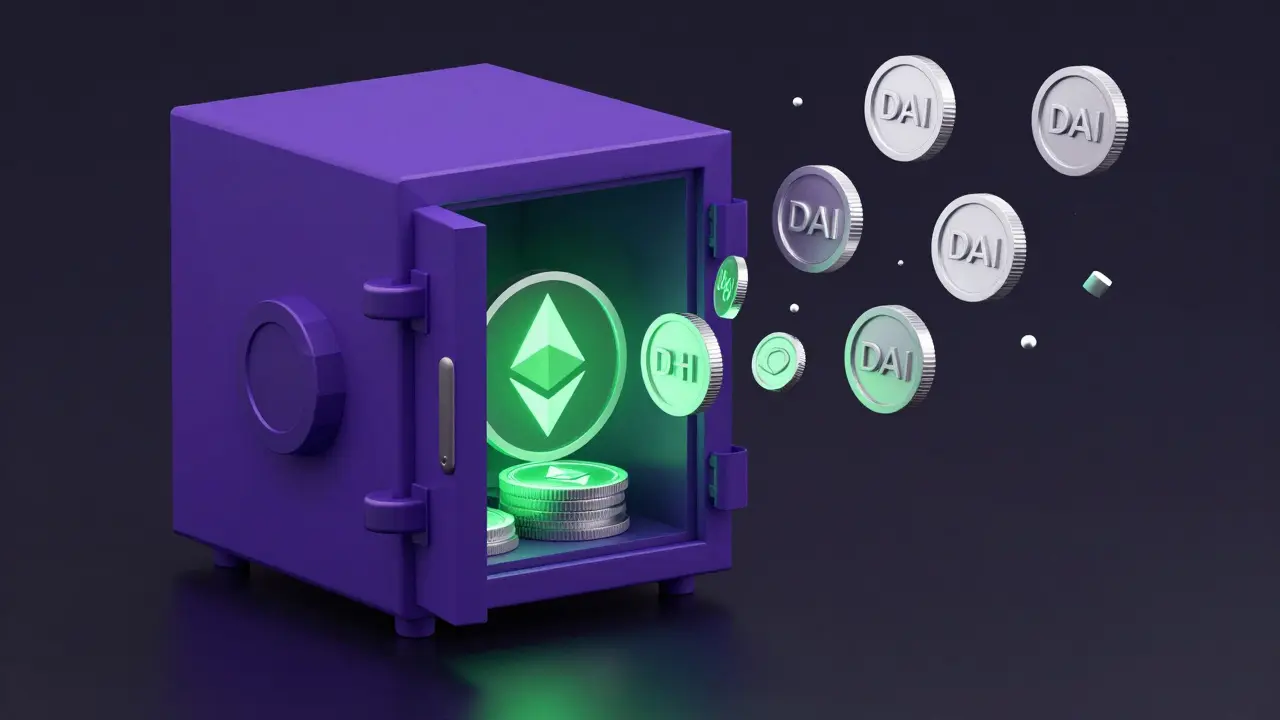
To understand MKR, you have to understand DAI, the USD-pegged stablecoin that the Maker Protocol generates. Unlike USDT or USDC, which are backed by cash reserves held by companies, DAI is backed by crypto assets locked in smart contracts.
Here is how it works in practice:
- A user opens a "vault" in the Maker Protocol.
- They deposit collateral, such as Ethereum (ETH), into the vault.
- They generate DAI against that collateral. For example, they might lock $150 worth of ETH to borrow $100 worth of DAI.
- As long as they keep enough collateral in the vault, they can keep the DAI. If they want their ETH back, they repay the DAI plus a small fee.
This system was originally launched in 2017 as Single-Collateral Dai (SAI), which only accepted ETH. Today, it has evolved into Multi-Collateral Dai (MCD), allowing various assets to be used as backing. This flexibility makes the system more robust, but it also requires careful management-which is where MKR voters come in.
| Feature | DAI (Maker Protocol) | USDT / USDC |
|---|---|---|
| Backing | Crypto collateral (over-collateralized) | Fiat currency reserves |
| Governance | Decentralized (MKR holders) | Centralized company |
| Transparency | On-chain, fully auditable | Periodic attestations |
| Risk Type | Smart contract & collateral volatility | Counterparty & regulatory risk |
Token Economics: Supply and Demand
MKR does not have a fixed supply like Bitcoin. Instead, its supply changes based on the health of the system. The maximum supply is capped at 1,000,000 tokens, but the circulating supply fluctuates.
When the Maker Protocol earns fees from borrowing DAI, it uses those earnings to buy back MKR from the market and burn it. This reduces the total supply, which can increase the value of remaining tokens. Conversely, if the system needs extra capital to stay solvent, it mints new MKR. As of mid-2026, the circulating supply hovers around 847,000 MKR, meaning a significant portion has already been burned or is held in reserve.
This dynamic supply mechanism aligns the interests of MKR holders with the success of the protocol. If DAI is widely used and the system is profitable, MKR becomes scarcer. If the system struggles, MKR holders absorb the cost through dilution. It is a high-stakes economic model designed to ensure long-term stability.
Market Performance and Price Volatility
Because MKR is tied to the broader DeFi ecosystem, its price is highly volatile. In June 2026, MKR trades around $1,300 USD. However, looking at its history gives context to its risk profile.
MKR hit an all-time high of over $6,200 during peak DeFi enthusiasm, but it has also dropped below $200 during market downturns. This wide range reflects its role as a governance asset rather than a simple currency. Investors often treat MKR like a stock in a tech company: its value depends on future growth, adoption, and the effectiveness of its governance.
Trading volume remains healthy, with major exchanges like Coinbase, Binance, and Uniswap offering deep liquidity. You can also manage MKR directly in wallets like MetaMask, making it easy to participate in governance or trade without relying on centralized custodians.
Who Should Care About MKR?
MKR is not for everyone. Here is who typically engages with it:
- DeFi Enthusiasts: Users who believe in censorship-resistant money and want to support decentralized infrastructure.
- Governance Participants: Individuals willing to research proposals and vote on critical protocol parameters.
- Long-Term Investors: Those betting on the continued growth of DAI and the Ethereum ecosystem.
If you are looking for quick flips or passive income without any responsibility, MKR might not fit your strategy. Holding MKR means accepting the role of a steward for a global financial system.
Risks and Considerations
No investment is risk-free, and MKR has specific challenges:
- Smart Contract Risk: Bugs in the code could lead to exploits, though the protocol has undergone extensive audits.
- Collateral Volatility: If the value of underlying assets crashes too fast, liquidations can become chaotic.
- Governance Failure: Poor voting decisions could destabilize DAI's peg.
- Ethereum Gas Fees: High network congestion can make voting or using vaults expensive.
Additionally, note that the project has announced a rebranding to "Sky" (SKY). While MKR remains tradable and functional, this transition indicates a shift in branding and possibly structure. Keep an eye on official announcements to understand how this affects your holdings.
Getting Started with MKR
If you decide to buy MKR, here are the basic steps:
- Set Up a Wallet: Use a reputable Ethereum wallet like MetaMask or a hardware wallet for security.
- Buy MKR: Purchase MKR from a major exchange like Coinbase or Binance, then transfer it to your personal wallet.
- Participate (Optional): Visit the MakerDAO governance portal to read active proposals and cast your votes by locking your tokens.
Remember, buying MKR is not just a financial transaction; it is an entry into a decentralized community responsible for maintaining one of the pillars of modern DeFi.
Is MKR a good investment in 2026?
Whether MKR is a good investment depends on your belief in the future of decentralized stablecoins. If you think DAI will continue to grow and compete with fiat-backed stablecoins, MKR benefits from increased usage and fee generation. However, its price is volatile, so it carries higher risk than traditional assets.
How do I vote with MKR?
To vote, you need to lock your MKR tokens in a designated voting contract via the MakerDAO governance interface. Each locked token represents one vote. Voting periods vary, and you must unlock your tokens after the period ends to use them again.
What happens if DAI loses its peg?
If DAI falls significantly below $1, the protocol may trigger emergency measures, including minting new MKR to raise capital. This dilutes existing MKR holders but aims to restore confidence and solvency in the system.
Can I lose my MKR if the protocol fails?
Yes. If the Maker Protocol suffers catastrophic failure or severe under-collateralization, the value of MKR could drop to near zero. Always invest only what you can afford to lose.
Is MKR the same as Sky (SKY)?
Not exactly. Sky is the new brand name for the Maker ecosystem. While MKR remains the current governance token, the transition to SKY involves structural changes. Check official channels for details on token swaps or dual-token operations.