What is Ratio1 (R1)? A Deep Dive into the Decentralized AI Compute Token
Have you ever wondered how artificial intelligence models run without relying on a single giant tech company’s servers? That question sits at the heart of Ratio1, also known by its ticker symbol R1. It is a cryptocurrency utility token that powers a decentralized network for executing AI workloads across independent edge nodes on the Base blockchain.
If you have been scrolling through crypto charts lately, you might have spotted R1. But unlike meme coins or simple payment tokens, Ratio1 tries to solve a very specific problem: giving developers and users access to computing power in a trustless way. In this guide, we break down what Ratio1 actually does, how its unique license system works, and whether it fits into your understanding of decentralized infrastructure.
The Core Concept: Decentralized AI Infrastructure
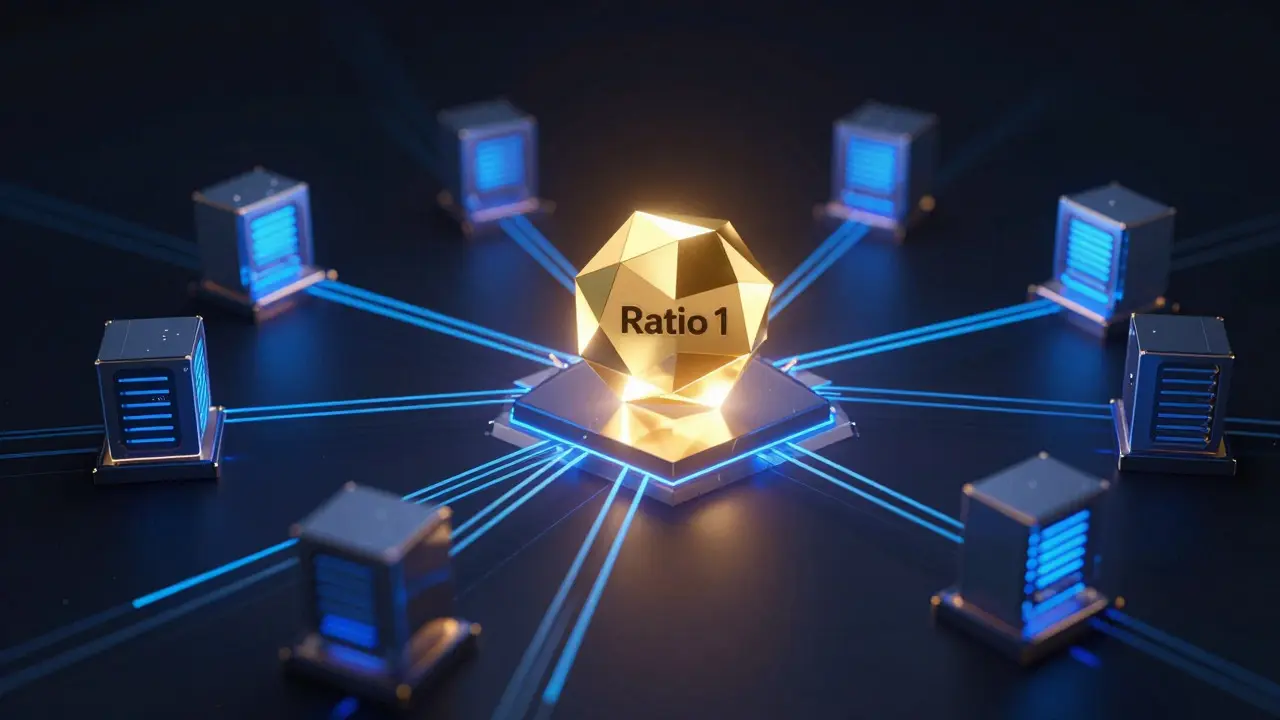
At its simplest level, Ratio1 Protocol is an "AI meta-operating system." This sounds technical, but the idea is straightforward. Traditional AI training and inference happen on centralized servers owned by big corporations. Ratio1 aims to change that by using a network of independently operated edge nodes. These are essentially computers with GPU resources contributed by individuals or small organizations.
The protocol runs on Base, which is an Ethereum Layer-2 network designed for lower transaction costs and faster confirmations. By building on Base, Ratio1 ensures that paying for compute services doesn't cost a fortune in gas fees. The R1 token acts as the fuel for this engine. You use R1 to pay for AI tasks, and node providers earn R1 when they contribute their hardware's processing power.
This setup creates a marketplace for computing power. Instead of renting from Amazon Web Services or Google Cloud, you can theoretically rent from a distributed network of global contributors. The key here is "trustless" execution. The blockchain verifies that the work was done correctly without you needing to trust the person running the server.
How the R1 Token Works
To understand the value proposition, you need to look at what the R1 token actually does. It is classified as a pure utility token. This means it is not a security, it does not represent ownership in a company, and it carries no promise of profit. Its job is strictly operational within the Ratio1 ecosystem.
Here are the primary functions of the R1 token:
- Compute Payments: Consumers pay in R1 to access AI inference, training, and storage services.
- Node Staking: Providers stake R1 to operate nodes and validate transactions.
- License Acquisition: Users spend R1 to buy Node Deeds (ND) which act as licenses to join the network.
- Protocol Fees: R1 covers coordination fees required to keep the network running smoothly.
- Governance: Holders can vote on future protocol upgrades and ecosystem proposals.
The supply mechanics are also quite distinct. The maximum supply of R1 is capped at exactly 161,803,398 tokens. This number isn't random; it is derived from the mathematical golden ratio (φ), approximately 1.618034. This branding choice ties the tokenomics to a well-known constant, emphasizing a fixed scarcity model rather than an arbitrary round number like 1 billion.
The License System: ND and MND Contracts
One of the most interesting aspects of Ratio1 is how it manages participation. It doesn't just let anyone spin up a node instantly. Instead, it uses a tiered license system built on smart contracts. This is where things get a bit more complex than standard staking.
There are two main types of licenses, both implemented as ERC-721 Non-Fungible Tokens (NFTs):
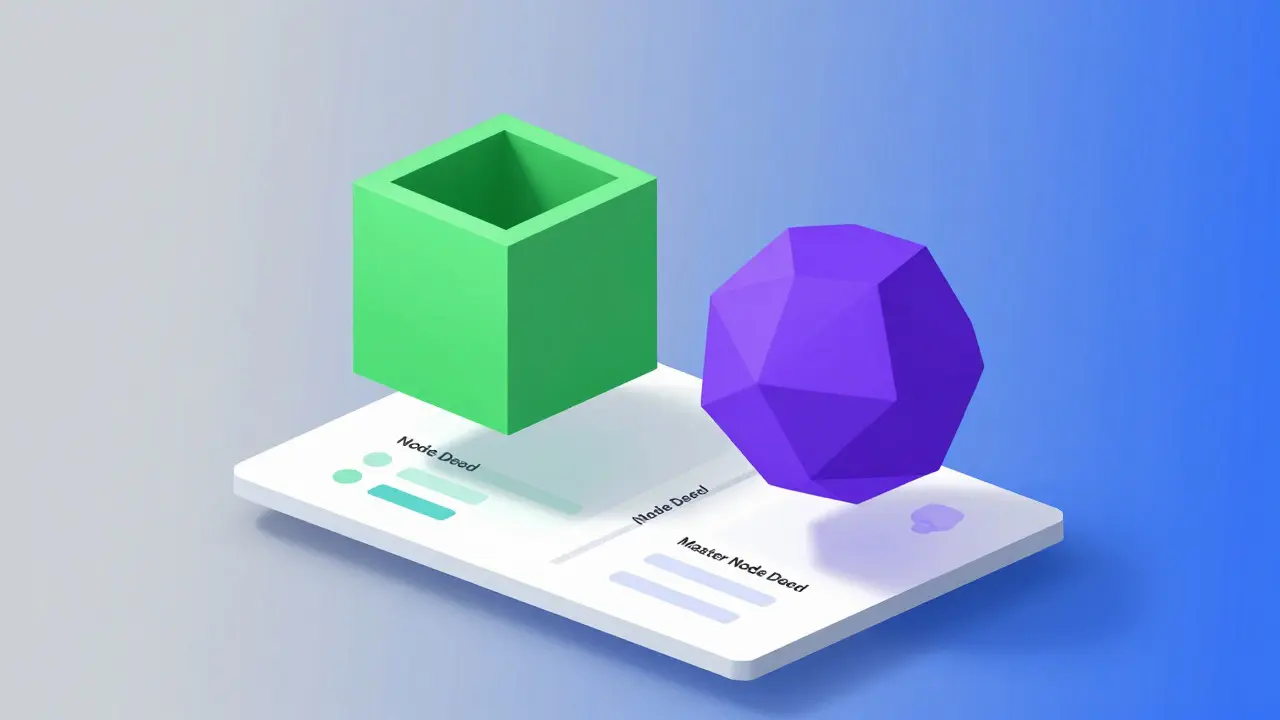
- Node Deeds (ND): These are public licenses managed by the NDContract. You acquire these to activate a standard compute node. They allow you to participate in the basic resource pool.
- Master Node Deeds (MND): These are managed by the MNDContract. Crucially, these are "soul-bound" tokens. This means they cannot be transferred or sold once assigned. They likely serve higher-level roles in the network hierarchy, ensuring accountability for master operators.
This structure creates a permissioned-but-open environment. You need the right digital keys (licenses) to unlock the ability to provide compute services. The R1 token is the currency used to acquire and maintain these licenses.
| Feature | Node Deed (ND) | Master Node Deed (MND) |
|---|---|---|
| Token Standard | ERC-721 NFT | ERC-721 Soul-Bound NFT |
| Transferable | Yes | No |
| Purpose | Activate standard compute nodes | High-level network roles/accountability |
| Acquisition Cost | Requires R1 tokens | Requires R1 tokens + Eligibility |
Consensus Mechanisms: PoA and PoAI
Most blockchains use Proof of Stake (PoS) or Proof of Work (PoW). Ratio1 introduces two specialized mechanisms tailored for AI workloads: Proof of Availability (PoA) and Proof of AI (PoAI).
Proof of Availability (PoA) checks if a node is online and properly licensed. It measures whether the hardware is ready to accept tasks. If your node goes offline, PoA detects it. This ensures the network only pays for active resources.
Proof of AI (PoAI) is the heavier lifter. It verifies that actual AI workloads were executed as claimed. This prevents lazy nodes from claiming rewards without doing the math. Together, these mechanisms tie token distribution directly to real-world compute services rather than just holding coins in a wallet. This approach aims to ensure fair rewards based on computational contributions.
Market Status and Price Context (Mid-2026)
When looking at any cryptocurrency, market data tells part of the story. As of mid-2026, Ratio1 remains a niche asset. It launched in May 2025, so it is still relatively young in crypto years.
Price volatility has been significant. In late July 2025, prices hovered around $1.50 to $1.80 depending on the exchange. By October 2025, some trackers showed a drop to roughly $1.22. However, by mid-2026, data from aggregators like Coingecko indicates a price closer to $0.41, with daily trading volumes under $1,000. This suggests low liquidity and high sensitivity to market sentiment.
The token ranks around #2286 among all cryptocurrencies by market capitalization, which places it firmly in the micro-cap category. It is listed on a handful of exchanges, including Binance and Crypto.com, as well as decentralized venues like Uniswap on Base. The limited number of markets means that large trades could impact the price significantly.

Risks and Considerations for Users
Before interacting with Ratio1, it is crucial to understand the risks. First, the smart contracts governing the protocol are non-upgradable. While this reduces governance risk (no one can secretly change the rules), it also means fixing bugs requires deploying entirely new contracts, which can be disruptive.
Second, the technical barrier to entry is high. Running a node requires familiarity with container orchestration (like Docker), GPU management, and interacting with ERC-721 contracts on Base. This is not a "set and forget" passive income scheme for beginners.
Third, regulatory clarity is still evolving. While Ratio1 positions R1 as a pure utility token with no voting rights for profits, regulators worldwide are scrutinizing AI and crypto intersections. Always do your own research and consult legal advice if investing significant capital.
Conclusion: Is Ratio1 Worth Your Attention?
Ratio1 represents an ambitious attempt to decentralize the backbone of artificial intelligence. By combining the Base blockchain with a unique license-based node system and dual-proof consensus, it offers a theoretical path toward trustless AI compute. For developers tired of centralized cloud monopolies, it provides an alternative architecture. For investors, it presents a high-risk, high-reward speculative play in the emerging AI-crypto sector.
Whether you are a node operator looking to monetize idle GPUs or a developer seeking decentralized inference, Ratio1 offers a functional prototype of what a distributed AI economy could look like. Just remember that the technology is still maturing, and the market remains volatile.
What is the maximum supply of R1 tokens?
The maximum supply of R1 is fixed at 161,803,398 tokens. This number is based on the mathematical golden ratio (φ) and cannot be increased.
Which blockchain does Ratio1 use?
Ratio1 operates on the Base blockchain, which is an Ethereum Layer-2 solution. This allows for lower transaction fees and faster processing compared to Ethereum mainnet.
Can I transfer Master Node Deeds (MND)?
No, Master Node Deeds are "soul-bound" ERC-721 tokens. Once assigned to a wallet, they cannot be transferred or sold to another address.
What is Proof of AI (PoAI)?
Proof of AI is a consensus mechanism used by Ratio1 to verify that actual AI workloads have been executed by a node. It ensures that rewards are paid only for completed computational tasks, preventing fraud.
Is R1 a security or a utility token?
Ratio1 officially defines R1 as a pure utility token. It is used for payments, staking, and governance within the protocol and does not represent ownership or carry profit-sharing rights.
Where can I buy R1 tokens?
R1 is available on several exchanges including Binance and Crypto.com, as well as decentralized exchanges like Uniswap on the Base network. Liquidity varies, so check current listings before trading.
Who founded Ratio1?
The team behind Ratio1 describes itself as a group of experienced software engineers. Individual founder names are not publicly highlighted, focusing attention on the technology brand rather than personalities.