
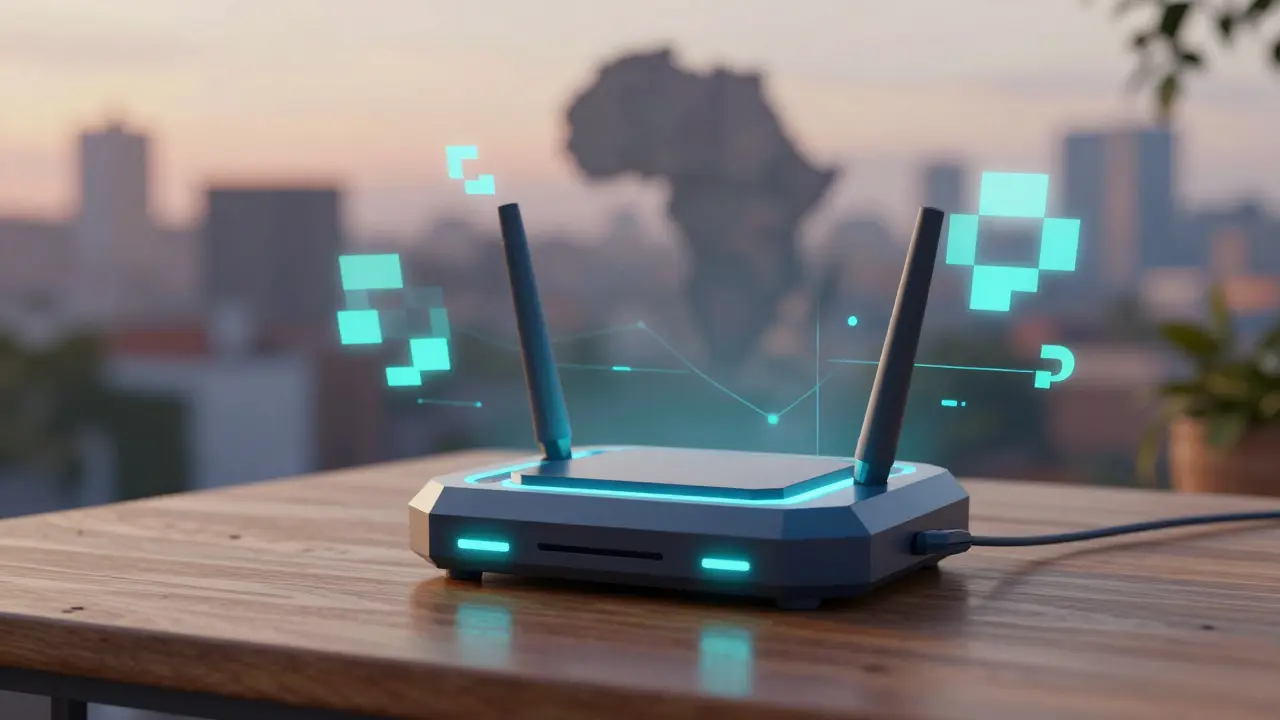
WNT Wicrypt NFT & Device Drop Airdrop: What Actually Happened and Why It Faded
Back in 2021, Wicrypt promised something simple: plug in a device, share your Wi-Fi, and get paid in WNT tokens. No complex trading. No guessing games. Just earn crypto by doing something you were already doing-using the internet. The hype was real. There were whispers of an WNT NFT & Device Drop airdrop, where early supporters would get both a physical router and a digital collectible. But here’s the truth: that airdrop never really happened the way people thought.
What Was the Wicrypt WNT Airdrop Supposed to Be?
Wicrypt wasn’t a typical crypto project. It didn’t just build a token. It built hardware. The idea was to create a decentralized Wi-Fi network where everyday people could rent out their unused bandwidth. You’d buy a Wicrypt device-priced at $99 at launch-for your home or office. Plug it in. Turn it on. And as others nearby connected to your network, you’d earn WNT tokens. It sounded like Helium, but for Wi-Fi instead of LoRaWAN. The “NFT & Device Drop” was marketed as a special early-access event. The promise? Buy a device, get a limited-edition NFT as a digital badge of honor. Some claimed the NFT would unlock future rewards or exclusive access to new features. But official documentation from Wicrypt’s Medium and website never clearly defined what the NFT actually did. Was it a membership pass? A collector’s item? A key to future airdrops? No one seemed to know. What we do know: the device drop happened. Thousands of units were shipped, mostly to Nigeria, Ghana, Kenya, and other parts of Africa where internet costs eat up a big chunk of monthly income. But the NFT component? It vanished after the initial announcement. No minting link. No wallet integration. No marketplace listing. By mid-2022, even the project’s own Telegram group stopped talking about it.How the WNT Token Was Actually Distributed
The real distribution of WNT tokens wasn’t through an airdrop. It was through a Token Generation Event (TGE) that ended on December 5, 2021. That’s when the token officially launched on Cardano’s OccamRazer launchpad. Investors who bought in during private sales got their tokens locked up for 36 months. Early community members who participated in pre-sales or referral programs received smaller allocations, but these weren’t free airdrops-they were purchases. There was no public claim page. No snapshot of wallet addresses. No “join our Discord and get 500 WNT” campaign. The only way to get WNT was to buy it during the TGE or later on decentralized exchanges like MEXC and BitMart. And even then, liquidity was thin. By early 2022, trading volume had dropped to near zero on most platforms. The NFTs? They were likely an afterthought. A marketing tactic to make the device drop feel more exclusive. But without clear utility, they became digital ghosts. No one minted them. No one traded them. No one even remembers what they looked like.The Device: Hardware That Never Took Off
The Wicrypt device itself was decently built. Dual-band Wi-Fi, gigabit Ethernet, ARM processor optimized for blockchain tasks. It looked like a sleek router you’d find in a tech store. But the problems started once people got them. Users in Lagos reported earning $3-$4 a day by sharing 200GB of bandwidth. That’s not bad in a country where the average monthly income is under $200. But the earnings weren’t steady. If your neighborhood had low internet demand, your device sat idle. If the power went out, you lost your earnings. And if your device overheated-common in tropical climates-it would reboot randomly, sometimes multiple times a day. Shipping delays were brutal. People waited 6 to 8 weeks just to get their router. Some never received theirs. Customer support on Telegram was fast, but they couldn’t fix logistics. Trustpilot reviews from 2021 show a 3.2/5 average, with 68% of negative reviews saying, “Not available in my country.” And here’s the kicker: Wicrypt never scaled beyond Africa. They didn’t launch in India, Brazil, or Indonesia-markets with even bigger internet affordability issues. Why? No clear marketing strategy. No partnerships with local ISPs. No government approvals outside Nigeria. The project looked like a local experiment, not a global network.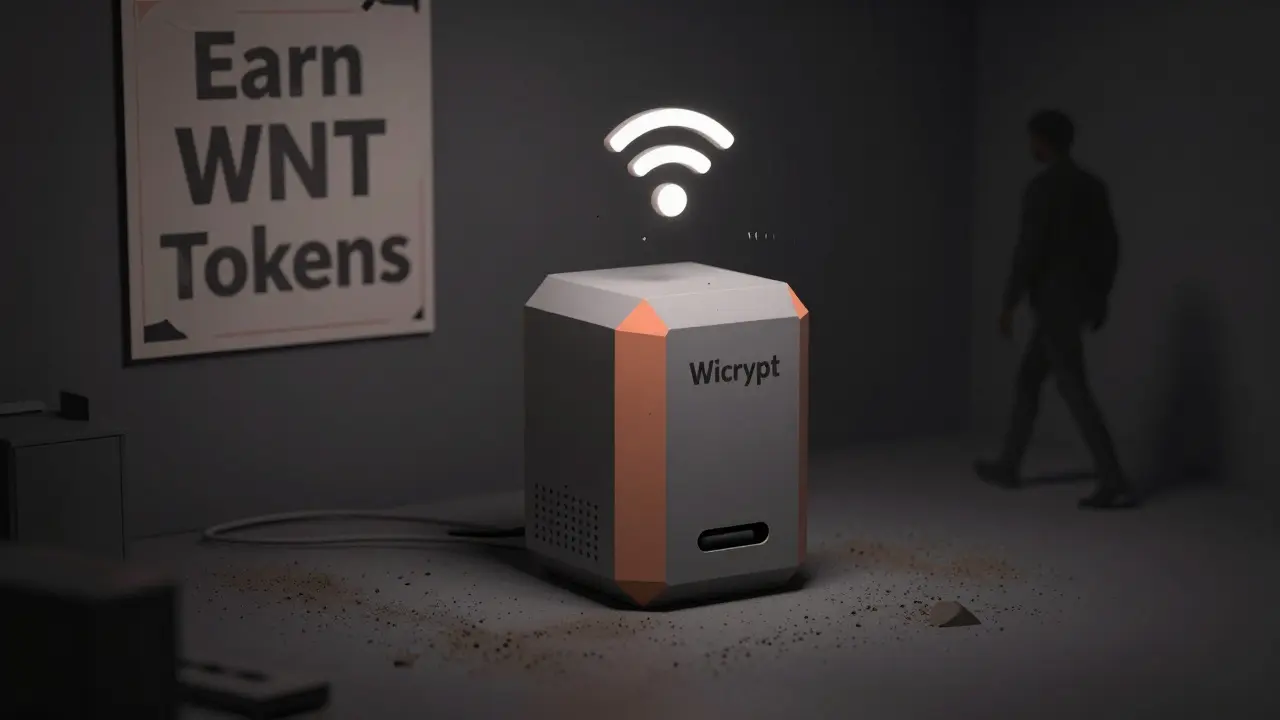
Why Wicrypt Died (And What It Teaches Us)
By March 2022, the last commit appeared on Wicrypt’s GitHub. The codebase froze. The Telegram group shrank from 8,500 members to under 1,200. The WNT token vanished from CoinGecko and CoinMarketCap by 2025. No trading. No updates. No roadmap. Why? Because hardware-dependent crypto projects are incredibly hard to scale. You need users to buy devices. You need them to keep them running. You need consistent demand for bandwidth. And you need to solve real-world problems like power outages, shipping delays, and local regulations. Helium succeeded because it targeted IoT sensors-low-cost, low-power, easy to deploy. Wicrypt tried to replace home internet. That’s a much harder sell. Why buy a $99 router when you can get unlimited data for $20 a month from your local provider? The NFT & Device Drop wasn’t a failure because of bad tech. It failed because the team misunderstood what users actually wanted. People didn’t want to become internet providers. They wanted cheap, reliable internet. Wicrypt gave them a device that turned them into miners-not users.What Happened to the WNT Tokens and NFTs Today?
The WNT token still exists on the Cardano blockchain, but no exchange lists it. You can still find the contract address, but no one’s buying. The NFTs? They were never minted properly. No one can prove ownership. No marketplace supports them. They’re digital artifacts with no value. If you bought a Wicrypt device in 2021, you might still have it sitting in a drawer. It still connects to Wi-Fi. But it doesn’t earn anything anymore. The network is dead.
Could This Ever Come Back?
Unlikely. The team has gone quiet. No announcements. No new hires. No funding rounds. The crypto world moves fast. Projects that stall for over two years are considered dead. But the problem Wicrypt tried to solve? Still real. In Nigeria, 7.3% of monthly income still goes to internet access. In India, rural broadband is still unreliable. The idea of decentralized Wi-Fi isn’t dead-it just needs a better team, better funding, and a real go-to-market plan. Wicrypt’s story isn’t about a failed airdrop. It’s about how even the most practical crypto ideas can collapse under the weight of poor execution. No amount of NFT hype can fix a broken product.What You Should Do Now
If you’re looking for a way to earn crypto by sharing bandwidth, skip Wicrypt. It’s gone. There are other projects trying the same thing-like Helium, which still has over 1 million hotspots active. Or newer ones like HiveOn or Sia, which focus on decentralized storage and networking. But even those are risky. Hardware-based crypto projects have a 70% failure rate within 18 months, according to Messari’s 2023 report. Don’t chase nostalgia. Don’t buy old devices off eBay hoping they’ll “wake up.” Don’t trust NFTs from dead projects. If it’s not on a live network with active users and transparent earnings, it’s not worth your time. The lesson? If a crypto project asks you to buy hardware before you understand how the network actually works, walk away. Real value comes from utility-not tokens, not NFTs, not airdrops. It comes from solving a problem people will pay for every month.Did Wicrypt actually do an NFT airdrop?
No, Wicrypt never executed a real NFT airdrop. While the project promoted an "NFT & Device Drop" in 2021, no NFTs were ever minted, listed, or assigned utility. The concept was abandoned after the initial marketing phase, and no wallet addresses were ever linked to NFT claims. Only the physical devices were shipped to buyers.
Can I still earn WNT tokens today?
No. The Wicrypt network shut down in 2022. The WNT token is no longer traded on any major exchange, and the devices no longer connect to a live blockchain network. Even if you still have your device, it won’t generate any earnings. The servers that tracked bandwidth usage and distributed rewards were taken offline.
Was the Wicrypt device worth the $99 price?
For a small number of users in Nigeria and Ghana, yes-for a short time. Some reported earning $3-$4 daily in late 2021 by sharing bandwidth. But earnings dropped as demand stabilized, and many users faced device overheating, frequent reboots, and long shipping delays. By 2022, the network was no longer profitable. The device had no resale value after the network died.
Why did Wicrypt fail when Helium succeeded?
Helium targeted IoT sensors, which are cheap, low-power, and easy to deploy at scale. Wicrypt required users to buy a $99 router and share their home internet-something most people don’t want to do. Helium had a global marketing push and partnerships with major hardware makers. Wicrypt stayed focused on Africa without scaling beyond it. Helium also had a clear token utility (network rewards). Wicrypt’s token had no clear use case beyond speculation.
Is there any way to recover my WNT tokens or NFTs?
No. The Wicrypt network is inactive, and there is no official recovery process. The WNT token contract still exists on Cardano, but it has no liquidity or active users. The NFTs were never minted properly, so there’s nothing to recover. Any websites or Telegram groups claiming to help you reclaim tokens are scams.



22 Comments
Sally Valdez
December 17, 2025 at 04:54
Wow so the whole NFT thing was just a scammy marketing gimmick? Of course it was. Crypto always promises the moon then delivers a brick wrapped in blockchain hype. 🤡
Sean Kerr
December 18, 2025 at 16:01
I bought one of those routers... still sitting in my closet. I thought I was getting in on the ground floor. Turns out I just bought a very expensive paperweight. 😔
Jonny Cena
December 19, 2025 at 02:32
Honestly, I feel bad for the people in Nigeria and Ghana who actually used these devices. They weren't chasing crypto dreams-they just wanted to make a few bucks off their internet. The system failed them, not the idea.
Florence Maail
December 20, 2025 at 09:19
This was all a CIA op to track bandwidth usage in Africa. They needed data on internet consumption patterns. The NFTs? Just a cover. The devices were listening devices. I told you all this back in 2021. No one listened. 😏
Dionne Wilkinson
December 20, 2025 at 21:31
It’s sad when a project with real potential gets lost in the noise. The idea of sharing bandwidth to earn crypto wasn’t crazy. It just needed patience, transparency, and real community building. Instead, they chased hype and vanished.
Timothy Slazyk
December 21, 2025 at 00:06
The real failure here isn’t the tech-it’s the belief that crypto can solve infrastructure problems without government, utility, or regulatory buy-in. You can’t decentralize something that needs centralized power, licensing, and maintenance. This was always doomed.
Emma Sherwood
December 22, 2025 at 11:02
In India, we see this all the time. Foreign projects come in with flashy white papers, promise to ‘empower the masses,’ ship hardware that overheats in 35°C heat, then vanish. The real solution? Local ISPs with subsidies-not $99 routers from a startup that can’t even run a Discord server.
Heather Turnbow
December 22, 2025 at 23:09
I appreciate the thorough breakdown of what went wrong. It’s rare to see such a balanced, evidence-based critique of a crypto project. The lack of clarity around the NFT’s utility was a red flag from the start. Transparency isn’t optional-it’s foundational.
Madhavi Shyam
December 23, 2025 at 14:36
Wicrypt’s model was fundamentally flawed. Bandwidth arbitrage only works if there’s demand elasticity. In markets where data is expensive, users don’t want to *share* their connection-they want to *own* it. The economics didn’t align.
Rebecca Kotnik
December 25, 2025 at 14:01
The notion that NFTs could serve as membership passes or keys to future utility without any technical integration or documentation is emblematic of a broader failure in crypto product design. Utility must be embedded, not implied. This was theater, not technology.
Jesse Messiah
December 27, 2025 at 03:52
I still think the hardware was solid. I mean, the specs were legit. It’s just that no one told users how to actually make money from it. If they’d made a simple dashboard with real-time earnings, maybe it would’ve worked. But nope. Just silence.
Greg Knapp
December 27, 2025 at 07:55
I got my device in 2022 and it kept rebooting every time it rained. I called support and they sent me a meme. That’s when I knew it was over. The whole thing was a joke. You people still believe in this?
Chevy Guy
December 27, 2025 at 18:48
They didn’t fail because of bad tech. They failed because they didn’t bribe the right Nigerian officials. Every crypto project that works in Africa has a backdoor deal with a telecom regulator. Wicrypt was too pure for this world.
Kayla Murphy
December 29, 2025 at 02:02
Don’t give up on the idea. Decentralized Wi-Fi is still the future. Just need the right team. One that listens. One that ships updates. One that doesn’t ghost its community. I’m still watching. Someone will do it right.
Amy Copeland
December 30, 2025 at 23:51
Oh please. You’re all acting like this was some noble experiment. People bought these devices because they thought they’d get rich. Not because they cared about decentralization. The NFTs were the bait. The router was the hook. And now we’re all just fish in the trash bin.
Cheyenne Cotter
January 1, 2026 at 10:30
I remember when they said you could earn $10/day. I quit my part-time job to run two routers. I made $1.50 total. Then my device died. No warranty. No refund. No apology. Just a bot reply in Telegram. That’s the whole story.
Sue Bumgarner
January 3, 2026 at 06:09
America doesn’t need this. Africa needs this. Why are we even talking about this like it’s a failure? It worked for the people who needed it. The fact that Americans got mad they didn’t get rich means the whole project was doomed from the start.
Samantha West
January 4, 2026 at 04:18
The most tragic part isn’t the dead network-it’s that the people who trusted this project the most were the ones least equipped to understand blockchain, smart contracts, or tokenomics. They were sold a dream using language they couldn’t decode. That’s not innovation. That’s exploitation.
Elvis Lam
January 4, 2026 at 04:57
If you want to earn crypto from bandwidth, try Helium. They’ve got 1M+ hotspots. Real data. Real rewards. Real community. Wicrypt was a glorified Kickstarter campaign that forgot to deliver. Don’t waste your time on ghosts.
Terrance Alan
January 4, 2026 at 13:00
Everyone’s acting surprised. Of course it failed. Crypto projects that require you to buy hardware are 99% scams. The only people who profit are the ones who sell you the hardware. The rest? Just noise.
Mark Cook
January 4, 2026 at 21:20
I still have my WNT tokens. They’re worth $0.0001 each. But I keep them as a reminder. Don’t believe the hype. Don’t trust the NFTs. Don’t buy the router. Just watch.
George Cheetham
January 5, 2026 at 09:51
There’s a quiet beauty in how this story unfolded. A team tried to solve a real problem. They stumbled. They vanished. But the problem remains. And perhaps, someday, someone will return-not with NFTs or hype-but with humility, patience, and a real plan.