Block Reward Comparison Across Blockchains: A 2026 Guide
Ever wondered why some miners get rich while others barely cover their electricity bill? It often comes down to one critical number: the block reward. This is the cryptocurrency payout you receive for successfully validating transactions and adding a new block to the chain. It’s not just a random gift; it’s the engine that keeps networks secure and decentralized. But here’s the catch-these rewards vary wildly from one blockchain to another. Some shrink every few years, others stay flat forever, and a few are designed specifically to keep big industrial miners out.
If you’re looking at mining profitability or trying to understand tokenomics, comparing block rewards across major chains is essential. You need to know what you’re actually getting paid, how often it changes, and whether your hardware can even compete. Let’s break down the current landscape as of late 2026, looking at the heavy hitters like Bitcoin and the niche players keeping decentralization alive.
The Bitcoin Standard and Its Halving Cycle
You can’t talk about block rewards without starting with Bitcoin. Created by Satoshi Nakamoto in 2009, it set the template everyone else followed. The original reward was 50 BTC per block. Today, following the fourth halving in April 2024, that number sits at 3.125 BTC per block. That’s a massive drop, but it’s by design. Bitcoin halves its reward every 210,000 blocks, which takes roughly four years. The next cut will bring it down to 1.5625 BTC around 2028.
Why does this matter to you? Because scarcity drives value. As the reward shrinks, the inflation rate of Bitcoin drops below that of most fiat currencies. But for miners, it means you need more efficient hardware or cheaper power to stay profitable. Bitcoin uses the SHA-256 algorithm, which basically requires specialized ASIC machines. Trying to mine Bitcoin on a laptop today is like trying to race a Formula 1 car against a bicycle-you’ll move, but you won’t win.
Proof-of-Work Alternatives: The ASIC vs. GPU Divide
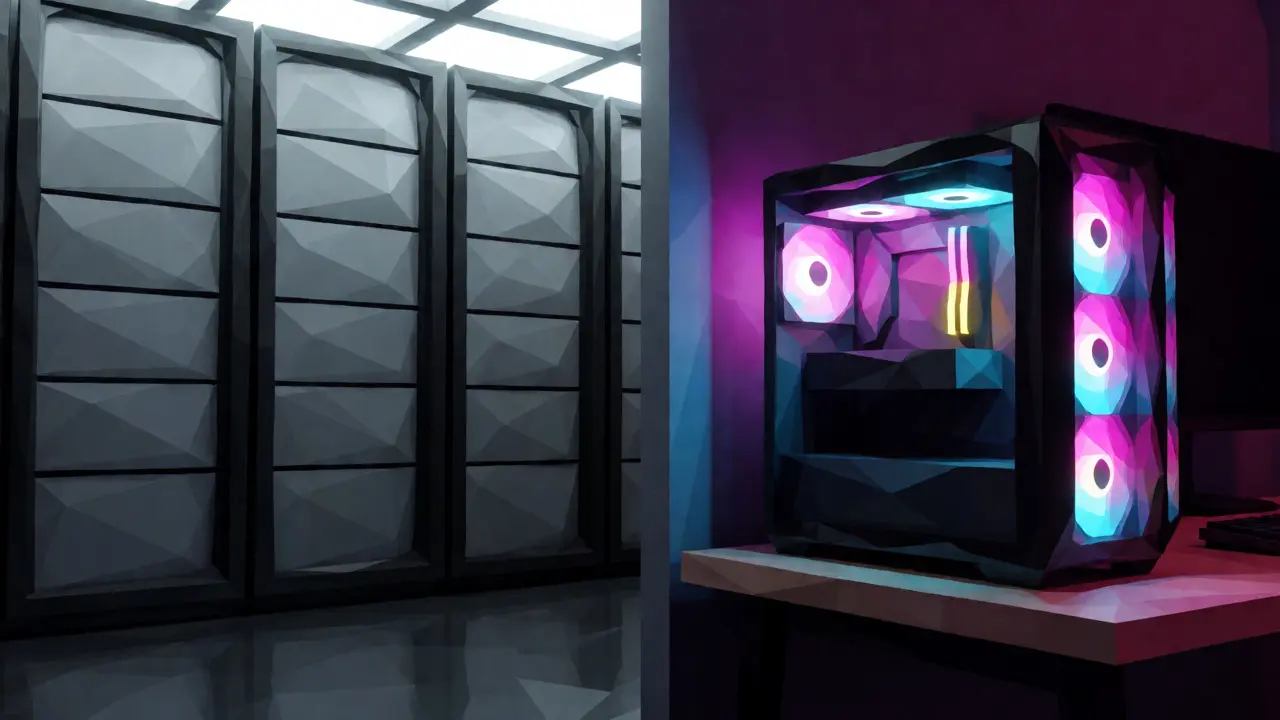
Not every blockchain wants to be dominated by billion-dollar mining farms. Many projects deliberately choose algorithms that resist ASICs, allowing regular people with gaming PCs to participate. This creates a different economic dynamic where block rewards might look smaller in absolute terms, but the competition is less fierce.
Monero (XMR) is the king of privacy coins and ASIC resistance. It currently pays out approximately 0.6046 XMR per block. Monero uses the RandomX algorithm, which is optimized for general-purpose CPUs. If you have a decent home server or a high-end desktop, you can mine Monero. The reward structure includes a "tail emission," meaning the reward never hits zero. Instead, it settles into a tiny, constant amount to incentivize miners indefinitely after the main supply is mined. This ensures network security doesn’t rely solely on transaction fees.
Then there’s Kaspa (KAS), which has gained huge traction recently. Kaspa isn’t a traditional blockchain; it uses a blockDAG architecture that allows for much faster block times. Currently, it offers around 166 KAS per block. Because the blocks come so fast, the annualized issuance rate is high, but the network aims for scalability. Kaspa uses KHeavyHash, which is ASIC-friendly now, but its rapid growth has made it a favorite for those seeking higher volatility and potential upside compared to established giants.
Legacy Chains and Stable Issuance Models
Some older cryptocurrencies stick to simpler models. Litecoin (LTC), often called the silver to Bitcoin’s gold, currently provides 6.25 LTC per block. Like Bitcoin, Litecoin follows a halving schedule, having started at 50 LTC. It uses the Scrypt algorithm. While ASICs dominate Litecoin mining now, the barrier to entry is slightly lower than Bitcoin because Scrypt ASICs are generally cheaper and more available.
Dogecoin (DOGE) takes a completely different approach. It doesn’t have a cap on total supply, nor does it halve. Dogecoin pays a flat 10,000 DOGE per block. This infinite supply model keeps miner incentives strong over time, ensuring the network remains secure without relying entirely on transaction fees. Since Dogecoin shares its algorithm (Scrypt) with Litecoin, they are often merged-mined. This means if you mine Litecoin, you can also earn Dogecoin simultaneously without extra energy costs, effectively boosting your daily income.
Ethereum Classic (ETC) survived the Great Split and continues to operate on Proof-of-Work. It distributes about 2.048 ETC per block. ETC uses the Etchash algorithm, which is designed to be resistant to certain types of ASICs, though dedicated hardware exists. For GPU miners who didn’t want to switch to Ethereum’s Proof-of-Stake transition back in 2022, ETC became a primary destination. Its reward schedule is similar to Bitcoin’s, with halvings reducing the payout over time.
Niche Players and High-Reward Networks
If you’re hunting for specific use cases, you’ll find unique reward structures in the niche sectors. Zcash (ZEC) focuses on shielded transactions. It currently offers 1.5625 ZEC per block. Zcash uses Equihash, an algorithm that was once popular for GPUs but has seen increased ASIC adoption. The reward here supports both transparent and private transactions, making it crucial for users who prioritize financial confidentiality.
Ravencoin (RVN) is built for asset transfer. It pays out a hefty 2,500 RVN per block. Ravencoin uses the KAWPOW algorithm, which is explicitly ASIC-resistant. This makes it a go-to coin for hobbyist miners with consumer-grade graphics cards. The high numerical reward reflects the token’s lower individual price point, but it keeps the network decentralized by preventing large industrial players from monopolizing hash power.
Consider Grin (GRIN), a newer project focused on simplicity and scalability. It pays 60 GRIN per block using Cuckatoo and Cuckaroo algorithms. Grin’s reward structure is designed to be sustainable long-term, avoiding the extreme deflationary pressure of Bitcoin. Similarly, Vertcoin (VTC) offers 12.50 VTC per block and prides itself on being "the people’s coin," using Lyra2REv3 to ensure CPU/GPU accessibility.
Profitability Reality Check
High block rewards don’t always mean high profits. You have to factor in difficulty, electricity costs, and token price. Here’s a snapshot of how these numbers translate in practice as of 2026:
| Blockchain | Current Block Reward | Algorithm | Hardware Type | Est. Daily Profit* |
|---|---|---|---|---|
| Bitcoin | 3.125 BTC | SHA-256 | ASIC | $8.90 - $12.00 |
| Monero | 0.6046 XMR | RandomX | CPU/GPU | $1.50 - $3.00 |
| Litecoin | 6.25 LTC | Scrypt | ASIC | $2.00 - $4.50 |
| Dogecoin | 10,000 DOGE | Scrypt | ASIC | Bundled with LTC |
| Kaspa | ~166 KAS | KHeavyHash | ASIC/GPU | $5.00 - $15.00 |
| Ravencoin | 2,500 RVN | KAWPOW | GPU | $0.80 - $1.50 |
*Profits assume $0.10/kWh electricity cost and average market prices. Actual results vary significantly based on hardware efficiency and local rates.
Notice that Bitcoin yields the highest dollar profit per machine, but the upfront cost for an Antminer S19 or newer is substantial. In contrast, mining Ravencoin on a mid-range GPU rig might yield pennies, but the entry cost is low. If you already own a gaming PC, mining Monero or Vertcoin is practically free money, provided your electricity isn’t too expensive.
The Role of Transaction Fees
Here’s a trend you can’t ignore: as block rewards decrease, transaction fees become the primary source of miner revenue. On Bitcoin, fees have occasionally spiked to match or exceed the block subsidy during congestion periods. On Ethereum Classic and other PoW chains, fees are growing in importance as subsidies shrink.
This shift changes the game. Miners aren’t just rewarded for securing the network; they’re rewarded for processing demand. If a blockchain becomes widely used for DeFi or NFTs, the fee revenue can sustain miners even when the block reward is near zero. This is why some analysts argue that Bitcoin’s eventual end-game relies on a robust ecosystem of applications driving up transaction volume.
Choosing Your Mining Path
So, where should you put your effort? If you have access to cheap industrial power and capital, Bitcoin and Litecoin remain the safest bets for stable returns. Their networks are mature, liquid, and widely recognized. However, if you’re a hobbyist with a gaming rig, look at ASIC-resistant coins like Monero, Ravencoin, or Vertcoin. These allow you to participate in the network without competing directly against multi-million dollar mining farms.
Keep an eye on emerging tech like Kaspa. Its speed and novel architecture offer high-risk, high-reward opportunities. Just remember, block rewards are only part of the equation. Network difficulty adjusts dynamically to keep block times consistent. If everyone rushes to mine a new coin, the reward per miner drops instantly. Diversification is key. Don’t put all your eggs in one basket-or rather, one algorithm.
What happens to miners when the block reward reaches zero?
Miners continue to earn compensation through transaction fees paid by users sending transactions on the network. For Bitcoin, this is estimated to happen around the year 2140. Until then, the mix of subsidy and fees sustains the network. Other coins like Monero have a "tail emission" that never fully stops, providing a small ongoing subsidy alongside fees.
Why do some blockchains have higher block rewards than others?
It depends on the token’s unit price and supply strategy. Coins like Dogecoin or ECASH have very low individual token values, so they issue millions of units per block to maintain meaningful economic incentives. Conversely, Bitcoin has a high unit value, so it issues fewer whole coins. The goal is to balance inflation control with sufficient miner motivation.
Can I mine Bitcoin with a normal computer?
Technically yes, but you would likely spend more on electricity than you earn in Bitcoin. Bitcoin mining is dominated by specialized ASIC hardware that performs trillions of calculations per second. A standard CPU or GPU is orders of magnitude slower, making solo mining impractical for beginners unless you join a pool and accept negligible earnings.
How often do block rewards change?
For Bitcoin and Litecoin, rewards halve approximately every four years (every 210,000 blocks). For Monero, the reward decreases gradually via a tail emission formula. For coins like Dogecoin, the reward is fixed and does not change over time. Always check the specific protocol documentation for each cryptocurrency you intend to mine.
Is mining still profitable in 2026?
Yes, but margins are tighter. Profitability depends heavily on your electricity rate. If you pay under $0.08 per kWh, you can still make a profit on many coins. Above $0.15 per kWh, only highly efficient ASIC rigs on major networks like Bitcoin or Litecoin tend to break even. Always calculate your net profit after electricity costs before investing in hardware.