
Crypto Asset Service Provider Licensing in EU: MiCA Requirements and Real-World Challenges
When the EU's Markets in Crypto-Assets Regulation (MiCA) took full effect on December 30, 2024, it didn't just change the rules - it rewrote the entire game for crypto businesses operating in Europe. No longer could a firm set up shop in one country and hope to slip through the cracks elsewhere. Now, if you're offering crypto services to EU residents, you need a Crypto Asset Service Provider (CASP) license. And getting one isn't just a paperwork exercise - it's a full organizational overhaul.
What Exactly Is a CASP?
A CASP is any legal entity that provides one or more crypto services on a professional basis. This includes custody, trading platforms, exchanging crypto for euros or dollars, giving investment advice, and even placing new crypto tokens with investors. The definition is broad, but the requirements are precise. You can't just call yourself a crypto exchange and start operating. You need formal authorization from a National Competent Authority (NCA) in an EU member state.The key shift? Passporting. Once you're licensed in one EU country - say, France or Germany - you can offer services across all 27 member states. No more applying for separate licenses in Spain, Italy, and Poland. That’s the big win. But the catch? The bar to get that first license is extremely high.
The Five Must-Have Requirements
Getting licensed under MiCA isn’t optional compliance - it’s mandatory. Here’s what every applicant must deliver:- EU-based registered office: Your legal headquarters must be physically located in the EU. Remote directors or offshore registration won’t cut it.
- At least one EU-resident director: Someone with real authority must live in the country where you apply. This isn’t a figurehead role - they’re legally accountable.
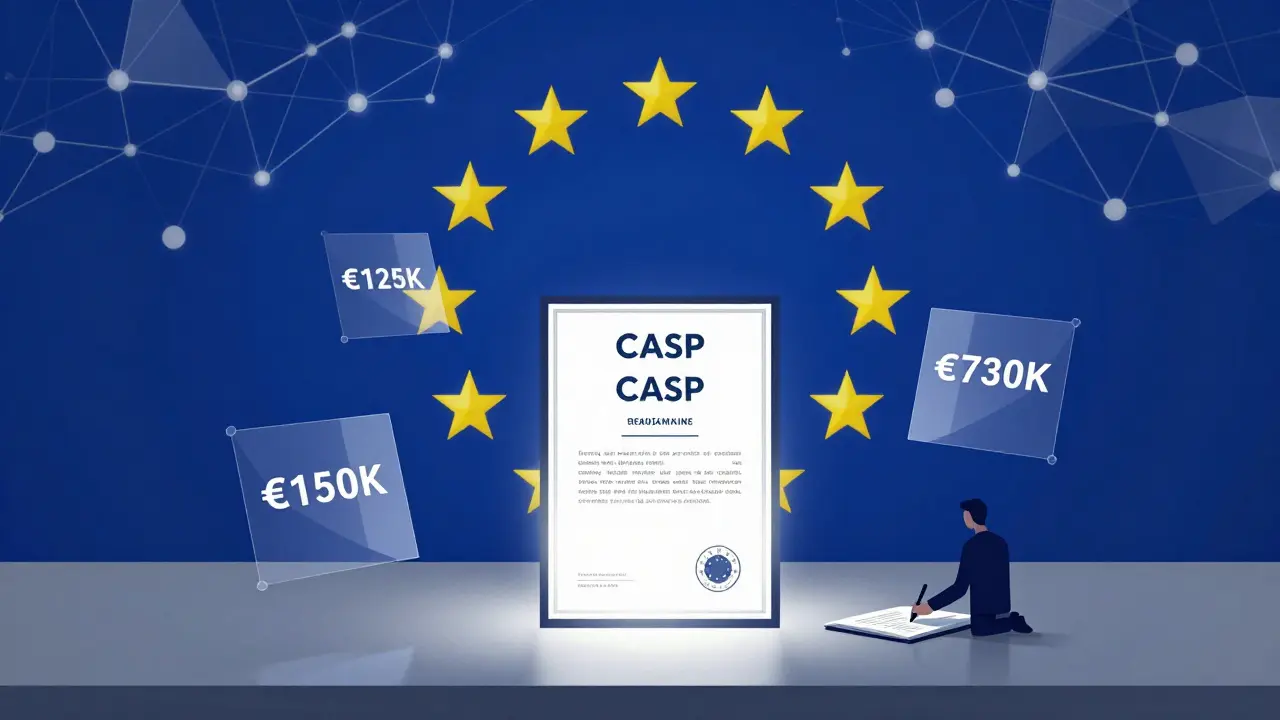
- Minimum capital: You need €125,000 if you only custody assets, €150,000 for fiat-crypto exchanges, and €730,000 if you run a trading platform. These aren’t suggestions - regulators verify bank statements before approving anything.
- Full AML/KYC compliance: You must follow the EU’s 6th Anti-Money Laundering Directive. That means real-time transaction monitoring, customer due diligence on all users, and reporting suspicious activity within 24 hours.
- Environmental impact reporting: This is new. If you use proof-of-work, you must publicly disclose your energy consumption. Even proof-of-stake firms must report on infrastructure power usage. The EU’s Blockchain Observatory method is the only accepted standard.
These aren’t just checkboxes. Regulators like France’s AMF and Germany’s BaFin are cross-checking every claim. One firm in Estonia got rejected because their director’s residency proof showed they only lived in the country for 90 days per year - not enough to qualify.
Significant CASPs: The Extra Layer
If your service reaches 15 million EU users on average per year, you’re labeled a significant CASP (sCASP). That triggers a whole new set of rules:- Quarterly stress tests
- Annual third-party audits by approved firms
- Real-time transaction monitoring systems
- Direct reporting to ESMA, not just your national regulator
This isn’t about size alone - it’s about systemic risk. Kraken, Bitstamp, and Coinbase fall into this category. But even smaller firms can get flagged if they hit the 15M threshold unexpectedly. One DeFi wallet provider in Lithuania got classified as an sCASP after a single token launch brought in 18 million users in three months. They weren’t ready. Their license was suspended for six months.
Who’s Applying - And Who’s Struggling
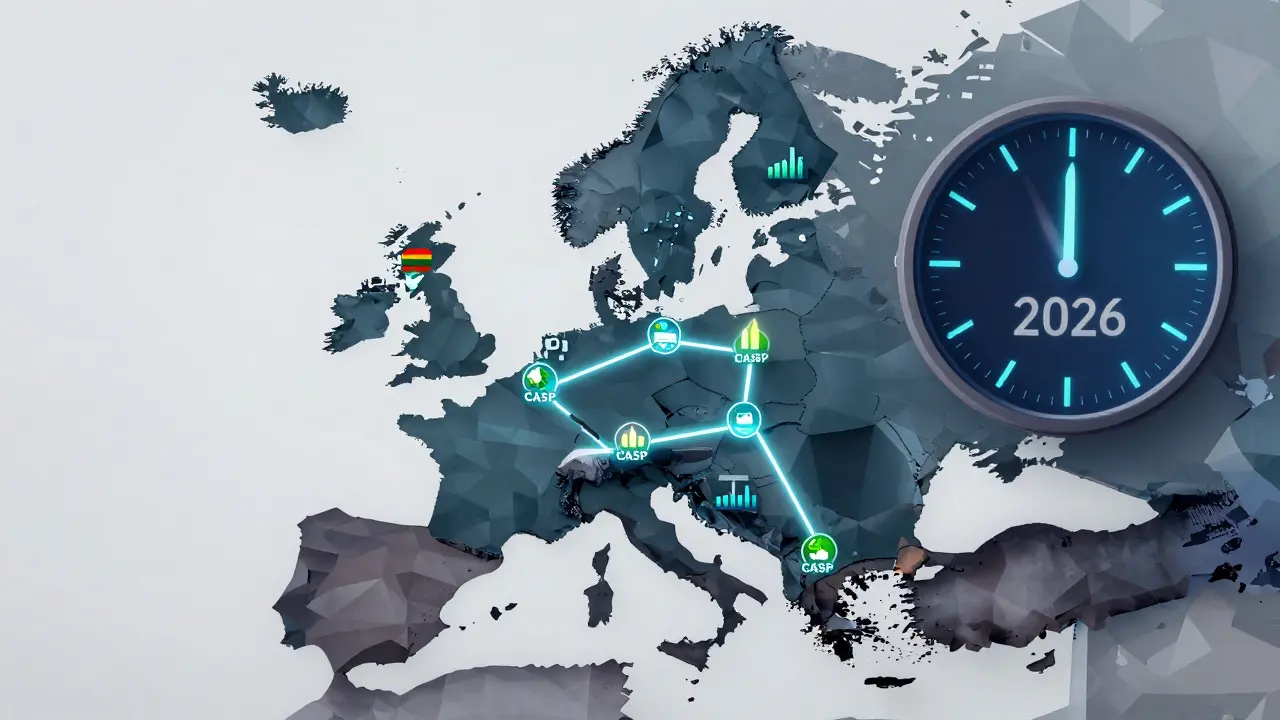
As of August 2025, 89 firms are fully authorized across the EU. France leads with 15 approvals, Germany 12, Lithuania 8. But there are 217 active applications. Why the backlog?Most delays come from three places:
- Documentation quality: Many applicants submit vague business plans. Regulators want detailed org charts, risk matrices, and cybersecurity protocols - not PowerPoint slides.
- Resource gaps: Only 42% of NCAs have dedicated crypto teams. In Malta and Estonia, applications take 9-11 months to process, even though MiCA says 6 months max.
- Non-EU firms underestimating complexity: A Deloitte survey found 73% of U.S. and Asian firms thought they could adapt their existing compliance systems. They couldn’t. MiCA requires EU-specific governance, data storage, and reporting - not just translations.
One founder from Canada told us: “We spent $1.8 million on consultants, hired a new CEO in Berlin, moved our data servers to Frankfurt - and still got asked for 14 more documents.”
Costs You Can’t Ignore
The total cost to get licensed varies wildly:| Service Type | Minimum Capital | Avg. Total Cost | Time to Approve |
|---|---|---|---|
| Custody Only | €125,000 | €750,000 | 6-8 months |
| Crypto-Fiat Exchange | €150,000 | €1.3 million | 7-10 months |
| Trading Platform | €730,000 | €2.5 million | 9-12 months |
These numbers include legal fees, tech upgrades, compliance staff, and audit costs. The biggest surprise? The environmental reporting system. For mid-sized exchanges, setting up the tracking and disclosure pipeline costs €200,000-€500,000 annually. That’s not a one-time fee - it’s an ongoing operational cost.
Why DeFi Platforms Are Avoiding the EU
MiCA was never meant for decentralized protocols. If you’re a DeFi app with no legal entity, no CEO, and no registered office - you’re out of scope. And that’s intentional.A University of Zurich study in February 2025 found that 68% of DeFi protocols have actively avoided EU markets since MiCA launched. Why? Because the regulation requires identifiable, accountable persons. No anonymity. No smart contracts as legal actors. No DAO voting as corporate governance.
Some projects tried to “comply” by creating shell companies in Lithuania. Regulators shut them down within weeks. The message is clear: if you’re truly decentralized, you can’t operate in the EU under MiCA. That’s not a loophole - it’s a boundary.

The Real-World Impact: What Users See
For everyday crypto users, MiCA’s effects are visible:- More security: 63% of Trustpilot reviews praise improved asset segregation and proof-of-reserves. Users know their funds are legally protected.
- Fewer tokens: 41% of negative reviews complain about reduced token selection. MiCA’s strict asset admission rules mean only vetted, low-risk tokens make it onto licensed platforms.
- More warnings: Article 58 forces platforms to show risk disclaimers before every trade. Many users find them overwhelming - “It’s like reading a legal textbook before buying Bitcoin.”
But the trade-off is real. In 2023, FTX’s collapse wiped out billions. MiCA was designed to prevent that. Now, if a licensed CASP fails, client assets are segregated and protected. That’s the core promise.
What’s Next? MiCA 2.0 and the Road Ahead
The European Commission is already working on MiCA 2.0, expected to launch in late 2026. It will tackle NFTs, DeFi, and stablecoins more directly. But for now, the rules are clear:- By July 1, 2026, all crypto service providers operating in the EU must be licensed - or shut down.
- Starting January 2026, real-time transaction monitoring becomes mandatory for all CASPs.
- The Anti-Money Laundering Authority (AMLA) will take over cross-border AML supervision in June 2026, centralizing enforcement.
For firms still waiting, time is running out. The window for transitional compliance ends in less than a year. Those who haven’t started the application process now are likely too late.
Final Reality Check
MiCA isn’t perfect. It’s expensive. It’s slow. It’s rigid. But it’s the first time Europe has created a single, enforceable rulebook for crypto - and it’s working.If you’re a startup with a small team and no EU presence, MiCA may not be for you. But if you’re building a serious crypto business with long-term ambitions in Europe, there’s no shortcut. The license isn’t a hurdle - it’s your ticket to the entire market.
And in a world where crypto regulation is still a patchwork elsewhere, that’s worth more than most people realize.
Can I apply for a CASP license from outside the EU?
No. You must have a legal entity registered within the EU and at least one director who is a resident of the member state where you apply. You can’t use a foreign company or remote director to bypass this. The EU requires physical presence and accountability.
How long does the CASP application process take?
MiCA legally requires NCAs to process applications within six months. But in practice, it takes 7-12 months due to staffing shortages and incomplete submissions. Germany’s BaFin processes applications fastest (average 6-7 months), while Malta and Estonia can take over 9 months. Delays usually happen because applicants submit vague business plans or fail to provide proof of capital.
What happens if I operate without a CASP license after July 1, 2026?
You’ll be illegal. After July 1, 2026, all crypto service providers must be licensed. Unlicensed firms will be blocked from EU markets, fined, and possibly shut down by regulators. Customers may also be barred from using your service. There is no grace period after this date.
Are DeFi platforms allowed under MiCA?
No. MiCA only applies to legal entities with identifiable management, registered offices, and accountability structures. Decentralized protocols without a legal person behind them cannot be licensed. This exclusion is intentional - DeFi remains outside MiCA’s scope, which is why most DeFi projects avoid EU markets entirely.
Do I need to report energy usage even if I use proof-of-stake?
Yes. All CASPs must report environmental impact, regardless of consensus mechanism. Even proof-of-stake firms must disclose the energy consumption of their servers, data centers, and infrastructure. The EU uses the Blockchain Observatory methodology - not industry estimates. This is mandatory and auditable.
Can I use my existing AML system from the U.S. or UK?
No. MiCA requires full compliance with the EU’s 6th Anti-Money Laundering Directive. U.S. or UK systems don’t meet EU standards for customer due diligence, real-time monitoring, or reporting timelines. You must upgrade your system to meet EBA technical standards, which include EU-specific data retention and reporting protocols.
What’s the difference between a CASP and a stablecoin issuer?
A CASP provides services like trading or custody. A stablecoin issuer creates and manages asset-referenced tokens (like EUR-backed coins). Stablecoin issuers are regulated under separate MiCA rules, overseen by the European Banking Authority (EBA), and must maintain 1:1 reserves with audited proof. They also face stricter liquidity and redemption requirements than CASPs.
Is MiCA better than U.S. crypto regulation?
For businesses wanting to operate across multiple markets, yes. MiCA offers a single license valid across 27 countries. In the U.S., firms must navigate 50 state laws plus federal agencies like the SEC and CFTC - a much more fragmented and costly system. But MiCA is stricter on capital, reporting, and operational requirements, making it harder for small players to enter.




24 Comments
Justin Credible
March 24, 2026 at 10:05
man i just tried to apply for a casp license and wow. spent 3 months just filling out forms. they asked for my dog's birth certificate. no joke. my lawyer cried. now i'm just gonna sell nfts and call it a day.
Nicolette Lutzi
March 25, 2026 at 04:34
this is just the new world order. china and russia are laughing while the eu cripples its own crypto scene. they think they're protecting citizens but they're just protecting banks. next they'll require a license to buy bitcoin with cash. #freebitcoin
Jeannie LaCroix
March 25, 2026 at 17:22
I CAN'T BELIEVE THIS IS HAPPENING.
THE EU ISN'T REGULATING CRYPTO. THEY'RE ERASING IT.
THIS ISN'T COMPLIANCE. THIS IS CULTURAL GENOCIDE.
WE BUILT THIS ON TRUST, NOT LEGAL PAPERWORK.
MY HEART IS BROKEN.
MY WALLET IS CRYING.
WE WERE SUPPOSED TO BE FREE.
AND NOW? WE'RE JUST ANOTHER BANK WITH A BLOCKCHAIN LABEL.
WHY DID WE EVEN TRY?
Domenic Dawson
March 26, 2026 at 22:04
if you're building something real, this is actually a gift.
yes, it's expensive. yes, it's slow.
but now you're not competing with sketchy offshore ops.
you're competing with legit players.
that’s how you build trust.
that’s how you survive the next crash.
trust me - i’ve been through 3 cycles.
this is the foundation.
not the fence.
Abhishek Thakur
March 27, 2026 at 04:31
MiCA is a regulatory framework designed to bring clarity to crypto markets. The CASP licensing requirement ensures accountability, reduces systemic risk, and aligns with AML/CFT obligations. The capital thresholds are calibrated to operational scale, and environmental reporting mandates transparency. While implementation delays exist due to resource constraints in NCAs, the long-term stability benefits outweigh short-term friction.
Jackie Crusenberry
March 27, 2026 at 09:44
so... you're telling me i have to pay 2.5 million just to let people buy dogecoin? why not just let me do it in my basement? i'm not a bank. i'm a guy with a laptop and a dream.
Neil MacLeod
March 29, 2026 at 06:29
The regulatory architecture of MiCA, while ostensibly designed to foster market integrity, inadvertently creates an oligopolistic environment wherein capital-intensive entities dominate. The requirement for physical presence, EU-resident directors, and exorbitant capital thresholds constitutes a de facto barrier to entry for innovation-driven startups. The net effect is not consumer protection, but institutional entrenchment.
Misty Williams
March 31, 2026 at 04:50
This is exactly why crypto will never be mainstream. People think freedom means no rules. But freedom without responsibility is chaos. If you can't prove you're not laundering money or scamming people, you don't deserve to operate. Stop whining and get compliant. It's not hard. It's just not easy.
Anand Makawana
April 2, 2026 at 02:26
The MiCA framework, while demanding, is a necessary evolution. The capital requirements ensure solvency; the environmental reporting ensures accountability; the passporting mechanism ensures market efficiency. The delays in processing are not failures of regulation, but reflections of under-resourced NCAs. Investment in regulatory infrastructure is the next frontier for EU crypto leadership.
Mohammed Tahseen Shaikh
April 3, 2026 at 06:26
they want us to be a bank? fine. but don't call it crypto.
crypto was never meant to be licensed.
it was meant to be unshackled.
now we're just fintech with a blockchain sticker.
the soul is dead.
the code still runs.
but who's left to care?
Sarah Terry
April 4, 2026 at 19:15
If you're a startup, this is terrifying. But if you're serious? This is your launchpad.
Get licensed. Hire the EU director. Move the servers.
It's expensive. Yes.
But now you're not fighting regulators - you're working with them.
And that’s how you win long-term.
kavya barikar
April 5, 2026 at 21:45
Regulation is not the enemy of innovation. It is the framework that allows innovation to scale safely. The EU has chosen to build a system where trust is legally enforceable. This is not a restriction - it is a covenant.
namrata singh
April 6, 2026 at 04:18
I read this whole thing twice.
It's heavy.
But I get it now.
It's not about control.
It's about making sure no one loses everything again.
Like FTX.
That hurt.
Maybe this hurts too.
But maybe it's worth it.
Andrea Zaszczynski
April 7, 2026 at 22:03
wait so i have to report my laptop's power usage? and my home router? what if i mine on solar panels? do i need a notary to sign my solar panel's birth certificate? this is insane. i'm moving to switzerland.
Cordany Harper
April 8, 2026 at 22:14
honestly? i’m surprised it’s not worse.
the u.s. is a mess - 50 different rules, SEC vs cftc, lawsuits every week.
at least here, you know what you’re up against.
you pay the price.
you get the passport.
you play in europe.
that’s fair.
Zion Banks
April 8, 2026 at 22:27
this is a crypto kill switch disguised as regulation.
they don't want you to succeed.
they want you to disappear.
the 15 million user threshold? that’s a trap.
they want to scare off the big ones.
the ones who actually matter.
they’re scared.
and they’re using paperwork to hide it.
manoj kumar
April 10, 2026 at 14:13
why are we even talking about this? crypto is dead. the eu just killed it with bureaucracy. next they'll tax your wallet. then they'll track your wallet. then they'll own your wallet. we lost.
JOHN NGEH
April 10, 2026 at 22:43
i know it’s expensive. i know it’s slow.
but if you build this right, you’re not just licensed - you’re respected.
people will trust you.
investors will back you.
partners will come to you.
this isn’t a wall.
it’s a gate.
and only the real ones get through.
Jenni Moss
April 11, 2026 at 07:16
you got this.
it’s hard.
it’s messy.
but you’re not alone.
we’re all in this together.
one form at a time.
one euro at a time.
one director at a time.
you’re building something that lasts.
i believe in you.
vu phung
April 12, 2026 at 10:51
the cost breakdown is legit.
€200k just to track energy? yeah.
but think about it - if you're running a platform, you're already using cloud servers.
you can automate the reporting.
it’s not magic.
it’s just plumbing.
and plumbing costs money.
but it keeps the lights on.
Lorna Gornik
April 13, 2026 at 15:22
this is why i love europe 🇪🇺
they’re not trying to be cool.
they’re trying to be safe.
and honestly? after ftx? i’m glad.
no more scams.
no more rug pulls.
just clean, clear, regulated markets.
finally. 💯
Joshua T Berglan
April 13, 2026 at 23:16
the real win? passporting.
one license. 27 countries.
no more playing whack-a-mole with 10 different regulators.
that’s the future.
yeah, the first step hurts.
but once you’re in? you’re in for life.
that’s power.
Kevin Da silva
April 15, 2026 at 14:00
MiCA’s real value isn’t in the rules. It’s in the certainty.
Before: chaos.
After: clarity.
That’s worth the cost.
And the wait.
And the paperwork.
Just don’t half-ass it.
Andrew Midwood
April 16, 2026 at 11:39
i applied from canada.
spent $1.2m.
hired a ceo in berlin.
moved servers to frankfurt.
still got asked for 7 more docs.
but now? i’m licensed.
and i’m the only one in my niche with a eu license.
clients are lining up.
so... yeah. worth it.