
EU Travel Rule Compliance for Crypto: What Zero Threshold Means for Your Transactions
The EU Travel Rule is now fully active, and it changes everything for crypto transactions in Europe. As of December 30, 2024, every single crypto transfer between regulated exchanges and wallet providers in the EU must include full sender and recipient details - no matter how small the amount. Even a €0.01 transfer triggers full compliance. There is no minimum. No exceptions. This is the world’s first and only true zero-threshold Travel Rule, and it’s already live.
What Exactly Is the EU Travel Rule?
The EU Travel Rule comes from two laws: Regulation (EU) 2023/1113 and Regulation (EU) 2023/1114 (MiCA). Together, they require crypto asset service providers (CASPs) - like exchanges, custodial wallets, and trading platforms - to collect and share specific data for every transaction. That includes:- Full name of the sender
- Sender’s account number or wallet address
- Sender’s address or national ID number
- Full name of the recipient
- Recipient’s account number or wallet address
Why Zero Threshold? The EU’s Bold Move
Most countries follow the FATF’s original recommendation: apply the Travel Rule only to transfers over $1,000 (or €1,000). The U.S. still uses a $3,000 threshold. But the EU decided to go further. Why? The official reasoning is simple: crypto is different from traditional banking. Banks already have KYC and transaction monitoring built into their systems. Crypto, especially peer-to-peer, doesn’t. The EU argues that even small transfers can be part of a larger laundering scheme - and if you allow exceptions, bad actors will exploit them. It’s controversial. Critics say it’s overreach. After all, most crypto transactions under €100 are just people buying coffee, tipping content creators, or sending pocket change to friends. But the EU isn’t swayed. They’re treating crypto like cash - and cash has no thresholds for reporting suspicious activity.What Happens If Data Is Missing?
This is where things get real. If a transaction arrives without full sender or recipient details, the receiving CASP doesn’t just ignore it. They have to make a decision:- Accept it - if they judge the risk low
- Reject it - if the missing data is too risky
- Return it - send it back to the sender’s provider
- Suspend it - hold it while they investigate
Who Does This Affect?
This rule doesn’t apply to individuals holding crypto in non-custodial wallets - like MetaMask or Ledger. You can send ETH from your personal wallet to a friend’s wallet without filling out forms. But if you’re using any exchange, custodial wallet, or platform registered in the EU - Binance, Kraken, Bitpanda, Coinbase, etc. - you’re covered. Even if you’re not in the EU, if you’re sending crypto to an EU-based CASP, they’ll ask for full details. If you’re in the EU and sending to someone outside, the same rules apply. The big shift? You can’t just send crypto from one exchange to another anymore without the data being passed along. The platforms have to talk to each other.How Are Companies Handling It?
Major exchanges have spent the last 18 months building systems to handle this. Companies like KYCAID, Trulioo, and ComplyAdvantage have launched specialized tools that automate data exchange between CASPs. These systems use secure messaging protocols - often based on the FATF’s own Travel Rule messaging standards - to pass required info without exposing sensitive data to third parties. Some platforms have even built custom APIs that link directly to their compliance engines. When you initiate a transfer, the system checks:- Is the recipient’s CASP compliant?
- Do we have their full KYC data?
- Is their wallet verified?
- Is the recipient on any sanctions list?
What About Cross-Border Transfers?
This is the biggest headache. If you’re sending crypto from an EU exchange to one in the U.S., Japan, or Singapore - where the Travel Rule doesn’t apply or has a higher threshold - the EU CASP must treat that as a high-risk transfer. They’ll likely block it unless the receiving platform can prove it has its own AML controls. The European Banking Authority (EBA) calls these "non-compliant jurisdictions" high-risk. So even if you’re sending $50 to a friend in Canada, your EU exchange might refuse to process it. That’s not a glitch - it’s policy. Some users are turning to peer-to-peer platforms or decentralized exchanges (DEXs) to avoid this. But even there, if you’re using a DEX that’s registered in the EU - like a regulated DeFi gateway - you’ll still face the same rules.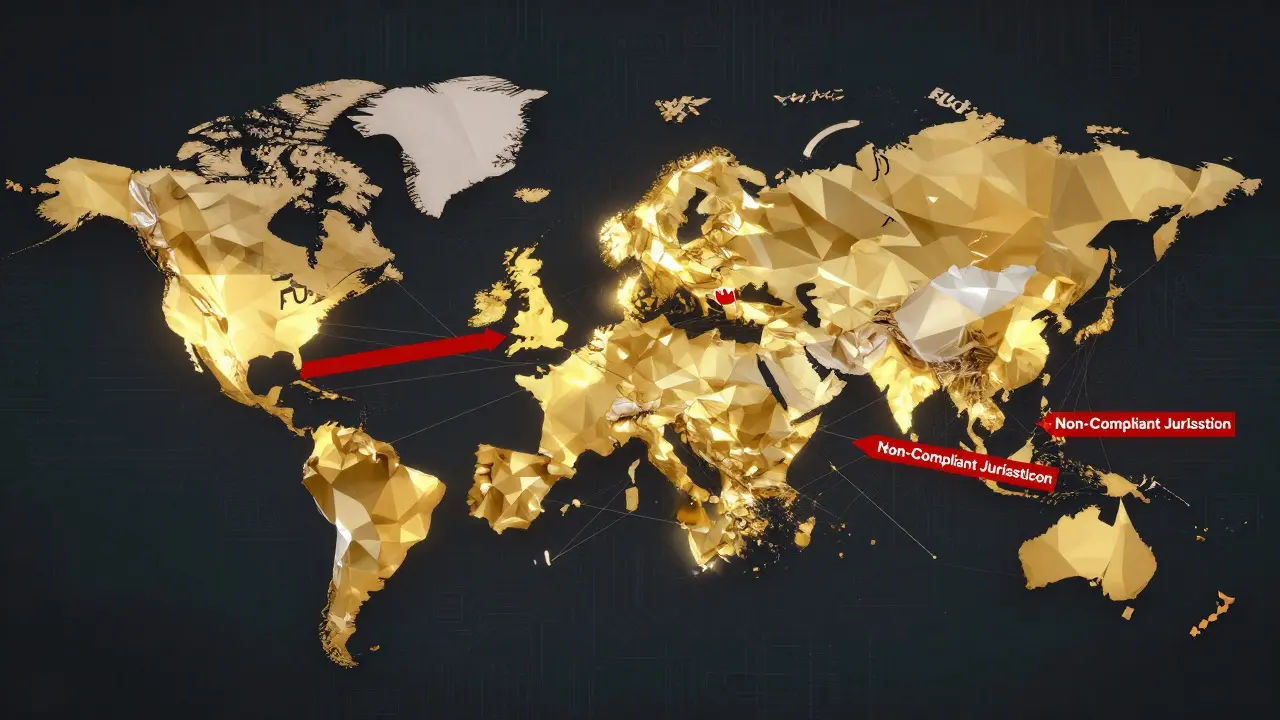
What Happens If You Don’t Comply?
Non-compliance isn’t a warning. It’s a penalty. CASPs that fail to meet Travel Rule requirements face:- Fines up to 5% of annual turnover
- Temporary suspension of trading licenses
- Loss of access to EU banking services
- Public regulatory notices that damage reputation
- Exclusion from the EU crypto market entirely
What This Means for Everyday Users
You won’t notice much if you’re just holding crypto. But if you’re moving funds between platforms - say, from Coinbase to Bitstamp - you might see delays. Or a message asking you to confirm your address or ID again. That’s not a bug. It’s the system working. If you’re sending crypto to someone outside the EU, make sure they’re using a compliant platform. Otherwise, your transfer might bounce back. And if you’re a freelancer getting paid in crypto, your EU-based client might ask you to provide your wallet address with your full legal name attached - or they won’t be able to pay you.What’s Next?
The EU is already looking ahead. Next steps include:- Expanding the rule to cover non-custodial wallets that interact with regulated platforms
- Standardizing data formats across all CASPs to reduce technical friction
- Creating a shared EU-wide registry of compliant VASPs
- Pushing other countries to adopt zero-threshold rules
For now, the message is clear: in the EU, crypto isn’t anonymous. It’s monitored. Every transaction. Every time.
Does the EU Travel Rule apply to personal wallets like MetaMask?
No, the EU Travel Rule only applies when transactions go between regulated crypto asset service providers (CASPs), like exchanges or custodial wallets. If you’re sending crypto from your own MetaMask or Ledger wallet to another personal wallet, no data needs to be shared. But if you’re sending from MetaMask to a Coinbase account, Coinbase will require full sender details - and if they’re missing, your transaction may be blocked.
What if I send €1 to a friend on Binance from Kraken?
Both Kraken and Binance are EU-regulated CASPs. Even for €1, they must exchange full sender and recipient details. If either platform doesn’t have complete KYC data for the other, the transfer may be delayed, rejected, or returned. You’ll likely see a notification asking you to verify your identity or confirm the recipient’s details before the transaction can proceed.
Can I avoid the Travel Rule by using a decentralized exchange (DEX)?
Only if the DEX isn’t regulated by the EU. If you’re using an unregulated DEX like Uniswap or PancakeSwap from outside the EU, the rule doesn’t apply. But if you’re using a DEX that’s registered as a CASP in the EU - even if it’s called "decentralized" - it must comply. Many EU-based DeFi platforms now require KYC to interact with their interfaces.
What happens if my transaction gets rejected because of missing data?
You’ll get an error message from your exchange explaining the reason. You may be asked to re-submit your identity documents, confirm the recipient’s details, or provide proof of address. If the recipient’s platform is non-compliant or in a high-risk jurisdiction, you may need to choose a different recipient or wait until they upgrade their system. There’s no workaround - it’s a system-wide enforcement.
Is this rule going to spread to other countries?
Yes, the EU’s zero-threshold model is already being watched as a global benchmark. Countries like the UK, Japan, and Singapore are reviewing their own rules. The U.S. is under pressure to lower its $3,000 threshold. If the EU proves this system works without crippling innovation, more nations will likely adopt similar standards - making crypto globally less anonymous.





18 Comments
Abdulahi Oluwasegun Fagbayi
January 21, 2026 at 09:51
This is the future, honestly. Privacy isn't dead, it's just moved to non-custodial wallets. If you want to transact like cash, use a ledger. If you want to use exchanges, play by their rules. Simple.
Anna Topping
January 22, 2026 at 10:20
so like... i just sent 50 cents to my friend on binance and now i have to submit my birth certificate again? 🤦♀️
Jeffrey Dufoe
January 23, 2026 at 07:51
I get why they did it. People use small transfers to hide bigger stuff. It’s not about the €1, it’s about the pattern. Still, it’s annoying when you just want to tip someone.
katie gibson
January 23, 2026 at 15:05
THEY’RE TURNING CRYPTO INTO A BANKING SYSTEM. AGAIN. 🤬 I thought we were building a new world but nope, they just slapped on KYC and called it innovation. This is the death of freedom, people. 💔
Margaret Roberts
January 23, 2026 at 22:04
This is just the beginning. Next they’ll track your wallet through your IP, then your device fingerprint, then your coffee purchases. They’re not stopping at crypto. This is the first step to total financial surveillance. You think your MetaMask is safe? Think again.
Tselane Sebatane
January 25, 2026 at 09:07
I come from a place where people send money via WhatsApp because banks are broken. Now you’re telling me I can’t send 20 naira to my cousin because some EU regulator says so? This isn’t compliance, this is cultural imperialism. We didn’t ask for your rules. We just wanted to move money.
Linda Prehn
January 26, 2026 at 19:28
I used to think crypto was about freedom until I had to fill out a form to send 10 euros to my sister. Now I just use cash. At least cash doesn’t ask for your middle name
Adam Lewkovitz
January 27, 2026 at 02:55
EU thinks they’re the police of the world. Good luck enforcing this in Nigeria or India. The moment this hits real users, it’ll just push everything to P2P and darknet. You’re not stopping criminals, you’re just making life harder for normal people.
Clark Dilworth
January 29, 2026 at 00:27
The FATF Travel Rule was always a band-aid. What the EU implemented is a systemic overhaul of the AML infrastructure for digital assets. It’s not about control - it’s about interoperability. CASPs now operate on a shared state protocol. This is the foundation for institutional adoption.
Mark Estareja
January 29, 2026 at 14:10
I’ve been in this space since 2017. I’ve seen every ‘revolution’ turn into a compliance nightmare. This is the moment crypto lost its soul. The blockchain was supposed to be the anti-bank. Now it’s just a bank with a blockchain logo.
Athena Mantle
January 29, 2026 at 19:25
I just want to send my friend a birthday gift in ETH 😭 why does this have to be so complicated?? Like... I’m not a criminal. I’m just a girl who likes NFTs and wants to pay her barista in crypto. 🥺
carol johnson
January 31, 2026 at 09:47
I’m so over this. I’m not a criminal, I’m not laundering money, I just want to send my mom 5 euros for her birthday. Why does the EU need to know her full legal name, address, and passport number? It’s a gift. Not a wire transfer.
Chidimma Catherine
January 31, 2026 at 22:51
This is a very important development. As someone from Nigeria where remittances are lifelines, I see how this can hurt ordinary people. But I also understand the need for transparency. The solution is not to reject the rule, but to build better tools for small users - low-cost, simple interfaces that auto-fill KYC. We need inclusion, not exclusion.
Nathan Drake
February 2, 2026 at 11:19
The real question isn’t whether this works. The question is: what are we trading freedom for? If every transaction is tracked, even the smallest, then anonymity is gone. And once it’s gone, it never comes back. We’re not just regulating crypto - we’re redefining what trust means in a digital economy.
Taylor Mills
February 3, 2026 at 10:33
US should’ve done this 5 years ago. You think your decentralized exchange is safe? It’s not. The moment you link it to a fiat gateway, you’re in the system. This EU move is the only thing keeping crypto from becoming a criminal playground. Stop whining and get compliant.
Deepu Verma
February 4, 2026 at 13:58
Hey everyone, don’t panic. This is just growing pains. Yes, it’s annoying now. But think of it like the early days of online banking - everyone complained about passwords and 2FA. Now we don’t even think about it. This will become invisible. The tech will get better. The UX will improve. Give it time.
MICHELLE REICHARD
February 6, 2026 at 07:27
Of course the EU did this. They think they’re smarter than everyone else. But they’re just creating a bureaucratic nightmare. Meanwhile, the real innovation is happening in places where regulation doesn’t stifle creativity. This isn’t progress - it’s control dressed up as security.
Jennifer Duke
February 6, 2026 at 18:42
Honestly? This is why I left the EU. I moved to Georgia because I didn’t want my every crypto move monitored. The EU thinks they’re protecting the people, but they’re just building a financial panopticon. And guess what? The criminals will always find a way. The only people hurt are the ones trying to play by the rules.