
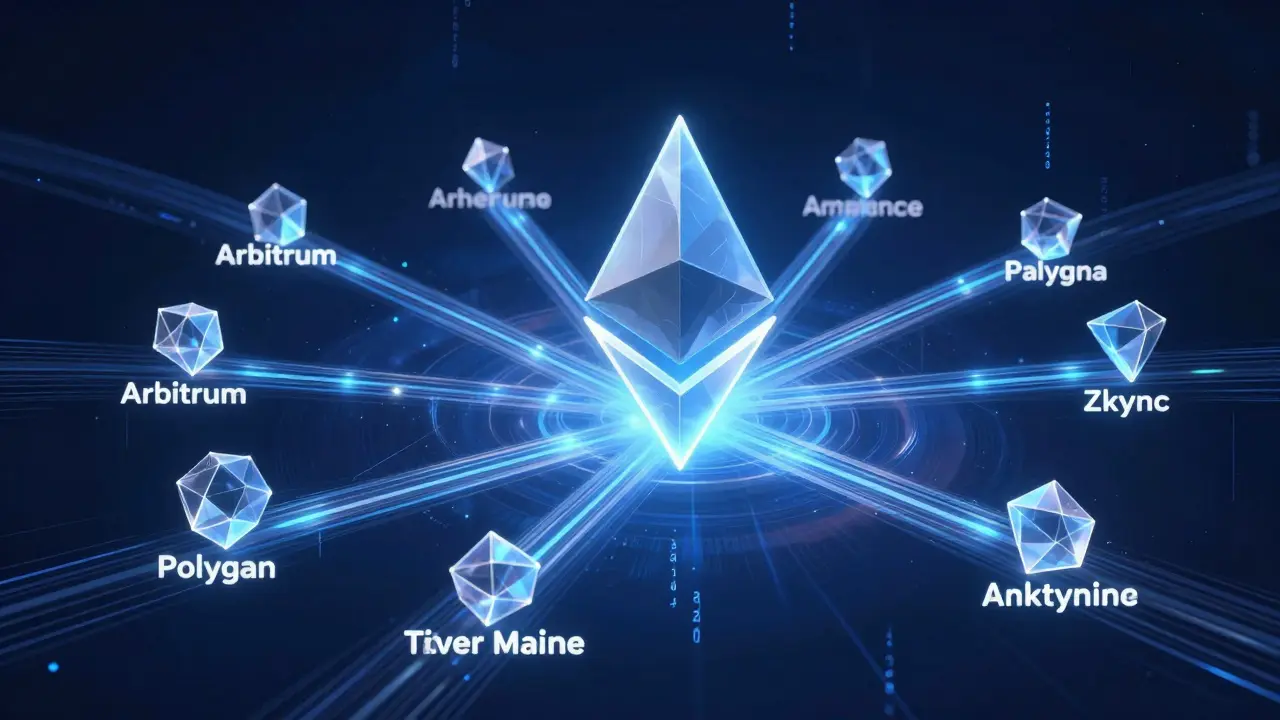
Future of Layer 2 Scaling: How Rollups Are Making Blockchain Fast, Cheap, and Real
Layer 2 Fee Calculator
Transaction Cost Comparison
See how much you'll save by using Layer 2 networks instead of Ethereum mainnet
Your Savings
$
High gas fees during peak times
$
Optimistic Rollup
$
ZK-Rollup (zkEVM)
$
Privacy-focused (zkSync, StarkNet)
$
Average Layer 2 savings
Five years ago, using Ethereum for a simple token swap could cost you $50 in gas fees. Today, that same swap costs less than 20 cents. What changed? Layer 2 scaling didn’t just improve Ethereum-it rebuilt it from the inside out.
Layer 2 solutions aren’t a tweak. They’re a complete overhaul. Instead of forcing every transaction onto Ethereum’s main chain, they handle thousands of transactions off-chain, then bundle them into one secure proof that gets posted back to Ethereum. Think of it like a high-speed express lane that still pays tolls on the main highway-except now, the toll is a penny instead of a dollar.
How Layer 2 Scaling Actually Works
At its core, Layer 2 scaling means moving work off Ethereum’s main chain while keeping its security. Ethereum’s mainnet can only process about 15 transactions per second. That’s fine for digital gold, but useless for paying for coffee or trading NFTs. Layer 2 networks fix this by doing the heavy lifting elsewhere.
There are two main types: Optimistic Rollups and Zero-Knowledge Rollups (ZK-Rollups). Both work differently, but both deliver the same result: faster, cheaper, and just as secure as Ethereum.
Optimistic Rollups assume transactions are valid unless someone proves otherwise. It’s like a courtroom where you’re innocent until proven guilty. If someone spots a bad transaction, they can challenge it within a 7-day window. This system is simple, compatible with existing Ethereum code, and works well for DeFi and NFTs. Networks like Arbitrum and Optimism use this model.
ZK-Rollups are the math-heavy version. They use cryptographic proofs called zero-knowledge proofs to prove transactions are valid without revealing any details. It’s like showing a friend you know the password to a safe without telling them the password. This gives stronger privacy and faster finality. zkSync and StarkNet are the leading ZK-Rollups.
The Top Layer 2 Networks in 2025
Not all Layer 2s are created equal. Some are built for speed. Others for privacy. Some for developers. Here’s who’s leading the pack as of late 2025.
- Arbitrum: The king of ecosystem growth. With 600+ dApps and $6.2 billion locked in, it’s the go-to for DeFi, lending, and trading. It runs on Optimistic Rollup tech, so most Ethereum smart contracts work without changes.
- Optimism: Almost identical to Arbitrum in performance-4,000 TPS, 90% cheaper fees-but with tighter ties to institutional finance. Its “Superchain” vision aims to link multiple Layer 2s into one unified network.
- Polygon: The speed demon. At 65,000 TPS, it handles gaming, social media, and high-frequency trading better than any other. Over 1,000 dApps run on it, and its zkEVM version now blends ZK-Rollup efficiency with Ethereum compatibility.
- Base: Built by Coinbase, it’s the most user-friendly for newcomers. It’s an Optimistic Rollup with built-in compliance tools, making it popular for regulated tokens and institutional onboarding.
- zkSync and StarkNet: These are the privacy champions. If you need to send money without revealing amounts, recipients, or transaction history, they’re the only choice. Used by enterprise clients and privacy-focused DeFi protocols.
Transaction fees? All of them cut costs by 90% or more. Where Ethereum gas used to average $10-$50 during spikes, Layer 2s now charge $0.02-$0.10 per transaction. That’s not an improvement-it’s a revolution.
Why Layer 2s Are the Real Future of Ethereum
Ethereum’s original vision was to be a global computer. But high fees and slow speeds made it unusable for everyday people. Layer 2s fixed that without breaking Ethereum’s core promise: decentralization and security.
Vitalik Buterin himself has said Ethereum’s future isn’t about making the main chain faster. It’s about making Layer 2s the main interface. In 2025, that’s already happening. Daily transactions on Arbitrum and Polygon regularly outpace Ethereum mainnet. More than half of all Ethereum-based activity now happens on Layer 2.
Why does this matter? Because it unlocks use cases that were impossible before.
GameFi? Now you can trade in-game items every few seconds without breaking the bank. NFT artists? They can mint 10,000 pieces in one day and still make a profit. DeFi traders? Slippage is lower, orders fill faster, and micro-investments under $10 are now viable.
Enterprise adoption is accelerating too. Banks in Argentina and the U.S. are testing tokenized bonds on Arbitrum and Base. Pension funds are exploring Layer 2-based ETFs. Even the U.S. Federal Reserve has signaled openness to Layer 2 infrastructure for wholesale payments.

What’s Next? The Road Ahead
Layer 2s aren’t done evolving. The next wave is about connection-not just speed.
Right now, moving assets between Arbitrum, Polygon, and zkSync requires multiple bridges, each with its own risk and delay. But new cross-Layer 2 protocols like LayerZero and Axelar are changing that. In 2025, you’ll be able to send ETH from Arbitrum to zkSync in under 30 seconds, with one click and zero extra fees.
Developer tools are also improving. New frameworks let you write smart contracts once and deploy them across multiple Layer 2s automatically. Grants from Layer 2 teams total over $50 million this year alone, fueling innovation from small teams and solo devs.
Security is no longer a concern. The biggest Layer 2s have withstood years of real-world use, audits, and attacks. The most common issue now? User confusion. Many people still think they need to “choose” one Layer 2 forever. But the future is multi-Layer 2: use Polygon for gaming, Arbitrum for trading, zkSync for private payments. Wallets like MetaMask now auto-detect and switch between them seamlessly.
How to Get Started
Getting on a Layer 2 takes less than 15 minutes.
- Open your Ethereum wallet (MetaMask, Coinbase Wallet, etc.).
- Add the Layer 2 network. For Arbitrum, search for “Arbitrum One.” For Polygon, search “Polygon zkEVM.”
- Bridge your ETH or tokens from Ethereum mainnet to the Layer 2. Most wallets have a one-click bridge.
- Start using dApps. Swap tokens, stake, play games-everything works the same, just cheaper.
For developers: If you’ve built on Ethereum, your code likely works on Arbitrum or Optimism with no changes. For ZK-Rollups, you’ll need to learn new tools, but the payoff in privacy and speed is worth it.
What to Watch Out For
Layer 2s aren’t perfect. Some risks remain.
First: liquidity fragmentation. If you hold assets on multiple Layer 2s, you might miss out on yield opportunities because your funds aren’t all in one place. Use aggregators like Camelot or Synapse to move assets efficiently.
Second: regulatory gray zones. Some ZK-Rollups offer true privacy, which could attract scrutiny. In the EU and U.S., regulators are watching closely-but so far, they’re treating Layer 2s as extensions of Ethereum, not separate systems.
Third: over-reliance on a few networks. If one Layer 2 becomes too dominant, it could become a single point of failure. That’s why decentralization efforts are now focused on ensuring no single entity controls more than 20% of any network’s sequencers or validators.
But here’s the truth: the problems are solvable. The momentum isn’t slowing. It’s accelerating.
Final Thought: Layer 2 Is the New Normal
The future of blockchain isn’t about faster mainnets. It’s about smarter layers on top. Ethereum’s main chain is now the anchor-secure, decentralized, and slow. Layer 2s are the engines-fast, cheap, and everywhere.
If you’re still using Ethereum mainnet for daily transactions, you’re paying a luxury tax. The tools are here. The savings are real. The future isn’t coming-it’s already running on Arbitrum, Polygon, and zkSync.
Are Layer 2s safer than Ethereum mainnet?
Yes, for everyday use. Layer 2s inherit Ethereum’s security because they post final proofs back to the main chain. Even if the Layer 2 operator goes offline, your funds are still protected and can be withdrawn to Ethereum. The biggest risk isn’t hacking-it’s user error, like sending funds to the wrong network.
Can I use DeFi on Layer 2s?
Absolutely. In fact, most DeFi activity now happens on Layer 2s. Uniswap, Aave, Compound, and Curve all have full versions on Arbitrum, Optimism, and Polygon. You’ll get better prices, faster trades, and fees that are 90% lower than on Ethereum mainnet.
Which Layer 2 is best for NFTs?
Polygon and Arbitrum lead for NFTs. Polygon’s speed makes it ideal for minting large collections, while Arbitrum’s strong developer tools and low fees make it popular for high-value collectibles. ZK-Rollups like zkSync are growing in this space too, especially for artists who want privacy around sales.
Do I need to learn new wallet software?
No. MetaMask, Coinbase Wallet, and Trust Wallet all support Layer 2s out of the box. You just need to add the network and bridge your assets. No new apps or complex setups required.
Will Layer 2s replace Ethereum mainnet?
No-they’ll rely on it. Ethereum mainnet will stay the secure settlement layer. Layer 2s will handle all the daily activity. Think of Ethereum as the bank vault and Layer 2s as the branches where people do their business. You still need the vault, but you rarely go there.
What’s the difference between Polygon and Polygon zkEVM?
Polygon’s original chain was a sidechain with its own consensus-less secure than Ethereum. Polygon zkEVM is a ZK-Rollup built directly on Ethereum. It’s fully compatible with Ethereum’s code and inherits its security. If you’re choosing between them, always pick Polygon zkEVM for serious use.
Is it worth switching from Ethereum mainnet to Layer 2?
If you’re doing anything beyond holding ETH, yes. Gas fees on mainnet are unpredictable and often over $10. On Layer 2s, you pay pennies. Transaction speed jumps from 15 seconds to under 2. For trading, gaming, NFTs, or DeFi, staying on mainnet is like using a dial-up modem in 2025.


20 Comments
Andy Walton
December 15, 2025 at 04:32
so like... layer 2s are basically just eth's chill cousin who pays for coffee and never asks for the last slice of pizza? 🍕✨ i love it. my wallet cries tears of joy now. why did we wait this long??
Candace Murangi
December 16, 2025 at 16:28
I’ve been on Arbitrum for six months now and honestly? It feels like switching from a horse-drawn carriage to a Tesla. No more waiting. No more panic when gas spikes. Just... smooth. I didn’t think crypto could feel this easy.
Albert Chau
December 16, 2025 at 22:14
You people are so naive. This is just a centralized illusion wrapped in blockchain glitter. The sequencers? Controlled by a handful of VC-backed teams. You think you’re free? You’re just renting freedom.
Madison Surface
December 17, 2025 at 03:52
I just bridged my first ETH to Polygon zkEVM and cried. Not because it was hard-because it was SO EASY. Like, I didn’t even need to read the docs. My 72-year-old aunt did it last night and now she’s minting NFTs of her cats. This isn’t tech. This is magic.
Tiffany M
December 17, 2025 at 12:21
Okay but can we PLEASE stop pretending zkSync isn't just a privacy tool for money launderers?? I mean... yeah it's cool, but why are we acting like this is some noble innovation? It's just... hiding. And that's not always good.!!!
Eunice Chook
December 17, 2025 at 14:44
Layer 2s are a band-aid. Ethereum should’ve scaled properly. Now we have 10 different chains pretending to be one. It’s fragmentation with a marketing budget.
Lynne Kuper
December 19, 2025 at 03:38
You think you're saving money? Try swapping $500 worth of tokens on Base and watch your gas fee hit $0.12. Then try doing it on mainnet. You’ll feel like you just won the lottery. And no, I’m not sponsored. I just have eyes.
Jessica Eacker
December 20, 2025 at 23:55
I started using Layer 2s because I was tired of paying $15 to mint a single NFT. Now I mint 50 a week. My art business is alive. Thank you to whoever coded this. You’re a real one.
Kathleen Sudborough
December 21, 2025 at 03:56
I used to avoid crypto because of the fees. Now I’m staking on Arbitrum, playing GameFi on Polygon, and sending small tips to artists on zkSync. I didn’t think I’d ever be part of this. It’s... beautiful. Thank you for making it accessible.
Claire Zapanta
December 22, 2025 at 12:49
This is all American tech imperialism dressed up as innovation. Europe has better privacy laws. China has better infrastructure. Why are we all just cheerleading Silicon Valley’s latest hype cycle? The world is watching. And it’s not impressed.
Kathy Wood
December 24, 2025 at 08:05
If you’re using Layer 2s, you’re already complicit in the centralization of crypto. You’re trading decentralization for convenience. And that’s not progress-it’s surrender.
Abhishek Bansal
December 24, 2025 at 12:50
bro why u all so hyped? i used polygon last week and my tx got stuck for 3 hours. then i had to bridge back to mainnet and pay $8. so much for cheap. this is just another scam. 🤡
Anselmo Buffet
December 24, 2025 at 20:25
I’ve been in crypto since 2017. I’ve seen the hype cycles. This one feels different. Not because of the tech-though it’s brilliant-but because people are actually using it for real stuff now. Not speculation. Real life. That’s the win.
Steven Ellis
December 25, 2025 at 22:34
The elegance of this architecture cannot be overstated. Ethereum mainnet serves as the cryptographic anchor, while Layer 2s function as scalable execution environments. This separation of concerns is a masterclass in protocol design. The security model is not merely inherited-it is cryptographically enforced.
Sue Gallaher
December 27, 2025 at 05:33
I dont care what u say i still use mainnet and i like it. layer 2s are for kids who cant afford gas. i got my ETH and i dont need your fancy rollups
Hari Sarasan
December 29, 2025 at 00:58
The ZK-Rollup paradigm represents a quantum leap in cryptographic efficiency. Leveraging SNARKs and STARKs, these systems achieve sub-linear verification complexity while maintaining zero-knowledge properties. The computational overhead is non-trivial, yet the tradeoff is economically optimal for high-throughput applications.
Stanley Machuki
December 29, 2025 at 21:45
I used to think crypto was broken. Now I just use Polygon for everything. Gas is 10 cents. I minted 100 NFTs last week. My dog has a digital tattoo. Life is good.
Lloyd Cooke
December 30, 2025 at 23:56
Is it not profound that we’ve outsourced scalability to a layer that doesn’t even need to be trusted? The main chain becomes a notary, not a processor. We’ve inverted the entire paradigm. This isn’t an upgrade-it’s a philosophical revolution.
Kurt Chambers
December 31, 2025 at 23:56
lol america thinks it invented blockchain. china’s building a digital yuan on their own chain. europe’s regulating this into oblivion. and we’re over here acting like layer 2s are the second coming. get a grip.
Kelly Burn
January 2, 2026 at 11:53
just bridged to zkSync and now i’m sending $0.05 tips to artists with full privacy 😍✨ i feel like a spy. also my gas fee was 3 cents. i’m in love. 💕