
Mining Crypto in India: Law and Restrictions Explained
Bitcoin, Ethereum, and other cryptocurrencies are mined all over the world - but in India, it’s not as simple as plugging in a rig and turning it on. While mining crypto isn’t outright banned, the legal environment is one of the most restrictive in the world. If you’re thinking about mining cryptocurrency in India, you need to understand the real costs, risks, and rules - not just what’s on paper, but what’s enforced.
It’s Not Illegal, But It’s Heavily Taxed
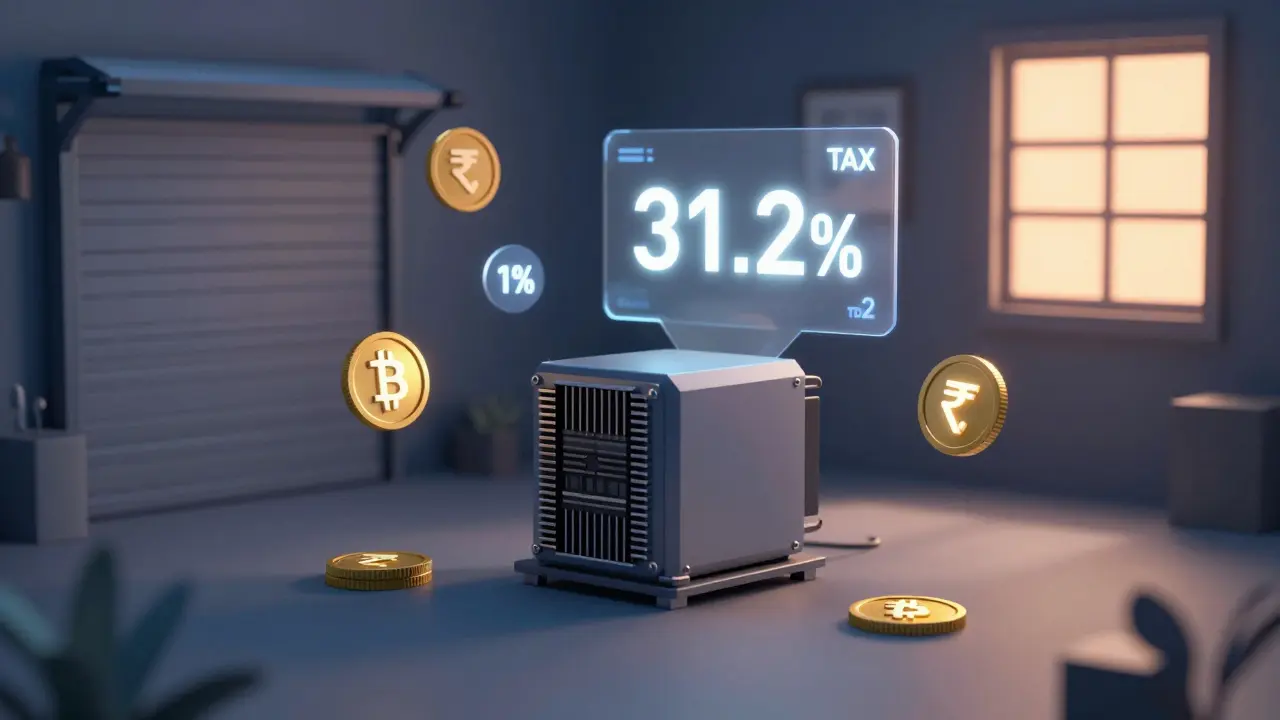
You won’t find a law that says, "You cannot mine cryptocurrency in India." But you will find a tax code that makes it nearly impossible to profit. Since 2022, the Indian government has treated all mined crypto as a Virtual Digital Asset (VDA) under Section 2(47A) of the Income Tax Act. That means every Bitcoin or Ethereum you mine is treated like taxable income - no matter how you got it.The tax rate? A flat 30%. On top of that, there’s a 4% cess, bringing the total to 31.2%. And here’s the kicker: you can’t deduct any of your expenses. Not the electricity. Not the mining rigs. Not the pool fees. Not even the cost of shipping hardware from China. The only thing you can subtract is the cost of acquiring the asset - which, for mined crypto, is zero. So if you mine 0.5 BTC worth ₹25 lakh, you owe ₹7.8 lakh in taxes - even if your electricity bill was ₹3 lakh and your rig cost ₹12 lakh.
1% TDS on Every Transaction - Even Your Own Rewards
Every time you sell, trade, or even transfer your mined coins to another wallet, a 1% Tax Deducted at Source (TDS) kicks in. This applies to every transaction on Indian exchanges like WazirX or CoinDCX. Even if you’re just moving your mined ETH from a mining pool wallet to your personal wallet on an exchange - TDS is taken. And the exchange does it automatically. You don’t get a choice.What does this mean in practice? Let’s say you mine 1 ETH and sell it for ₹3 lakh. ₹3,000 is taken before you even see the money. Then, when you file your taxes, you pay another 31.2% on the full ₹3 lakh. That’s over ₹93,000 in taxes - on income you never actually held in cash. And if you mine multiple times a week? Each payout triggers TDS. The cumulative effect is brutal.
18% GST on Exchange Services - Added to Your Costs
Starting July 7, 2025, Indian exchanges began charging 18% GST on all crypto-related services. That includes deposits, withdrawals, trades, and even staking. If you use an exchange to convert your mined coins into INR, you’re hit with this tax on top of everything else. So if you mine 1 BTC and sell it for ₹50 lakh, you pay:- ₹15.6 lakh in income tax (31.2%)
- ₹50,000 in TDS (1%)
- ₹90,000 in GST on exchange fees
That’s over ₹17 lakh in taxes on a single BTC payout. Your net take-home? Less than ₹33 lakh. And you didn’t even get to deduct your power bill.

Who’s Watching You? Multiple Agencies, No Clarity
There’s no single regulator for crypto mining in India. Instead, you’re caught between five different agencies - each with its own rules.- The Income Tax Department tracks your mining income through Project Insight, NMS, and NUDGE - AI systems that monitor blockchain transactions and flag unusual activity. If you mine and don’t report, you’ll get an automated notice.
- FIU-IND (Financial Intelligence Unit) enforces anti-money laundering rules. They’ve fined Binance ₹18.8 crore and Bybit ₹9.27 crore for failing to report Indian users. If you’re mining at scale, you’re on their radar.
- RBI still warns the public about crypto risks. Though it lost its 2018 ban in court, it hasn’t stopped pressuring banks to cut ties with crypto businesses.
- SEBI started monitoring crypto tokens as securities in April 2025. If your mined asset looks like a security (like some DeFi tokens), you could be breaking securities law.
- The Finance Ministry is drafting new rules. A discussion paper was planned for June 2025 to define commercial mining, equipment imports, and energy usage - but nothing’s final yet.
You’re not just dealing with one rulebook. You’re dealing with five - and they don’t always agree.
Equipment, Power, and Imports - More Hidden Costs
Importing mining hardware into India isn’t cheap. Most rigs come from China, South Korea, or the U.S. But import duties on ASIC miners and GPUs are high - often 20% to 30% on top of the price. Add GST on top of that, and a ₹5 lakh mining rig can cost you ₹7 lakh by the time it’s in your garage.Electricity is another problem. India’s grid isn’t designed for 24/7 mining. Commercial power rates for industrial use start at ₹8-10 per unit. Residential users pay ₹5-7, but mining on residential power violates utility terms - and if caught, you could lose your connection. Some miners use solar setups or diesel generators to cut costs, but those add their own expenses and maintenance.
What Happens If You Don’t Report?
The penalties are severe. If you fail to report mined crypto income:- You’ll get an automated notice from the Income Tax Department within 30 days.
- If you ignore it, you’ll be slapped with a penalty of 50% to 200% of the tax due.
- You could be charged with tax evasion - which carries up to 7 years in jail.
- Your bank accounts may be frozen under PMLA if FIU-IND suspects money laundering.
There’s no gray area here. The government has AI tools that trace every crypto transaction back to your PAN card. If you mined 10 ETH in 2024 and didn’t declare it, they know. And they’re already auditing thousands of cases.
Why Are So Many People Still Mining?
Despite all this, India still has over 107 million crypto users as of 2025. Why? Because the global demand for crypto is too strong to ignore. Many miners operate underground - using offshore pools, anonymous wallets, or foreign exchanges. Some run mining farms in states with cheaper power like Chhattisgarh or Odisha. Others export their mined coins to the U.S. or UAE and convert them there.But that’s not legal. If you’re an Indian resident mining crypto, even through a foreign pool, you’re still required to report it. The OECD’s Crypto-Asset Reporting Framework (CARF), which India plans to adopt by April 2027, will force foreign exchanges to share data with Indian tax authorities. So offshore mining won’t hide you forever.
Is There Any Hope for Change?
There are signs of movement. The Finance Ministry’s 2025 discussion paper could lead to clearer rules - maybe even allowing deductions for electricity or equipment. Some industry groups are pushing for a 10% tax rate with deductions, similar to how other countries treat mining. But the government’s focus remains on revenue, not innovation.For now, the message is clear: if you mine crypto in India, you’re not a tech pioneer. You’re a taxpayer under heavy surveillance. And unless the rules change, the math doesn’t work.
What Should You Do?
If you’re already mining:- Keep every receipt - equipment, electricity, pool fees, shipping.
- Declare every mined asset in Schedule VDA of your Income Tax Return.
- Record the date, amount, and value of every reward in INR.
- Pay TDS on every transfer or sale.
If you’re thinking about starting:
- Calculate your total cost: hardware, import duty, electricity, taxes.
- Use a crypto tax calculator to simulate your net loss.
- Ask yourself: Is this worth the risk?
Most people who try to mine crypto in India lose money. Not because they’re bad at tech - but because the system is designed to make it unprofitable.
Is crypto mining legal in India?
Yes, crypto mining is not explicitly illegal in India. However, it operates under strict tax and reporting rules. All mined cryptocurrency is treated as a Virtual Digital Asset (VDA), and miners must pay 30% income tax on the value of mined coins, with no deductions for expenses. Failure to report can lead to heavy penalties and legal action.
Do I have to pay tax on mined crypto even if I don’t sell it?
Yes. Under Indian law, the moment you mine cryptocurrency, it becomes taxable income based on its market value in INR on the day you receive it. You don’t need to sell it to owe tax. The tax is triggered by receipt, not conversion.
Can I deduct mining equipment or electricity costs from my taxes?
No. India’s tax rules allow only one deduction: the cost of acquisition. Since mined crypto has no purchase price, you can’t deduct anything - not your GPU, not your power bill, not your internet or cooling. This makes mining in India one of the least tax-friendly environments in the world.
What happens if I use an offshore mining pool?
Even if you mine through a foreign pool, you’re still required to report the income if you’re an Indian resident. The Indian government is preparing to adopt the OECD’s Crypto-Asset Reporting Framework (CARF) by 2027, which will force foreign exchanges and pools to share data with Indian tax authorities. Ignoring this won’t protect you.
Can the government shut down my mining rig?
The government can’t legally seize your equipment just for mining - but they can freeze your bank accounts, issue tax notices, and pursue criminal charges for tax evasion. If you’re mining at scale and not reporting, you’re at risk of being flagged by FIU-IND or the Income Tax Department. In practice, this often leads to asset freezes or legal proceedings before any physical seizure.
Is it worth mining crypto in India in 2026?
For most individuals, no. The combined tax burden - 30% income tax, 1% TDS, 18% GST on exchange fees, plus import duties and high electricity costs - makes mining unprofitable unless you have access to near-free power and industrial-scale operations. Even then, regulatory uncertainty and enforcement risks make it a high-stakes gamble. Many experienced miners have moved operations overseas or stopped entirely.






25 Comments
Brenda White
March 17, 2026 at 19:46
so u just mine and pay 31.2% tax and no deductions?? like bro u even pay tax on ur electricity?? this is a joke. i mined in canada and we got to write off everything. india is just punishing innovation lmao
Lauren J. Walter
March 18, 2026 at 11:53
I mean… if you’re mining crypto in India, you’re not a tech genius. You’re a tax accountant with a GPU. 🙃
Angelica Stovall
March 18, 2026 at 22:12
this is why crypto will never take off here. the government doesn’t want innovation, they want to tax every damn thing. they’re not regulating, they’re extorting. and now they’re using AI to track your wallet like you’re a criminal??
Taylor Holloman.
March 20, 2026 at 09:18
i’ve read this entire thing twice. honestly? it’s not that mining is illegal. it’s that the system is designed to make it so unprofitable that only the rich or the desperate try it. and even then… they’re probably getting audited. it’s a trap wrapped in a spreadsheet.
Carol Lueneburg
March 21, 2026 at 22:15
i’m so proud of indian miners who still do it 💪 even with all this chaos. you’re like digital gladiators in a system that wants you to fail. i don’t know how you sleep at night, but i salute you 🙌✨
Konakuze Christopher
March 22, 2026 at 12:42
the government is scared. they know crypto is the future. so they’re trying to kill it with paperwork. 30% tax? 1% TDS? 18% GST? this isn’t taxation. this is economic warfare.
S F
March 22, 2026 at 20:28
india thinks it’s smart to tax mining but it’s just chasing away talent. why would a dev build here when they can move to portugal and pay 5%? this is how you lose the next tech revolution.
Henrique Lyma
March 24, 2026 at 12:15
The structural inefficiencies of India’s regulatory architecture are not merely fiscal but epistemological. One cannot meaningfully engage in decentralized economic activity under a centralized, non-adaptive tax regime that treats cryptographic assets as fungible income streams without accounting for capital depreciation or operational overhead. The entire framework is a performative gesture of control, not governance.
Manali Sovani
March 25, 2026 at 14:33
It is imperative to note that the Indian government has demonstrated fiscal prudence and regulatory clarity. The imposition of taxation on Virtual Digital Assets is neither arbitrary nor punitive. It is, in fact, a responsible measure to ensure transparency in an otherwise opaque digital economy.
Bryan Roth
March 26, 2026 at 20:03
you know what’s wild? people still mine. not because it makes sense, but because they believe in it. like they’re building a cathedral in a desert, one hash rate at a time. i don’t get it, but i respect it.
Sahithi Reddy
March 28, 2026 at 09:24
mining in india is hard but not impossible if you know the rules. i do it. i keep receipts. i declare everything. it’s a pain but it’s legal. stop complaining and just do it right
George Hutchings
March 28, 2026 at 12:10
this is why crypto is a global game. you mine in india, you move your profits to dubai, you live in portugal. borders are just lines on a map. the real power is in the blockchain.
Steph Andrews
March 29, 2026 at 15:57
i just think its funny how we treat mining like its a business when really its just a hobby for most people. but now the government is treating it like a corporation with 100 employees. why not just leave us alone??
Marc Morgan
March 29, 2026 at 19:37
so you mine 1 btc, pay 17 lakh in taxes, and still have 33 left? that’s actually better than my job. maybe i should quit and start mining. 🤔
Anastasia Thyroff
March 31, 2026 at 07:46
i dont even know why i read this far. the answer is: dont mine in india. just dont. save your money. save your sanity. go buy a house. or a dog. anything but this
Kira Dreamland
April 1, 2026 at 16:42
i just wanna say… the people mining in india? you’re doing something wild. even if it’s losing money. even if the government hates it. you’re still doing it. and that’s kinda beautiful
shreya gupta
April 2, 2026 at 07:05
The government's stance is entirely appropriate. The taxation of Virtual Digital Assets is a necessary measure to prevent illicit financial flows. It is not a restriction, but a safeguard.
Derek Lynch
April 2, 2026 at 21:10
i’ve been mining for 3 years. i’ve lost money every year. but i keep going because i believe in the tech. the system wants me to quit. i’m not gonna let it win.
Shreya Baid
April 4, 2026 at 18:55
I have personally witnessed the struggles of Indian miners. Many are forced to use residential connections, risking disconnection. Yet they persist. This is not just about profit - it’s about dignity in the face of institutional hostility.
Ann Liu
April 5, 2026 at 22:41
Just to clarify: the 31.2% tax is on the fair market value of the mined coins at the time of receipt. TDS applies per transaction. GST applies to exchange services. All three are legally separate and cumulative. If you’re not tracking each, you’re asking for trouble. Keep detailed logs.
Dionne van Diepenbeek
April 6, 2026 at 16:05
i know someone who mined 5 eth last year. they got audited. their bank account froze. they spent 6 months proving they didn’t launder money. they still lost 40% of their holdings. dont do it. seriously.
Tony Weaver
April 8, 2026 at 10:14
The Indian government has created a regulatory environment that is not merely hostile, but absurdly self-defeating. By taxing mining without allowing deductions, they are effectively discouraging capital investment in infrastructure, innovation, and energy efficiency - all while pretending they’re protecting the economy. It’s performative governance at its finest.
john peter
April 9, 2026 at 13:10
The entire framework of cryptocurrency taxation in India reveals a deeper truth: the state fears decentralized autonomy. By making compliance so burdensome, they are not regulating - they are coercing conformity. This is not fiscal policy. It is psychological control.
Prakash Patel
April 9, 2026 at 14:06
everyone says mining is unprofitable. but have you seen the price of bitcoin in 2027? what if it hits 100k? then all those taxes look like a cheap entry fee. you’re thinking short term. the real players are playing 5 years ahead.
Tobias Wriedt
April 11, 2026 at 05:04
if you’re mining crypto in india and not reporting, you’re not a tech bro. you’re a criminal. and if you get caught? good. you deserve it. this isn’t the wild west. we have laws. use them or suffer the consequences.