Mining Crypto in Iran: Law, Restrictions, and the 2025 Reality
You might think that because cryptocurrency is digital, it exists outside the reach of government borders. In Iran, that assumption can cost you your hardware, your money, or worse. As of mid-2026, mining crypto in Iran is technically legal, but the path to compliance is narrow, expensive, and fraught with sudden policy shifts. The era of wild west mining-where anyone could plug in ASICs and draw cheap power-is over. Today, the Central Bank of Iran (CBI) holds the keys to the kingdom, and they are turning them tightly.
The Legal Framework: From Ban to Strict Licensing
Cryptocurrency mining in Iran has a turbulent history. It wasn't always clear-cut. For years, miners operated in a gray area, tolerated by the state because they helped monetize excess energy capacity, but ignored when the grid struggled. That changed dramatically in January 2025. President Masoud Pezeshkian issued a directive that formalized the entire cryptocurrency market under the sole regulatory authority of the CBI.
What does this mean for you? If you want to mine legally today, you need a license. Not just any license, but one approved by the CBI. This applies to everyone: individuals, legal entities, and businesses. The days of operating under the radar are gone. The CBI now demands unrestricted access to all data, statistics, and records related to your operations. You must conduct rial transactions through designated accounts approved by the central bank. Transparency is no longer optional; it is the price of admission.
This shift didn't happen in a vacuum. It was a direct response to the chaos of summer 2024. During that period, severe nationwide blackouts forced the government to implement a four-month ban on mining operations. The message was clear: if mining hurts the national grid, mining stops. The current licensing regime is designed specifically to prevent that from happening again. It limits energy consumption and ensures that only vetted operators can touch the grid.
Is crypto mining legal in Iran in 2026?
Yes, but only with a license from the Central Bank of Iran (CBI). Unlicensed mining is illegal and subject to confiscation and fines.
The Electricity Trap: Subsidies vs. Tariffs
Let’s talk about the elephant in the room: electricity. Iran offers some of the lowest industrial electricity rates in the world, hovering around $0.004 per kWh. This is the primary reason foreign investors and local entrepreneurs flock to Iranian mining. However, there is a catch. These subsidized rates are not automatically available to miners.
To mine legally, you must adhere to electricity tariffs set specifically for mining operations. These are the highest among Iran's power-intensive industries. Why? Because the government wants to discourage excessive energy use while still allowing the industry to exist. You also need approval from the Ministry of Industry, Mine and Trade, which verifies your hardware compliance and energy consumption projections.
Here is where it gets tricky. Tavanir, Iran's state-owned power provider, estimates that illegal miners were stealing approximately 2,000 megawatts of the national supply before the crackdown. Following the December 2024 outages, Tavanir began prioritizing residential and industrial consumers over mining operations during peak demand. This means even if you have a license, your power could be cut if the grid is stressed. Your mining operation becomes secondary to keeping hospitals and homes running.
Many operators try to bypass these high tariffs. A common workaround involves establishing facilities within mosques or religious institutions, which receive free electricity from the government. While clever, this is technically illegal and carries significant risk. If discovered, your equipment will be seized, and you’ll face criminal charges. The government is actively hunting these "free ride" operations.
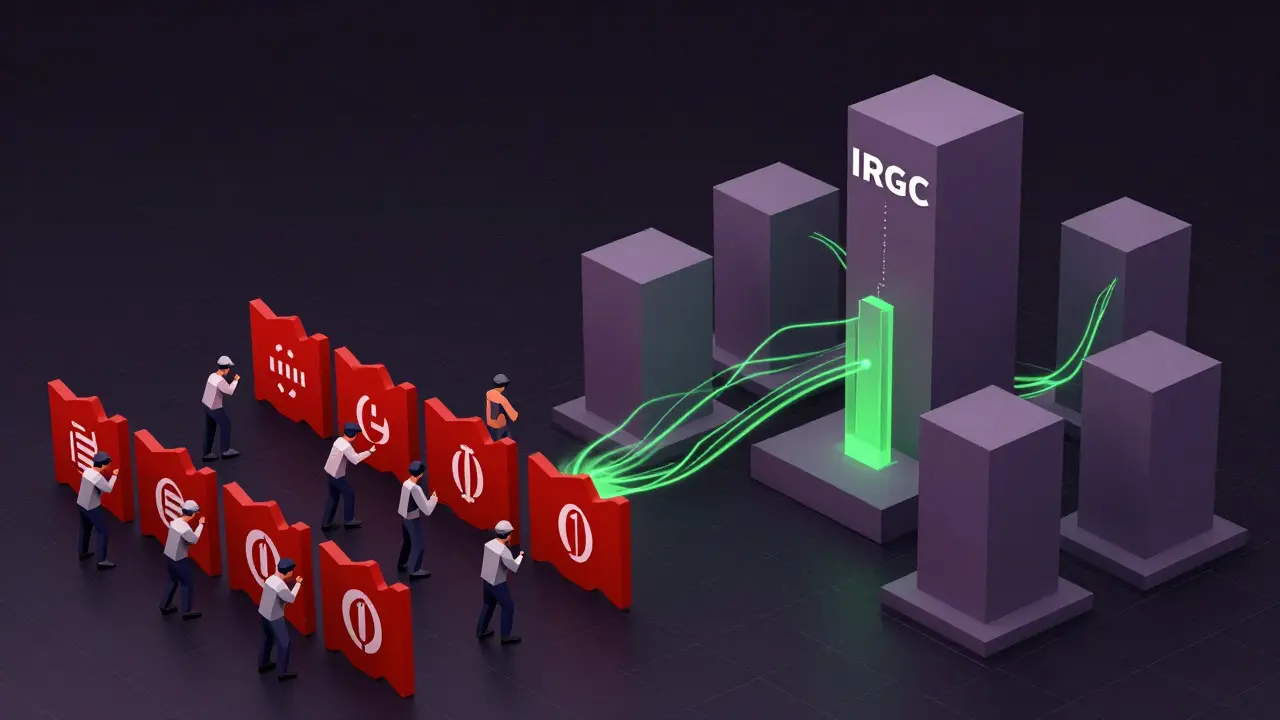
The Shadow Market: IRGC and State-Affiliated Mining
If you’re looking at Iran’s mining landscape, you can’t ignore the biggest player in the room: the state itself. Specifically, the Islamic Revolutionary Guard Corps (IRGC) and entities linked to Supreme Leader Ali Khamenei. Since 2019, these groups have established massive mining operations that often operate with impunity.
Consider the 175-megawatt Bitcoin farm in Rafsanjan, Kerman province. This facility is a joint venture between IRGC-linked enterprises and Chinese investors. It draws heavily subsidized power, often ignoring electricity bills entirely. According to investigations by NCR-Iran, state-affiliated entities control approximately 65% of Iran's total mining capacity. They benefit from political protection that private miners do not have.
This creates a dual-market reality. On one side, you have licensed private operators facing strict regulations, high tariffs, and potential power cuts. On the other, you have politically connected giants operating with minimal oversight. For foreign investors, this is a major red flag. You are competing against entities that don’t play by the same rules. The playing field is not level; it is tilted heavily toward the state.
| Feature | Licensed Private Miner | State-Affiliated (IRGC) |
|---|---|---|
| Regulatory Oversight | Strict CBI monitoring, daily reporting | Minimal, political protection |
| Electricity Cost | Highest industrial tariff | Subsidized or free |
| Power Priority | Low (cut during shortages) | High (protected status) |
| Licensing Requirement | Mandatory CBI license | Internal state approval |
| Risk Level | High (policy changes, bans) | Low (state-backed) |
Navigating the Bureaucracy: How to Get Licensed
If you decide to proceed despite the risks, here is what the process looks like. It is not simple. It requires patience, legal expertise, and constant vigilance.
- Hardware Approval: You cannot just buy any ASIC miner. You must use government-approved hardware. Submit specifications to the Ministry of Industry, Mine and Trade for verification.
- Energy Projection: Provide detailed calculations of your expected energy consumption. Tavanir will review this to ensure it fits within regional grid capacities.
- Financial Transparency: Open a designated account with a bank approved by the CBI. All rial transactions must flow through this account. Prepare for full audit trails.
- Dual Licensing: Obtain licenses from both the Ministry of Industry, Mine and Trade and the Central Bank of Iran. Missing either step renders your operation illegal.
- Ongoing Compliance: Monitor official communications from at least three government entities daily: the Ministry of Industry, the CBI, and Tavanir. Regulations change frequently.
The learning curve is steep. Many experienced operators hire specialized legal compliance officers who understand both blockchain analytics and Iranian financial regulations. This is not a set-it-and-forget-it business. It is a full-time job of navigating bureaucracy.

Market Instability and User Impact
The regulatory environment affects more than just miners. It impacts the entire crypto ecosystem in Iran. In January 2025, the CBI effectively blocked all Iranian cryptocurrency-to-rial payments through internet websites. For 23 days, an estimated one million Iranians were unable to buy cryptocurrencies to make payments. This caused widespread frustration and economic disruption.
Although the government partially reversed this ban in late January by unblocking exchanges with their own government API, the damage was done. Trust eroded. User acquisition costs for domestic exchanges increased by 300%. Furthermore, in February 2025, a global ban on cryptocurrency advertising-both online and offline-was implemented. This silenced public discussion and made it harder for new users to enter the market.
Data from TRM Labs shows an 11% decline in cryptocurrency inflows during the first half of 2025. The market is contracting. Individual usage has shifted toward peer-to-peer (P2P) transactions to circumvent platform restrictions, with LocalBitcoins reporting a 78% increase in Iranian P2P volume following the December 2024 payment blockade. The formal market is shrinking, while the informal market grows in the shadows.
Future Outlook: State Control and Digital Rial
Where is this heading? The trend is clear: increasing state control. The CBI is developing its own digital currency, the "Rial Currency," described as the electronic version of common banknotes. Unlike Bitcoin, it cannot be mined, and its supply is regulated by the bank. This positions the state to replace decentralized cryptocurrencies in official transactions.
Analysts remain skeptical about the long-term viability of private mining in Iran. AGSI notes that cryptocurrency is unlikely to help the regime evade US sanctions immediately. Meanwhile, the Iranian Cryptocurrency Union warns that the mining sector could collapse entirely if summer 2026 brings power shortages comparable to previous years. The fundamental contradiction remains: Iran needs crypto revenue, but its infrastructure cannot support the energy demands of mining without sacrificing stability.
For foreign investors, the advice is cautious optimism at best. The low electricity costs are attractive, but the regulatory whiplash is dangerous. You are entering a market where the rules change overnight, and your biggest competitor is the government itself. Proceed with extreme caution, secure robust legal counsel, and prepare for volatility.
Who regulates crypto mining in Iran?
The Central Bank of Iran (CBI) is the sole regulatory authority for licensing and oversight, working alongside the Ministry of Industry, Mine and Trade for hardware and operational approvals.
Can foreigners mine crypto in Iran?
Yes, foreign investors can obtain licenses, but they face the same strict regulations as locals. Joint ventures with state-linked entities are common due to political protection.
What happens if you mine without a license?
Unlicensed mining is illegal. Equipment is subject to confiscation, and operators face fines and potential criminal charges for electricity theft.
How much does electricity cost for miners in Iran?
Legal miners pay the highest industrial tariff, significantly more than the subsidized $0.004/kWh rate. Illegal miners may access cheaper or free power but risk seizure.
Is the Iranian crypto market growing?
No, it is contracting. TRM Labs reported an 11% drop in inflows in early 2025, driven by regulatory bans and advertising restrictions.