PayPal Limited Your Account? How Crypto Alternatives Protect You
There is a specific kind of panic that hits when you log into your PayPal a centralized online payments company founded in December 1998 account and see the dreaded red banner: "Your account is limited." If you are running an online business, freelancing, or even just managing personal finances, this notification feels like a sudden cardiac arrest. Your money-often hundreds or thousands of dollars-is frozen. You cannot withdraw it. You cannot send it. And usually, there is no clear timeline for when you will get it back.
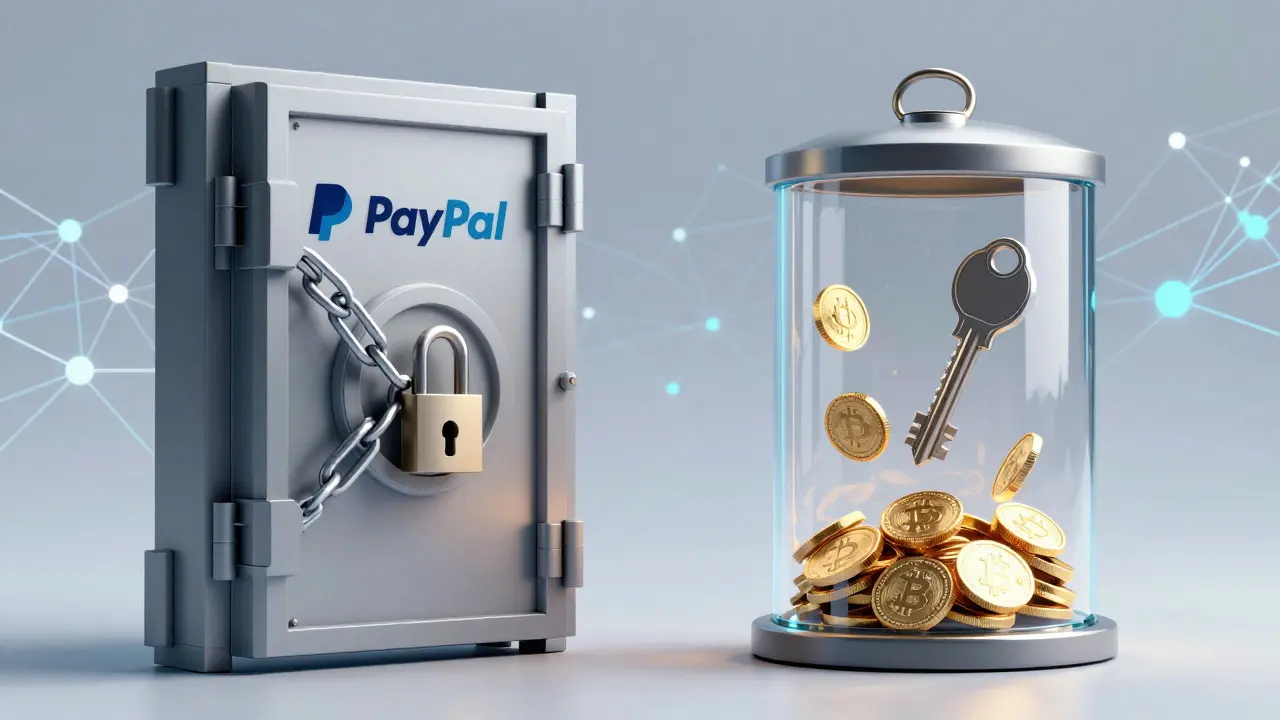
This is not a glitch. It is a feature of centralized finance. When you use PayPal, you do not actually own the funds in the way you think you do. You have a claim on a ledger entry inside their database. They hold the keys to that database. If their automated risk algorithms flag your activity as suspicious, or if they need to verify your identity again, they can cut off your access instantly. This reality has pushed many users to look for crypto billing solutions that operate outside these centralized control mechanisms.
Why Centralized Gatekeepers Will Always Limit You
To understand why you need an alternative, you first have to accept how PayPal works. Founded by Max Levchin, Peter Thiel, and others, PayPal grew into a global giant by offering convenience. But that convenience comes with a price: total surrender of control. Under PayPal's terms, they retain the contractual right to limit, freeze, or restrict both fiat and crypto balances for risk, compliance, or policy reasons.
In 2020, PayPal introduced retail cryptocurrency functionality in the United States, allowing users to buy, hold, and sell Bitcoin (BTC), Ethereum (ETH), Litecoin (LTC), and Bitcoin Cash (BCH). On the surface, this looks like progress. However, this is a custodial model. PayPal acts as the custodian via third-party providers. You cannot export your private keys. If PayPal places a limitation on your main fiat account, that limitation propagates immediately to your Crypto Hub. Your digital assets are frozen alongside your dollars.
The limits are strict. For verified U.S. accounts, the weekly crypto purchase limit is up to USD 100,000, but new accounts start much lower, around USD 1,000 per week. Transfers out to external wallets are capped at USD 25,000 per week. These are hard-coded ceilings. In contrast, permissionless cryptocurrency networks like Bitcoin or Ethereum have no per-user notion of "account limitation" enforced by a single company. The protocol rules apply uniformly to everyone, regardless of who they are or where they live.
The Core Problem: Custody vs. Control
The fundamental issue with PayPal-and any traditional bank or centralized exchange-is custody. When you store value in a centralized system, you are relying on someone else's integrity and infrastructure. Community reports from platforms like Hacker News frequently highlight cases where users had accounts locked without prior notice, sometimes holding funds for approximately 180 days pending risk review. Critics argue that holding significant balances in such systems is risky because "they are not a bank" in the regulatory sense that offers deposit insurance for crypto holdings.
The solution lies in shifting from custodial, account-based systems to non-custodial, key-based systems. In a non-custodial setup, you hold your own private keys. There is no central database entry labeled with your real-world identity that a company can flag or freeze. Control is determined by possession of cryptographic keys. Transactions are validated by a decentralized network of nodes according to consensus rules. This architectural difference is why experts emphasize the principle: "not your keys, not your coins."
Non-Custodial Wallets: The First Step Toward Freedom
If your goal is to avoid account limitations entirely, your first move should be toward self-custody. Non-custodial cryptocurrency wallets are the most direct functional alternative. Technically, these wallets store your private keys locally-in encrypted files on your computer or, more securely, on hardware devices like Ledger or Trezor. They derive public addresses from those keys and broadcast signed transactions directly to the blockchain.
Because there is no corporate account associated with the wallet, there is no concept of an "account limitation" imposed by a service provider. The only constraints you face are network-level factors: transaction fees, block capacity, and protocol rules. Security trade-offs exist; hardware wallets prioritize isolation from internet-connected devices, while software wallets prioritize usability. But in all cases, the entity that can spend the funds is you, the holder of the private key, not an intermediary subject to internal risk policies.
Beyond Personal Use: Crypto Billing for Merchants
For individuals, moving to a self-custody wallet solves the problem of storing value. But what if you are a merchant? What if you run a website, offer freelance services, or sell digital products? You need a way to accept payments without creating a centralized point of failure. This is where modern crypto billing gateways come into play.
Traditional payment processors like Stripe or PayPal require extensive KYC (Know Your Customer) checks, registered business entities, and ongoing compliance reviews. If you trigger a fraud alert, your entire revenue stream stops. A growing number of solo founders, indie hackers, and small project operators are turning to non-custodial payment gateways that integrate directly with their own wallets.
These tools work differently. Instead of sending customer payments to the gateway's balance sheet, the gateway generates a unique payment address derived from your public keys. When a customer pays, the funds settle directly to your wallet on-chain. The gateway never touches the money. It simply watches the blockchain for the transaction and notifies you via webhook. Because the funds never enter the platform's custody, there is no possibility of chargebacks, payout holds, or account freezes. The settlement is final.
| Feature | PayPal / Centralized Banks | Custodial Exchanges (CEX) | Non-Custodial Crypto Billing |
|---|---|---|---|
| Custody | Platform holds funds | Exchange holds funds | User holds funds (Self-Custody) |
| Account Limits | Yes (Risk-based freezes) | Yes (KYC/Compliance holds) | No (Protocol-level only) |
| Chargebacks | High risk | Low risk (but reversible by admin) | Impossible (Final settlement) |
| Onboarding | Strict KYC + Business Docs | Strict KYC | Often minimal/no KYC required |
| Fees | Percentage + Fixed Fee | Trading/Withdrawal Fees | Flat subscription or low fee |
How Modern Crypto Billing Gateways Work
The technology behind these alternatives is sophisticated yet accessible. A typical non-custodial gateway allows you to connect your extended public keys (xpubs) from a hardware wallet. The system derives a unique invoice address for each transaction. Crucially, advanced SDKs allow developers to independently re-derive every payment address locally. This means you don't have to trust the gateway's server to give you the right address; your code verifies it against your own keys.
For example, some modern platforms support multiple chains including Bitcoin, Ethereum, Polygon, BNB Smart Chain, and TON. They use thin adapters over established third-party providers for payment detection, meaning you don't need to run complex node infrastructure. You just deploy a simple integration, and the gateway handles the rest. This approach is particularly appealing to vibe-coders and solo builders who want to ship features quickly without becoming payments-infrastructure experts.
One such example in this space is TxNod. Unlike traditional processors, TxNod is designed so that funds settle straight to the merchant's wallet. There is no platform-side balance. This structural design makes account freezes impossible because there is nothing for the platform to freeze. For operators who have been burned by PayPal's arbitrary holds, this shift in architecture provides peace of mind that no amount of customer support tickets can match.
Migrating from PayPal to Self-Custody
Transitioning away from a limited PayPal account requires careful steps. You cannot simply "move" your PayPal balance to a crypto wallet if the account is frozen. You must first resolve the limitation through PayPal's Resolution Center, which may involve uploading identity documents, proof of address, or business documentation. This process can take weeks or months.
Once you regain access, or if you are starting fresh, the migration path looks like this:
- Choose a Non-Custodial Wallet: Select a wallet compatible with your intended network. For Bitcoin, consider a dedicated BTC wallet. For Ethereum and ERC-20 tokens, MetaMask or a hardware wallet like Ledger works well. Securely back up your seed phrase. Losing this data permanently destroys access to your funds.
- Acquire Cryptocurrency: Since you cannot withdraw crypto from a limited PayPal account easily, you may need to use a regulated exchange or a peer-to-peer market to acquire initial capital. Be aware that exchanges themselves are custodial and can impose limits, so treat them as on-ramps, not storage.
- Set Up Crypto Billing: If you are a merchant, integrate a non-custodial payment gateway. Look for solutions that offer TypeScript SDKs, webhooks, and multi-chain support. Ensure the gateway does not require you to upload private keys.
- Manage Transaction Fees: In the crypto world, you pay network fees (gas fees) rather than processing percentages. Understand the fee structures of the chains you are using. Ethereum gas can be high during congestion, while Layer 2 solutions like Polygon or networks like TRON offer lower costs for stablecoin transfers.
- Handle Tax Reporting: PayPal previously handled consolidated statements. With self-custody, you are responsible for tracking disposals and gains. Use portfolio tracking tools that connect to your public addresses to automate this process.
Risks and Responsibilities of Self-Custody
While non-custodial solutions eliminate the risk of account freezing, they introduce a different type of risk: user error. If you lose your private keys or seed phrase, there is no "Forgot Password" button. No support team can restore your access. The funds are gone forever. This is the trade-off for freedom. You gain unilateral control, but you also bear full responsibility for security.
Additionally, while the blockchain itself cannot censor you, regulators can pressure centralized on-ramps and off-ramps. If you convert crypto back to fiat currency, you will eventually interact with banks or exchanges that enforce KYC. However, the ability to transact, hold, and transfer value globally without asking permission remains intact. This is why many industry educators recommend self-custody for anyone who cares about censorship resistance.
Conclusion: Reclaiming Financial Autonomy
PayPal's account limitations are not a bug; they are the inherent nature of centralized financial intermediaries. By placing your trust in a single company, you accept their rules, their risks, and their power to freeze your assets. Crypto alternatives, particularly non-custodial wallets and payment gateways, offer a different paradigm. They rely on mathematics and decentralized consensus rather than corporate policy.
For merchants and individuals alike, the shift to crypto billing and self-custody is not just about avoiding fees; it is about ensuring that your livelihood is not held hostage by an algorithm's risk score. By taking control of your keys and using tools that respect that autonomy, you build a financial foundation that truly belongs to you.
Can PayPal freeze my crypto holdings?
Yes. PayPal operates a custodial model for its crypto hub. If your main PayPal account is limited due to risk or compliance issues, that limitation extends to your crypto balances. You cannot withdraw your crypto to an external wallet if your account is frozen.
What is a non-custodial crypto payment gateway?
A non-custodial crypto payment gateway is a tool that helps merchants accept cryptocurrency without ever holding the funds. It generates payment addresses derived from the merchant's own wallet keys. Payments settle directly on-chain to the merchant, eliminating counterparty risk and the possibility of the gateway freezing funds.
How do I recover my funds if PayPal limits my account?
You must go through PayPal's Resolution Center. This typically involves submitting requested documents such as government ID, proof of address, or business records. The time frame varies based on complexity, but in severe cases, funds can be held for up to 180 days. There is no guaranteed quick fix.
Are there transaction limits on non-custodial wallets?
No. Non-custodial wallets do not have per-user transaction limits imposed by a service provider. The only constraints are network-level factors such as block size and transaction fees. You can send or receive any amount supported by the underlying blockchain protocol.
Is it safe to use crypto for business billing?
It can be very safe if you use proper tools. Non-custodial gateways provide finality of settlement, meaning no chargebacks. However, you must manage your own security (private keys) and handle tax reporting. Volatility can be mitigated by accepting stablecoins like USDC or USDT.