

Perpetual Futures vs Quarterly Futures: Which Crypto Derivative Fits Your Strategy?
Funding Fee Calculator
Calculate Your Costs
When you trade crypto derivatives, you’re not buying Bitcoin or Ethereum-you’re betting on their price. And two contracts dominate this space: perpetual futures and quarterly futures. They both let you go long or short without owning the asset, but they’re built for completely different kinds of traders. Pick the wrong one, and you could be paying hundreds in fees you didn’t see coming-or missing out on a better setup for your strategy.
Perpetual Futures: No Expiration, But a Hidden Cost
Perpetual futures have no end date. You can hold them for days, weeks, or even years-no need to roll over contracts or worry about expiration. That’s why they’re the go-to for day traders, scalpers, and anyone who wants to react instantly to price swings. You can open a position at 3 a.m. on a Sunday, and no one’s going to force you to close it.
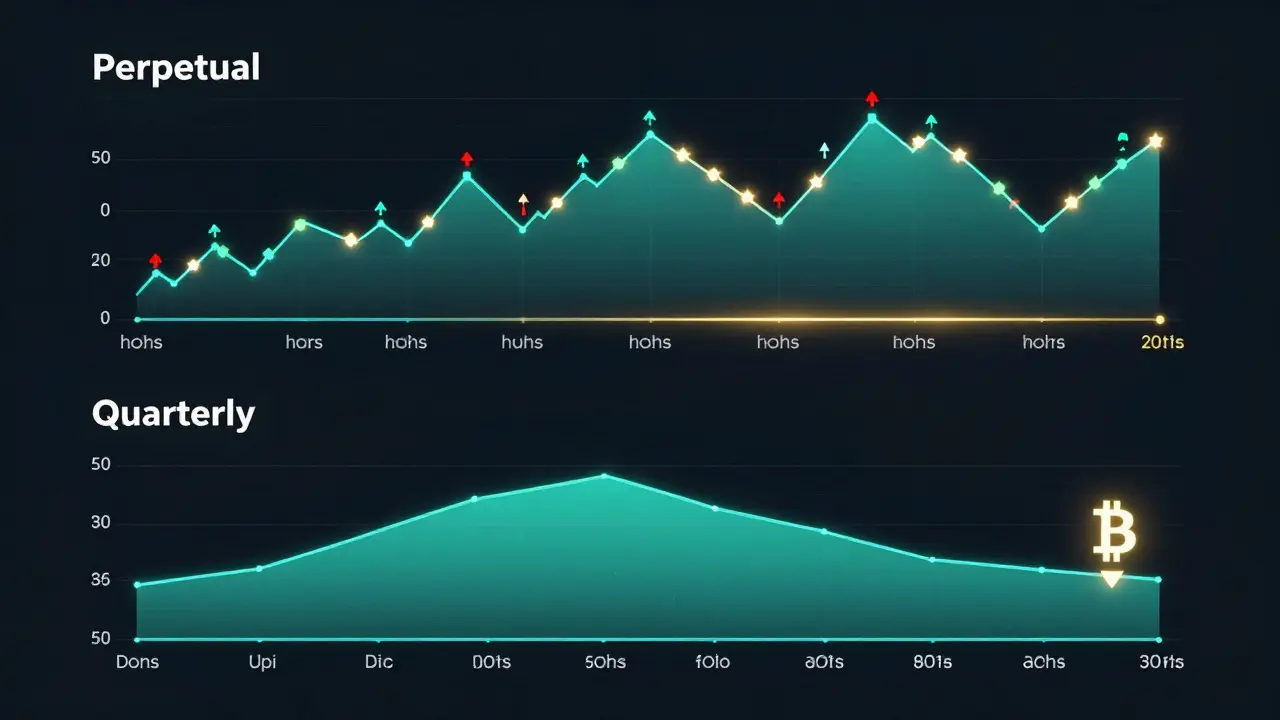
But there’s a catch: funding fees. Every eight hours, the exchange calculates a payment between long and short traders to keep the contract price tied to the actual spot price of Bitcoin or Ethereum. If you’re long and funding rates are positive, you pay shorts. If you’re short and rates are negative, you pay longs. It’s not a fixed fee-it moves with the market. On a volatile day, you could pay 0.05% every eight hours. That adds up to 0.15% per day, or over 5% a month. For a $10,000 position, that’s $500 a year just in fees-no price movement needed.
These fees aren’t random. They’re designed to prevent perpetual contracts from drifting too far from the spot price. If perpetuals trade at $70,000 while Bitcoin is at $68,000, longs pay shorts to bring the price back down. It’s a self-correcting system, but it’s also a cost you can’t ignore if you hold positions long-term.
Quarterly Futures: Set It and Forget It (Until It Expires)
Quarterly futures expire every three months-on the last Friday of March, June, September, and December. So if you open a BTC quarterly contract in January, it’ll expire on March 28, 2025. No more, no less. You can’t hold it past that date. But here’s the big win: zero funding fees.
That’s why professional traders, hedge funds, and long-term investors prefer quarterly contracts. If you’re holding a Bitcoin position for six months to hedge against a market dip, you won’t get drained by daily fees. You pay a one-time premium when you open the trade, and that’s it. No surprises. No overnight fee calculations. Just clean exposure.
These contracts also settle in Bitcoin, not USDT or USD. So if you’re long a BTC quarterly contract and it expires in-the-money, you don’t get cash-you get actual Bitcoin. That’s a big deal if you’re trying to accumulate the asset without buying it directly on an exchange. It’s a stealth way to build your stack.
Levelling the Playing Field: Leverage and Margin
Both contract types offer leverage-often up to 100x on some platforms. But the margin requirements differ. Perpetual futures usually require higher initial margins because of their constant price volatility and funding risk. Quarterly contracts, being more stable and predictable, often allow lower margin requirements. That means you can control the same size position with less capital upfront.
But here’s the trade-off: higher leverage on perpetuals means faster liquidations. If the market moves 5% against you on 20x leverage, you’re out. Quarterly contracts are less prone to sudden liquidations because they’re priced closer to spot and don’t have the funding fee distortion. That makes them safer for beginners who want to hold without micromanaging their positions.
Liquidity and Market Depth
Perpetual futures dominate trading volume. On Binance, Bybit, and OKX, the perpetual BTC/USDT pair trades more than 10x the volume of the quarterly contract. That’s because of the 24/7 nature of crypto and the flexibility of perpetuals. More traders = tighter spreads = better entry and exit prices.
Quarterly futures have lower volume, but they’re still deeply liquid-especially around expiration dates. That’s when institutional traders move in to close positions or roll them over. If you’re trading large sizes, quarterly contracts can still offer excellent execution, especially near the end of the quarter.
Who Should Use Which?
If you’re a day trader, swing trader, or scalper who opens and closes positions within hours or days-go with perpetual futures. The liquidity, speed, and 24/7 access are unmatched. You’ll pay funding fees, but if you’re not holding past 24 hours, those fees are negligible.
If you’re holding for weeks or months, hedging a portfolio, or trying to accumulate Bitcoin without buying it outright-choose quarterly futures. No funding fees. No surprises. Just clean, long-term exposure.
Some traders use both. They’ll hold a long-term position in quarterly futures to avoid fees, then use perpetuals for short-term trades on the same asset. It’s a hybrid strategy that gives you flexibility without the cost bleed.

What Happens When Quarterly Futures Expire?
You have three choices:
- Close your position before expiration-this is the safest move.
- Rollover to the next quarter-sell your current contract and buy the next one, locking in your profit or loss.
- Let it expire-your position settles automatically in Bitcoin, and you’ll receive the difference between your entry price and the final settlement price.
Most retail traders close or rollover. Letting it expire can be risky if you don’t have the Bitcoin to receive-or if you didn’t plan for the tax implications. Settlement isn’t instant; it can take 24-48 hours. And if you’re short and the price spikes at expiration, you could owe more than you expected.
The Bottom Line: It’s About Time and Cost
Perpetual futures are for speed. Quarterly futures are for savings. One gives you freedom to trade anytime. The other gives you freedom from fees.
Ask yourself:
- Are you holding longer than a week? Then quarterly futures probably save you money.
- Are you trading multiple times a day? Perpetuals give you the edge.
- Do you want to end up with actual Bitcoin? Quarterly contracts settle in the asset.
- Do you hate checking your funding rate every 8 hours? Then avoid perpetuals.
There’s no ‘better’ contract. Only the one that fits your rhythm. Most traders stick to one type because they don’t realize the other even exists. Don’t be one of them. Understand the cost structure. Know your time horizon. And trade smarter-not harder.
Are funding fees the same for all perpetual futures?
No. Funding rates vary by exchange, asset, and market conditions. Bitcoin perpetuals usually have lower rates than altcoins because they’re more stable. During big price moves-like a Bitcoin rally or crash-funding rates can spike to 0.1% or more every eight hours. Always check the current rate before holding a position overnight.
Can I switch from perpetual to quarterly futures mid-trade?
You can’t directly convert one into the other. But you can close your perpetual position and open a quarterly one at the same time. This is called a ‘roll.’ Traders do this when they want to avoid funding fees while keeping exposure. Just make sure you’re not paying double fees or missing a price gap between the two contracts.
Why do quarterly futures settle in Bitcoin instead of USDT?
Settling in Bitcoin gives traders direct exposure to the underlying asset without needing to buy it on a spot exchange. It’s especially useful for institutions and long-term holders who want to accumulate Bitcoin without triggering KYC or tax events on spot markets. It also reduces reliance on stablecoins, which some traders see as a counterparty risk.
Do quarterly futures have higher slippage than perpetuals?
Not usually. While perpetuals have higher overall volume, quarterly contracts still have deep order books, especially near expiration. Slippage depends more on trade size and market conditions than contract type. For retail traders under $10,000 per trade, slippage is minimal on both.
Is it risky to hold quarterly futures until expiration?
It’s risky if you don’t understand settlement. If you’re long and the price drops sharply at expiration, you’ll get less Bitcoin than expected. If you’re short and the price surges, you might owe more than your margin covers. Most traders close before expiration to avoid this. Only hold to expiry if you’re prepared to receive or deliver Bitcoin and understand the timing and tax implications.






16 Comments
Mohamed Haybe
December 2, 2025 at 15:17
Perpetuals are for noobs who can't plan ahead
Marsha Enright
December 3, 2025 at 09:52
Love this breakdown! Seriously helped me realize I was bleeding money on perpetuals holding overnight 😅 Switched to quarterly and my portfolio’s breathing again. Thank you!
Durgesh Mehta
December 3, 2025 at 17:10
Quarterly for long term makes sense
Sarah Roberge
December 4, 2025 at 11:17
like… isn’t this just capitalism’s way of making you pay to exist in a market? like we’re all just ants in a futures maze and the exchange is the queen bee sipping her matcha latte while we pay 0.05% every 8 hours like it’s a toll booth on the highway to nowhere
Jess Bothun-Berg
December 5, 2025 at 20:26
....this post is decent... but you didn't mention the tax implications of quarterly settlement in BTC... which is a MAJOR oversight. Also... why are you assuming everyone uses Binance? Some of us are on Deribit... where the dynamics are COMPLETELY different...
Joe B.
December 6, 2025 at 17:19
Let’s be real - perpetuals are a cash drain disguised as convenience. I’ve seen traders with $50k positions get wiped out by funding fees alone during a 48-hour rally. The funding rate isn’t a fee - it’s a stealth tax. Quarterly futures aren’t just cheaper - they’re psychologically liberating. No more 3 a.m. panic checks. No more ‘why is my balance down 2% when BTC barely moved?’ It’s not about trading skill - it’s about surviving the grind. And if you’re still using perpetuals for anything longer than 24 hours, you’re not trading - you’re donating to the exchange’s quarterly profit report.
Katherine Alva
December 8, 2025 at 15:13
There’s something poetic about quarterly futures - they force you to think in seasons, not seconds. The market doesn’t move in milliseconds, it moves in cycles. Holding through a quarter feels like planting a seed and waiting for harvest. Perpetuals? They’re like constantly replanting the same seed in the same pot, hoping the soil won’t run out. We forget that time is a tool, not a nuisance.
Murray Dejarnette
December 9, 2025 at 22:21
Bro you’re telling me you’re not using perpetuals because you’re scared of a few funding fees? 😂 Get a backbone. If you can’t handle 0.1% every 8 hours, you shouldn’t be trading crypto at all. I’ve made 30% on a single swing trade using 50x leverage on perpetuals - and paid $12 in fees. You’re not a trader if you’re afraid of the cost of doing business.
Sarah Locke
December 11, 2025 at 12:00
Y’ALL. I just want to say - this is the most clear, thoughtful breakdown I’ve read in months 🥹. I used to think quarterly futures were for ‘old-school’ traders. Then I held one for 90 days and realized I saved over $800 in fees. I’m not just trading - I’m building. And that matters. Thank you for writing this like a human, not a bot. 💛
Mani Kumar
December 12, 2025 at 14:13
Perpetuals are retail instruments. Quarterly are institutional. The distinction is not technical - it is existential.
Tatiana Rodriguez
December 13, 2025 at 08:02
I used to think I was being smart by using perpetuals because they were ‘always available’ - until I realized I was just addicted to the noise. The constant funding rate updates, the 24/7 charts, the FOMO - it was like being stuck in a casino where the slot machines beep every 8 hours. Switching to quarterly felt like stepping out of the noise into a quiet room. I sleep better. I think clearer. I trade better. It’s not about the money - it’s about your mental space. And that’s worth more than any leverage.
Philip Mirchin
December 14, 2025 at 00:02
As someone who’s traded both in the US and India - this is spot on. In India, most retail traders don’t even know quarterly futures exist. They just see ‘no expiry’ and think it’s easier. But the funding fees? Oh man, they don’t even track them. I’ve seen friends lose 15% of their account in a month just from fees. We need more education like this - especially in emerging markets.
Melinda Kiss
December 14, 2025 at 01:52
This was so helpful - I’ve been holding perpetuals for months and didn’t realize how much I was paying. I just thought my strategy was ‘bad.’ Turns out, I was just paying rent to the exchange. I’m switching to quarterly tomorrow. Thank you for explaining it so gently. I feel less stupid now 😊
Christy Whitaker
December 15, 2025 at 11:49
Wow. So you’re telling me that if you’re not a hedge fund, you’re just a sucker paying for the privilege of being manipulated? How original. And you wonder why retail traders lose money. This post is just a fancy way of saying ‘you’re too dumb for this game.’
Ann Ellsworth
December 15, 2025 at 18:03
Perpetual funding rates are a manifestation of market inefficiency - a Keynesian arbitrage mechanism disguised as a pricing mechanism. The fact that you’re reducing this to a ‘fee’ reveals your ontological misunderstanding of derivative pricing architecture. Quarterly contracts are merely temporal anchors - they don’t solve the root problem: the misalignment between futures pricing and spot convergence. Also, your ‘settlement in BTC’ point is misleading - it’s only true for non-custodial platforms. On centralized exchanges, it’s still fiat-denominated settlement with BTC accounting. You’re propagating a myth.
Catherine Williams
December 17, 2025 at 00:21
Thank you for writing this. I’m a mom of three who started trading crypto last year. I didn’t know the difference between these two until now. I was using perpetuals because I thought ‘no expiry’ meant ‘no stress.’ Turns out, it meant ‘no sleep.’ I just closed all my perpetual positions and opened a quarterly one. I slept 8 hours last night for the first time in months. You didn’t just explain trading - you gave me back my peace.