
Unifi Protocol DAO Explained: Not a Crypto Exchange, But a Cross-Chain DeFi Ecosystem
Many people think Unifi Protocol DAO is a crypto exchange. It’s not. You won’t find a login page, a deposit button, or a trading interface like Binance or Coinbase. Instead, Unifi Protocol DAO is a set of smart contracts built across multiple blockchains - and its main trading tool, uTrade, is a decentralized exchange that runs without a central company in charge.
What Unifi Protocol DAO Actually Is
Unifi Protocol DAO (UNFI) is a governance token. That means if you hold UNFI, you can vote on changes to the protocol - like new features, fee structures, or which blockchains to support. It’s not a currency you use to buy things. The real workhorse is UP, the utility token used inside the system for fees and rewards.
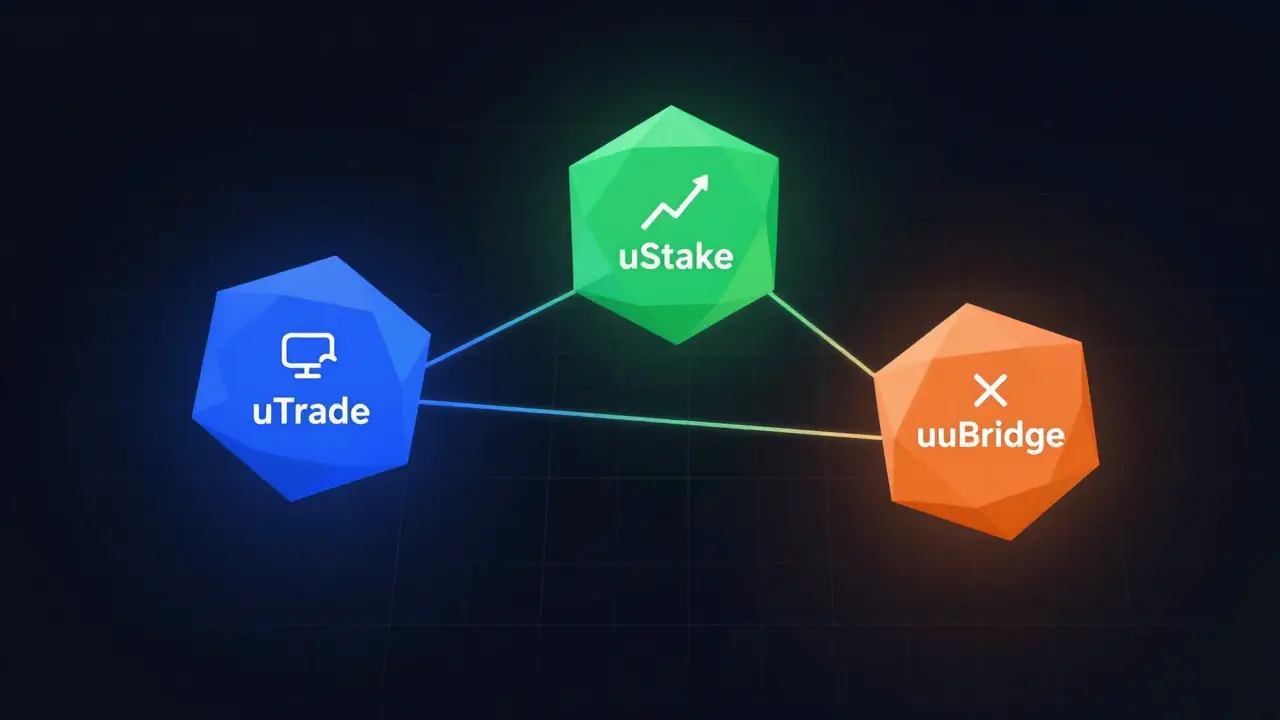
The whole setup has three parts: uTrade (the DEX), uStake (for earning interest on your crypto), and uBridge (to move tokens between chains like Ethereum and Binance Smart Chain). None of these are run by a company. They’re automated programs running on the blockchain. If you trade on uTrade, your money never leaves your wallet. That’s the whole point of decentralized finance.
Why People Get Confused
It’s easy to mix up Unifi Protocol DAO with a centralized exchange because UNFI is listed on trading platforms like Bybit. But here’s the catch: Bybit doesn’t run uTrade. It just lets you buy and sell UNFI the same way you’d buy Bitcoin. The actual trading of tokens across chains happens on uTrade - a separate, non-custodial platform.
Think of it like this: Amazon sells books (UNFI), but the actual reading happens in your home (uTrade). You can buy the book on Amazon, but you don’t read it there. Same with UNFI - you trade the token on centralized exchanges, but you use the DeFi tools on-chain.
How uTrade Works - And Why It’s Different
uTrade is a decentralized exchange that connects liquidity pools across different blockchains. Most DEXs like Uniswap or PancakeSwap only work on one chain. If you want to swap an ERC-20 token for a BEP-20 token, you usually need to bridge your assets first - which costs time and money.
uTrade cuts that step. It lets you trade directly between chains without moving tokens manually. Behind the scenes, it uses smart contracts to lock your asset on one chain and release an equivalent on another. This is useful if you hold ETH and want to trade it for BNB without using a bridge like Wormhole or Multichain.
But here’s the downside: liquidity is thin. Compared to Uniswap, which has billions in locked value, uTrade’s pools are small. That means you’ll likely face high slippage on larger trades. A $500 swap might cost you 5% in price impact. That’s not ideal unless you’re trading small amounts.
UNFI Price and Market Reality
As of late October 2025, UNFI traded around $0.14 on Bybit. That’s down from higher peaks in 2021. Some websites claim it could hit $65 or even $400 by 2041. Those numbers are fantasy. They’re based on speculative AI models with no real-world validation.
Real data tells a different story. CoinMarketCap flagged UNFI in April 2025 for failing periodic reviews due to low user interest and trading volume. One exchange even stopped accepting withdrawals for UNFI after that date, citing liability risks. That’s not a sign of a healthy project - it’s a red flag.
Technical indicators are neutral at best. The RSI sits around 40, meaning no strong trend. The 200-day moving average is trending downward. Kraken’s model predicts UNFI will hit $0.15 by 2026 and $0.18 by 2030 - a 5% annual rise. That’s not exciting. It’s barely inflation-adjusted.
Stablechain: The Only Real Hope
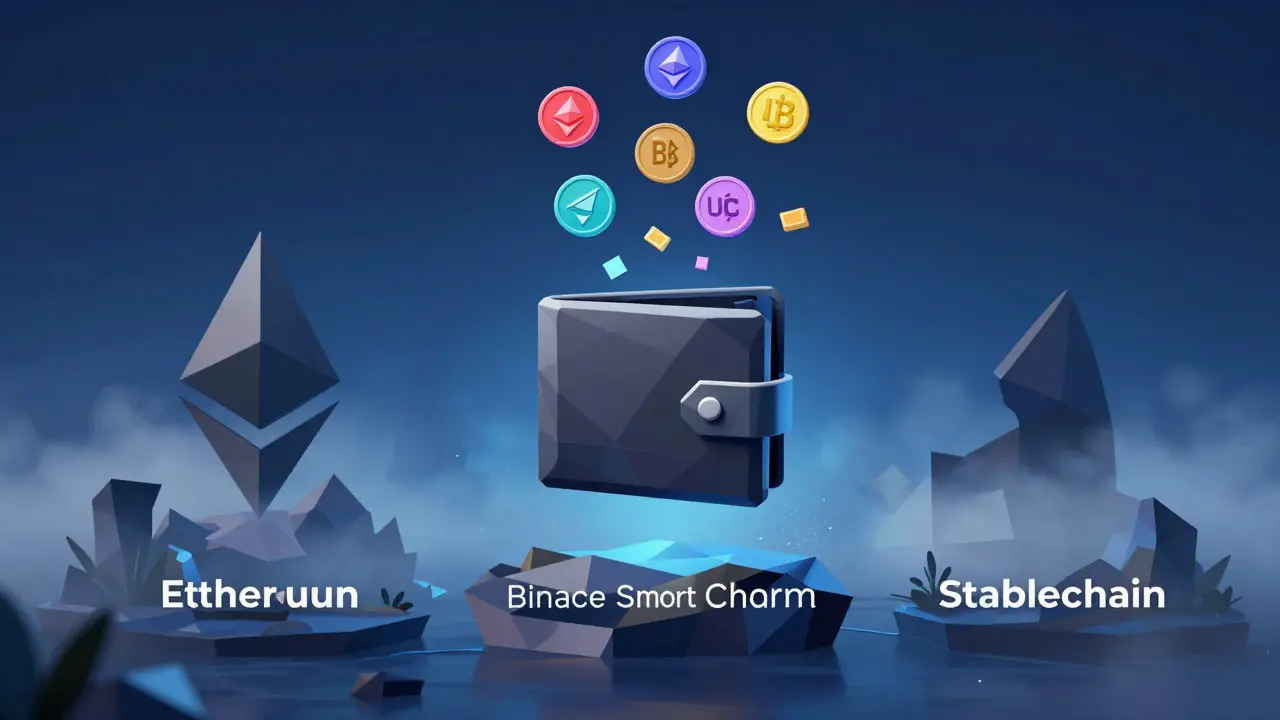
Unifi Protocol’s best shot at survival is Stablechain - a proposed blockchain where gas fees are paid in stablecoins like USDC, not in UNFI or ETH. Right now, using DeFi means paying fees in volatile tokens. If ETH spikes, your swap costs $50 in gas. If it crashes, you’re stuck with unused tokens.
Stablechain would fix that. Pay your fees in USDC, and you know exactly how much it costs. That’s huge for everyday users. But here’s the problem: no one has seen it live. No testnet. No code release. No timeline. Without this, Unifi Protocol is just another DeFi project with a cool idea and no users.
Who Should Even Care About UNFI?
If you’re a retail trader looking to make quick profits - skip it. UNFI has low volume, low liquidity, and no clear catalyst. You’re better off with UNI, COMP, or even MATIC.
If you’re a DeFi builder - maybe. If you’re experimenting with cross-chain swaps and want to test a non-mainstream DEX, uTrade could be a sandbox. But treat it like a lab, not a bank.
If you’re a long-term believer in decentralized infrastructure - keep an eye on Stablechain. If it launches and works as promised, it could be a quiet revolution. But until then, it’s just a slide in a pitch deck.
The Bottom Line
Unifi Protocol DAO is not a crypto exchange. It’s a set of tools for cross-chain DeFi, with a governance token that’s losing traction. uTrade is technically interesting but underused. UNFI’s price is flat, its community is small, and its future depends on a feature that hasn’t been built yet.
Don’t buy UNFI because you think it’s the next big thing. Buy it only if you understand the risks, you’re okay with losing most of your money, and you’re willing to wait years - if ever - for Stablechain to become real.
For most people, the best move is to ignore it. Focus on projects with real users, real volume, and real progress. Unifi Protocol DAO is a footnote in DeFi - not a headline.




18 Comments
Surendra Chopde
January 8, 2026 at 11:01
Unifi Protocol DAO isn’t a crypto exchange? Cool, so why does every listing site treat it like one? The branding is misleading, and that’s not just semantics - it’s a user experience failure.
Allen Dometita
January 10, 2026 at 05:07
uTrade sounds like a neat idea but if your $500 trade loses 5% to slippage, you’re better off just holding. No one wants to be a guinea pig for underfunded DeFi experiments.
Meenakshi Singh
January 10, 2026 at 10:46
Stablechain could be the real MVP 🚀 if it ever launches. Until then, it’s just vaporware with a fancy whitepaper.
Tre Smith
January 11, 2026 at 03:54
The claim that UNFI is "losing traction" is an understatement. CoinMarketCap flagged it for low activity, an exchange halted withdrawals, and the 200-day MA is sloping downward. This isn’t a speculative asset - it’s a graveyard with a token.
Sarbjit Nahl
January 11, 2026 at 20:26
People confuse governance tokens with exchanges because they want simplicity. But complexity is the price of decentralization. If you can’t handle that, stick to Coinbase
Valencia Adell
January 13, 2026 at 06:58
Anyone still holding UNFI after the withdrawal halt? You’re either delusional or already emotionally attached to the dream. Either way, you’re not investing - you’re subsidizing someone else’s fantasy.
sathish kumar
January 15, 2026 at 03:30
It is imperative to distinguish between the governance token (UNFI) and the operational infrastructure (uTrade, uStake, uBridge). Confusion arises not from the protocol’s design, but from the conflation of secondary market activity with primary utility. The absence of a centralized interface does not equate to absence of functionality.
Moreover, the assertion that liquidity is thin is empirically verifiable; however, this is not unique to Unifi Protocol DAO. Many niche DeFi protocols suffer from the same issue until network effects materialize. The critical variable is not liquidity per se, but the persistence of developer activity and community governance participation.
Stablechain, if implemented as described, would constitute a non-trivial innovation in gas fee abstraction. The current paradigm of paying fees in volatile native tokens is antithetical to user adoption among non-technical actors. The absence of a testnet does not invalidate the concept - it merely indicates premature public disclosure.
It is regrettable that speculative price targets are cited without methodological transparency. Financial forecasting without empirical grounding is not analysis - it is narrative construction. The RSI at 40 and the downward-moving average reflect market sentiment, not intrinsic value.
For the retail trader, UNFI offers neither arbitrage nor yield. For the institutional actor, it offers neither compliance nor custody. For the DeFi builder, it offers a sandbox - albeit one with limited participants. The question is not whether Unifi Protocol DAO is dead, but whether its core innovations can be absorbed by larger ecosystems before obsolescence.
Sabbra Ziro
January 15, 2026 at 18:08
I get that people are skeptical, but let’s not throw the baby out with the bathwater. Stablechain could be huge - imagine paying gas in USDC instead of watching your fee jump from $2 to $50 because ETH spikes. That’s not just convenient, it’s revolutionary for everyday users.
Maybe uTrade isn’t popular yet, but that doesn’t mean it’s useless. Sometimes the best tools are the quiet ones. I’d rather see someone building something real than another meme coin with a Discord full of bots.
Paul Johnson
January 16, 2026 at 15:24
unifi is just another coin that got listed on bybit and now everyone thinks its a platform lmao. you buy the token on a ce exchange and then you go to some weird website with no logo and try to swap tokens and then you realize you lost half your money to gas and slippage. why would anyone do this
Mujibur Rahman
January 17, 2026 at 07:27
The real issue here isn’t liquidity or price - it’s governance inertia. If UNFI holders aren’t voting on proposals, the protocol becomes a ghost town. No one’s updating the code, no one’s adding chains, no one’s even reading the docs. It’s not broken - it’s abandoned.
Stablechain might be the only thing left worth watching, but if the DAO hasn’t even deployed a testnet in 18 months, why should we believe they’ll ever ship it?
Sherry Giles
January 19, 2026 at 03:15
They’re hiding something. Why did that exchange stop withdrawals right after CoinMarketCap flagged it? CoinMarketCap is owned by Binance, and Binance hates decentralized competition. This isn’t a low-volume coin - it’s a target.
They want you to think it’s dead so they can buy it cheap and flip it later. Stablechain? Probably already built. They’re just waiting for the panic to hit so they can scoop up UNFI at 5 cents.
Don’t be fooled. This is a coordinated attack on a decentralized project. The ‘low traction’ narrative? That’s propaganda. The real users are just hiding until the price crashes.
Danyelle Ostrye
January 19, 2026 at 06:16
I tried uTrade once. It worked. Not perfectly, but it worked. I swapped ETH to BNB without bridging. Took 12 minutes. Paid $8 in gas. That’s better than most bridges.
Yeah, the UI is clunky. Yeah, the liquidity is thin. But it’s not broken. It’s just… quiet. Maybe that’s the point. Not every project needs to be a hype train.
Michael Richardson
January 20, 2026 at 04:17
So what you're saying is... Unifi is like a Tesla that only has one car in the whole world and no charging stations? Cool. I'll wait for the next model.
Krista Hoefle
January 21, 2026 at 08:06
Stablechain? More like Stable-sorry-i-dont-have-a-testnet-yet
Unifi is the crypto equivalent of a startup that still uses PowerPoint for its product demo
Jennah Grant
January 22, 2026 at 11:13
The real value proposition here is cross-chain atomic swaps without bridges. That’s not trivial. Most DEXs still require you to move assets manually - which means trusting a third party, paying extra fees, and waiting hours.
uTrade doesn’t solve everything, but it solves one thing better than anyone else. And in DeFi, that’s enough to matter.
Yes, liquidity is low. But that’s why builders should be contributing, not just complaining. The next big thing in cross-chain doesn’t start with 10 billion in TVL - it starts with a handful of devs and one working contract.
Calen Adams
January 22, 2026 at 14:12
Let’s cut through the noise: UNFI is a governance token for a multi-chain DEX ecosystem that’s still in alpha. The fact that it’s listed on Bybit doesn’t make it a CeFi product - it just means retail traders are speculating on a token they don’t understand.
uTrade’s cross-chain functionality is legit. It’s not Uniswap, but it doesn’t need to be. It’s solving a real problem: interoperability without bridge risk. The liquidity issue? That’s a chicken-and-egg problem. No one uses it because it’s small, and it’s small because no one uses it.
Stablechain is the only real path forward. If they can decouple gas fees from volatile assets, they unlock mass adoption. But until then, this is a niche tool for builders, not a retail play.
Don’t buy UNFI expecting returns. Buy it if you believe in decentralized cross-chain infrastructure. Otherwise, move on.
Kelley Ramsey
January 23, 2026 at 12:42
I just want to say - thank you for writing this. So many people are scared of DeFi because it’s confusing, and you didn’t just say ‘it’s bad’ - you explained why, and what actually matters. That’s rare.
Stablechain could change everything. I’m not saying buy UNFI, but if you’re a dev, or a builder, or even just someone who cares about making DeFi usable for normal people - keep watching. Maybe this is the quiet revolution we’ve been waiting for.
Jordan Leon
January 24, 2026 at 05:01
There’s a deeper philosophical question here: if a protocol has no users, no liquidity, and no working product - but the code exists - is it still alive? Or is it merely a ghost in the blockchain’s memory?
Unifi Protocol DAO is not dead. It’s suspended. Waiting. Like a seed in permafrost. The question isn’t whether it will grow - it’s whether anyone will notice when it does.
Most people want crypto to be fast, easy, and profitable. But true decentralization is slow, messy, and often unprofitable. Unifi is the antithesis of the meme coin. It doesn’t scream. It whispers. And most of the world is too loud to hear it.