
Funding Fees Explained: What They Are and How They Impact Crypto Trading
When you trade funding fees, periodic payments exchanged between long and short traders to keep perpetual contract prices aligned with the underlying asset. Also known as funding rates, they’re a core part of how exchanges like Binance, Bybit, and OKX maintain fair pricing without physical delivery. Unlike spot trading, where you own the coin, perpetual futures let you bet on price moves with leverage—and funding fees are the hidden cost that keeps those bets from drifting too far from reality.
Funding fees happen every 8 hours on most platforms. If longs pay shorts, it means the market is overbought and prices are too high. If shorts pay longs, the market is oversold. This back-and-forth acts like a natural brake. You don’t control it—you just pay or get paid based on your position. It’s not a fee you choose to pay like a withdrawal charge. It’s automatic, built into the contract. And it adds up fast if you hold positions for days or weeks. One trader on Bybit lost $1,200 in funding fees over 30 days on a $5,000 position—not from price movement, but from paying to stay in the trade.
These fees aren’t just about price alignment. They’re also tied to DeFi lending, the system where users lend crypto to earn interest, often used to fund leveraged positions. When borrowing rates on platforms like Aave or Compound spike, it often pushes funding fees higher too. Why? Because traders using leverage need to borrow funds to open positions, and when borrowing gets expensive, the market adjusts funding fees to reflect that cost. It’s all connected. And if you’re trading perpetuals on Solana or BSC, you’re still subject to these same mechanics—even if the interface looks different.
Some traders treat funding fees like noise. They ignore them until their profit turns into a loss. Others use them as signals. A consistently negative funding rate on Bitcoin might mean the market is flooded with short sellers—and that could be a contrarian buy signal. But you need to know what you’re seeing. High positive fees don’t mean the market is bullish. They mean longs are overextended and getting charged to hold. It’s the opposite of what it sounds like.
There’s no escape from funding fees if you’re using perpetuals. But you can manage them. Trade shorter timeframes. Avoid holding through funding times. Use tools that show real-time funding rate history. And never assume a high-yield DeFi strategy is safe just because the APY looks good—funding fees can wipe out your gains before you even cash out.
Below, you’ll find real cases where funding fees played a hidden role—whether it was a DeFi lending platform that drained trader profits, a meme coin futures market that collapsed under negative funding, or an exchange that changed its fee schedule overnight. These aren’t theoretical risks. They’re daily realities for anyone trading crypto with leverage.
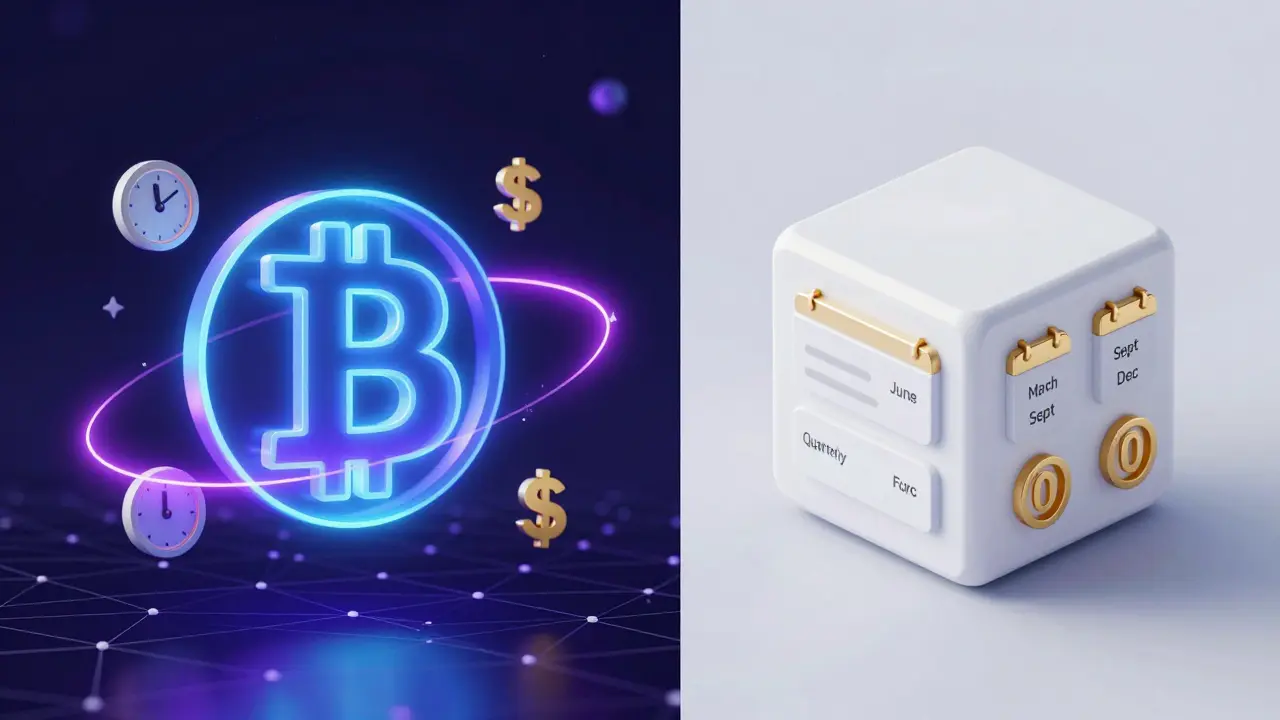
Perpetual Futures vs Quarterly Futures: Which Crypto Derivative Fits Your Strategy?
Perpetual futures offer 24/7 trading with funding fees; quarterly futures have no fees but expire every three months. Learn which one fits your trading style and holding period.
Read MoreLatest Post
-
-
How Layer 2 Solutions Are Shaping the Future of Gas Fees 26 November 2024
-

-

-
Market Orders vs Limit Orders: How They Trade in Order Books 6 December 2024