
What is Kusama (KSM) Crypto Coin? The Canary Network of Polkadot Explained
Kusama Staking Rewards Calculator
How Staking Works on Kusama
Kusama uses Nominated Proof of Stake (NPoS) where you earn rewards by locking KSM tokens. Current annual yield is approximately 13.5%. Rewards compound daily and are distributed to stakers.
This is an estimation. Actual rewards may vary due to network fluctuations. KSM price volatility can significantly impact real-world value.
Kusama isn’t just another cryptocurrency. It’s a live, high-stakes test lab for the future of blockchain - and its native token, KSM, is the fuel that keeps it running. If you’ve heard of Polkadot, think of Kusama as its wilder, faster, riskier sibling. While Polkadot focuses on stability and security for enterprise-grade applications, Kusama is where developers throw ideas at the wall to see what sticks - and they do it with real money, real stakes, and real consequences.
Why Kusama Exists: The Canary Network Concept
Kusama launched in August 2020, built by the same team behind Polkadot: Gavin Wood, Robert Habermeier, and Peter Czaban. Its entire purpose? To act as a "canary in the coal mine." In mining, canaries were used to detect dangerous gases before they harmed workers. In blockchain, Kusama serves the same role: if something breaks here, it breaks before it ever touches Polkadot. This isn’t a fake testnet like Ethereum’s old Ropsten. Kusama has real economic value. KSM tokens are traded on Kraken, Binance, and Coinbase. People lose money. People make money. And every upgrade is tested under real market pressure.
That’s why Kusama moves faster. Governance votes take 8 days instead of Polkadot’s 28. Upgrades deploy in 2 days instead of 28. That speed lets developers iterate quickly - but it also means mistakes can be costly. In December 2022, a governance proposal accidentally sent 10,000 KSM to a test address. On Polkadot, that kind of error would likely be caught before launch. On Kusama, it happened - and the community fixed it in real time.
How Kusama Works: Relay Chains, Parachains, and NPoS
Kusama runs on a multichain architecture. At its core is the Relay Chain - the main blockchain that coordinates everything. Around it, up to 100 custom blockchains called Parachains can connect. These aren’t sidechains. They’re independent chains that borrow Kusama’s security, speed, and interoperability. Think of it like a highway system where each Parachain is a different type of vehicle: one for DeFi, one for NFTs, one for gaming - all sharing the same road infrastructure.
To keep this system secure, Kusama uses Nominated Proof of Stake (NPoS). Validators - nodes that confirm transactions - must stake KSM as collateral. Nominators can also participate by staking as little as 10 KSM to support validators they trust. In return, they earn rewards. As of 2023, the annual yield hovers around 13.5%. The system is designed so that even small holders can help secure the network.
Block times are just 6 seconds. Transaction fees average $0.0005. During peak usage, fees can spike to 0.05 KSM - still dirt cheap compared to Ethereum. This low cost and high speed make Kusama ideal for developers building apps that need rapid feedback loops.
KSM Token: More Than Just a Currency
KSM isn’t just a coin you buy and hold. It’s a multi-tool for the network:
- Transaction fees: Pay to send KSM or interact with Parachains.
- Staking rewards: Earn more KSM by locking it up to support validators.
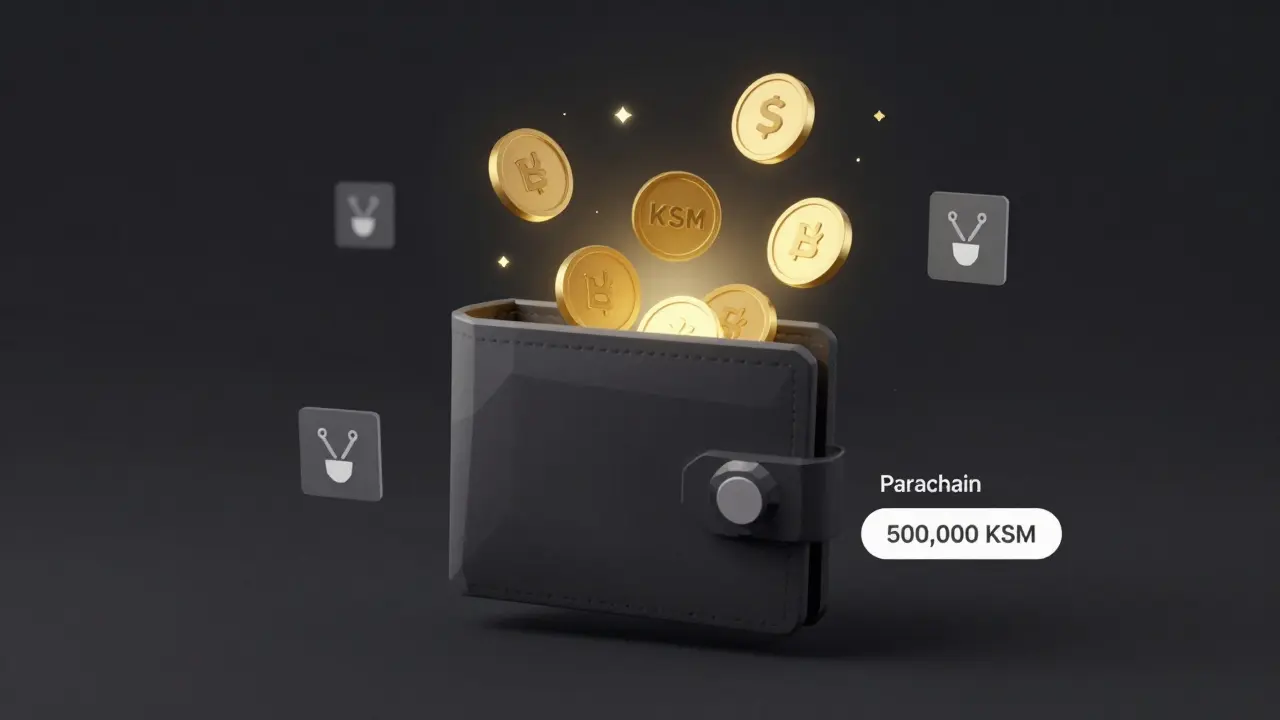
- Parachain auctions: To win a Parachain slot, teams must lock up large amounts of KSM - often 500,000 KSM or more - for months. This creates real economic commitment.
- Governance: Voting on upgrades requires locking KSM for at least 28 days. The more you lock, the more voting power you have.
There’s no fixed supply. KSM is inflationary by design. New tokens are minted regularly to reward stakers and incentivize participation. As of late 2023, around 8 million KSM were in circulation. That’s far less than Polkadot’s DOT, but it’s enough to sustain a thriving ecosystem.

Kusama vs. Polkadot: Speed vs. Safety
The biggest confusion people have is: "Is Kusama just a cheaper version of Polkadot?" No. It’s a different philosophy.
| Feature | Kusama | Polkadot |
|---|---|---|
| Primary Goal | Experimentation | Stability & Security |
| Governance Speed | 8-day votes, 2-day deployment | 28-day votes, 28-day deployment |
| Security Level | Lower - intentional trade-off | Higher - enterprise-grade |
| Token Supply | Uncapped, inflationary | Uncapped, inflationary |
| Typical Use Case | DeFi prototypes, NFT experiments, early-stage dApps | Banking, identity systems, institutional applications |
| Price Volatility (2023) | Up to 75% drops in corrections | Around 65% drops in corrections |
Experts like Messari say 92% of Polkadot’s major upgrades are first tested on Kusama. That’s not a coincidence. It’s by design. Kusama is the pressure cooker. Polkadot is the final product.
Real-World Use Cases: What’s Actually Built on Kusama?
Forget hype. What’s actually working?
- Karura: The leading DeFi hub on Kusama, with over $1.45 billion locked in lending and swapping protocols. It’s the equivalent of Aave or Compound - but built for speed and experimentation.
- Singular: An NFT marketplace where digital assets can own other NFTs. Imagine a virtual character (NFT) wearing armor (another NFT) that itself holds a weapon (a third NFT). This nested ownership isn’t possible on Ethereum or Solana.
- StellaSwap and Basilisk: Cross-chain DEXs that let users trade tokens across Kusama and Polkadot ecosystems with near-zero fees.
- GameFi projects: Several blockchain games use Kusama for testing tokenomics before launching on Polkadot. Their low fees and fast finality make them perfect for play-to-earn mechanics.
Developer activity is strong. GitHub shows over 1,200 Kusama-related repositories with nearly 5,000 contributors. Most are building in Rust using the Substrate framework - which means there’s a learning curve. Web3 Foundation estimates it takes 8-12 weeks for a new developer to become productive on Kusama.
Who Should Care About Kusama?
Not everyone needs Kusama. But if you fit one of these profiles, it’s worth your attention:
- Developers: If you’re building a blockchain app and want to test it fast, Kusama is the fastest path to real-world feedback. No waiting months for a testnet to be approved.
- Investors with high risk tolerance: KSM is volatile. But that volatility is tied to innovation. If a Parachain wins a slot auction, KSM often surges. If a governance vote fails, it can crash. This isn’t for passive holders.
- Early adopters of Web3: Kusama is where the next wave of blockchain features gets tried out - from advanced governance to novel NFT structures. You’re not just investing in a coin. You’re investing in the future of decentralized tech.
On the flip side, if you want a stable store of value, or you’re managing institutional funds, Kusama isn’t for you. Stick with Polkadot, Ethereum, or Bitcoin.
Getting Started with Kusama
Here’s how to begin:
- Buy KSM on Kraken, Binance, or Coinbase. Minimum purchase: 0.1 KSM for basic transactions.
- Set up a Polkadot.js wallet - it works for both Kusama and Polkadot.
- Switch the network to Kusama in your wallet settings.
- Use KSM to pay for transactions, stake, or participate in auctions.
Community support is strong. Discord has over 18,500 active members. Most questions get answered within 48 hours. The Polkadot Wiki has 47 updated guides for beginners.
The Future: What’s Next for Kusama?
Kusama isn’t standing still. In May 2023, it rolled out "Asynchronous Backing," boosting Parachain capacity by 300%. In July, OpenGov v2 gave technical experts a special governance role - letting them fast-track critical fixes without waiting for general votes.
The roadmap includes "Agile Coretime" (late 2023), which will let Parachains rent computing power on-demand instead of locking up KSM for years. And by mid-2024, Kusama will sync with Polkadot 2.0 - meaning it’ll inherit all the new upgrades before they hit the main chain.
Analysts are split. Citibank says Kusama has a 65% chance of staying a secondary network forever. Messari predicts its developer base will grow 15% annually through 2027. Gartner thinks it could fade as Polkadot improves its own testing tools.
But here’s the thing: Kusama doesn’t need to be the biggest. It just needs to be the boldest. And so far, it’s winning that race.
Final Thoughts: Kusama Is the Wild West of Blockchain
Kusama isn’t trying to be safe. It’s trying to be first. It’s where the most ambitious, risky, and creative ideas in blockchain get their first real test. KSM isn’t a coin you buy to sit on. It’s a tool - for developers to build, for investors to bet on innovation, and for the whole ecosystem to learn from failure before it costs billions.
If you want to see what blockchain will look like in 5 years, don’t just watch Polkadot. Watch Kusama. Because that’s where the future is being built - one bold, messy, high-stakes experiment at a time.


18 Comments
Heath OBrien
December 10, 2025 at 02:34
Kusama is just a dumpster fire with a token. Why would anyone stake here when Polkadot exists? This isn't innovation, it's chaos with a whitepaper.
Kathleen Sudborough
December 11, 2025 at 03:45
I get why people panic about Kusama’s volatility, but honestly? That’s the point. It’s not supposed to be a savings account. It’s a sandbox where devs learn how to build without breaking the main chain. I’ve seen projects die here and live on Polkadot. That’s not failure - that’s wisdom.
Taylor Fallon
December 11, 2025 at 07:47
Kusama reminds me of Socrates drinking hemlock - not because it’s doomed, but because it chooses truth over comfort. The fact that real money is at stake makes every bug, every failed vote, every slashed validator a lesson in human nature as much as in code. We don’t need safer blockchains. We need braver ones.
Sarah Luttrell
December 11, 2025 at 22:51
Oh wow, another crypto bro pretending Kusama is deep. 😒 Meanwhile, real innovators are building on Solana with 100ms finality and 0.00001 fees. This is like comparing a horse-drawn carriage to a Tesla and calling the carriage ‘experimental’. 🤦♀️
Kathryn Flanagan
December 12, 2025 at 00:53
I started staking KSM with just 15 tokens because I didn’t have much. But I learned so much - how governance works, how validators operate, how even small nominators can influence outcomes. It’s not about the money. It’s about being part of something that’s actually trying to evolve. I’ve never felt this connected to a blockchain before.
Alex Warren
December 13, 2025 at 20:13
The 10,000 KSM misdirect in 2022 wasn’t a bug. It was a stress test. The community fixed it in under 4 hours. That’s the kind of resilience you can’t simulate on a testnet. Polkadot’s safety is a luxury. Kusama’s agility is a necessity.
Anselmo Buffet
December 15, 2025 at 17:39
I don’t trade KSM. I just watch. It’s like watching a sci-fi movie where the hero keeps failing but never quits. Kinda beautiful in a weird way.
Vidhi Kotak
December 17, 2025 at 07:47
For devs in India or Nigeria, Kusama is a lifeline. You don’t need $10k to deploy a prototype here. With 10 KSM, you can test a DeFi flow, get feedback, and iterate. Polkadot’s gatekeeping feels like a country club. Kusama is the open-source garage where everyone’s welcome.
PRECIOUS EGWABOR
December 17, 2025 at 12:43
Kusama’s inflation isn’t a flaw - it’s a feature. It forces participation. If you just HODL, you’re literally subsidizing the network’s growth. That’s not speculation. That’s civic duty in blockchain form. Most people don’t get it because they’re still thinking in fiat terms.
Eunice Chook
December 17, 2025 at 13:59
92% of Polkadot upgrades tested here? That’s not a feature. That’s a dependency. Kusama isn’t the future - it’s Polkadot’s training wheels. And when Polkadot 2.0 drops, Kusama will be retired like a used lab rat.
JoAnne Geigner
December 19, 2025 at 06:00
I’ve been watching Kusama since 2021. I’ve seen teams cry when their parachain auction failed. I’ve seen devs celebrate when their NFT system finally worked. This isn’t finance. It’s art. And the token? It’s the paint. The network is the canvas. And we’re all co-creators.
Tiffany M
December 20, 2025 at 05:45
Kusama is the only place where a 19-year-old in Jakarta can out-innovate a Stanford team. That’s why I’m here. Not for the price. Not for the yield. For the freedom. No VC approval needed. No compliance forms. Just code. And chaos. And magic.
Hari Sarasan
December 21, 2025 at 01:54
The NPoS mechanism is fundamentally flawed. The concentration of nominator power among whale addresses creates a pseudo-centralized validator oligarchy. The 13.5% APY is a red herring - it masks the systemic risk of validator collusion and the lack of slashing diversity. This is not decentralized finance - it’s distributed feudalism.
Patricia Whitaker
December 21, 2025 at 05:09
I bought KSM at $12. Now it’s $2. I’m not mad. I’m just done. This isn’t investing. It’s gambling with a fancy name.
amar zeid
December 22, 2025 at 12:03
As someone who learned Substrate from zero, Kusama was my classroom. The docs were messy, the Discord was wild, but every error taught me more than any university course. The community didn’t hand me answers - they gave me tools to find them. That’s rare.
Joey Cacace
December 23, 2025 at 01:43
I just wanted to try staking. I ended up helping a new dev debug their parachain runtime. We spent 3 hours on Discord. They thanked me. I felt like I was part of something bigger than returns. 🌱
Madison Surface
December 23, 2025 at 14:14
I used to think Kusama was too risky. Then I watched a team rebuild their entire NFT protocol after a hack - not with a bailout, but with community votes and transparent code. That’s not crypto. That’s democracy in action. And it’s beautiful.
Taylor Farano
December 25, 2025 at 07:20
Kusama is the crypto equivalent of a reality show. Everyone’s screaming, someone’s getting eliminated every week, and the prize is... more volatility. Congrats, you won a 75% drawdown. Want a trophy?