
What is Mining Difficulty in Blockchain? A Simple Guide to How It Works
Imagine you are trying to solve a puzzle. Suddenly, someone adds more pieces to the box. The task just got harder. Now imagine that every time someone solves the puzzle, the system automatically adds or removes pieces to keep the solving time exactly the same. That is essentially what Mining Difficulty is a dynamic adjustment mechanism in proof-of-work blockchains that ensures consistent block production times regardless of network computational power. It is the invisible hand that keeps networks like Bitcoin stable.
If you have ever looked at crypto charts, you have probably seen "difficulty" mentioned alongside price and hash rate. But what does it actually mean for you? Whether you are a curious investor, a potential miner, or just someone trying to understand why your transaction took longer than usual, getting this concept right is crucial. It is not just a number; it is the heartbeat of network security.
The Core Concept: What Is Mining Difficulty?
At its simplest, mining difficulty is a measure of how hard it is to find a new block in a blockchain. In Proof of Work (PoW) systems consensus mechanisms where miners compete to solve cryptographic puzzles to validate transactions and secure the network, miners use powerful computers to guess random numbers. They are looking for a specific result called a "hash." This hash must meet certain criteria set by the network.
Think of it like a lottery. If there is only one ticket sold, your chances of winning are 100%. If there are a million tickets, your chances drop to one in a million. Mining difficulty controls how many "tickets" (computational attempts) are needed on average to win the "prize" (the right to add a block and earn rewards).
The key here is that difficulty is not static. It changes. Why? Because the goal of a blockchain like Bitcoin is not to make mining as hard as possible. The goal is to keep the time between blocks constant. For Bitcoin, that target is roughly every 10 minutes. If miners get faster, the game gets harder. If they slow down, it gets easier.
How the Adjustment Mechanism Works
You might wonder who decides when to change the difficulty. The answer is: no one. It is an algorithmic process built into the code. Let's look at Bitcoin, the most famous example.
Bitcoin’s protocol checks the difficulty every 2,016 blocks the standard interval at which Bitcoin's difficulty adjustment algorithm recalculates the mining challenge. At a 10-minute block time, this happens approximately every two weeks. Here is the logic:
- Measure Time: The network looks at how long it took to mine the last 2,016 blocks.
- Compare to Target: The target time is 20,160 minutes (2,016 blocks × 10 minutes).
- Adjust: If the actual time was shorter than the target, miners were too fast. The difficulty increases. If the actual time was longer, miners were too slow. The difficulty decreases.
This creates a self-regulating loop. It prevents the network from being flooded with blocks during periods of high activity and keeps the chain moving forward even if many miners go offline.
There is also a safety valve. To prevent wild swings that could destabilize the network, Bitcoin limits how much the difficulty can change in one adjustment. It cannot increase or decrease by more than a factor of four. So, if the hash rate suddenly spikes or drops drastically, the network adjusts gradually over several cycles rather than all at once.
| Cryptocurrency | Adjustment Frequency | Target Block Time | Primary Goal |
|---|---|---|---|
| Bitcoin | Every 2,016 blocks (~2 weeks) | 10 minutes | Stability and predictability |
| Ethereum Classic | Every block (with smoothing) | 13 seconds | Rapid response to hash rate changes |
| Litecoin | Every 2,016 blocks | 2.5 minutes | Faster transactions than Bitcoin |
| Dogecoin | Every block | 1 minute | High frequency adjustments |
The Relationship Between Hash Rate and Difficulty
To understand difficulty, you must understand Hash Rate the total computational power being applied to the network by all miners combined, measured in hashes per second. These two metrics are locked in a dance.
Hash rate is the supply of computing power. Difficulty is the demand for that power. When more miners join the network, or when existing miners upgrade to faster hardware, the hash rate goes up. More guesses are being made per second. Consequently, valid blocks are found faster than the target time. The next difficulty adjustment kicks in and raises the bar. The puzzle becomes harder.
Conversely, if electricity prices spike or a major mining region faces regulatory crackdowns, miners might shut down their machines. The hash rate drops. Blocks take longer to find. The difficulty adjustment lowers the requirement, making it easier for the remaining miners to continue securing the network.
This relationship is critical for security. A higher difficulty generally means a higher hash rate. And a higher hash rate makes the network more secure against attacks. Specifically, it makes a "51% attack" prohibitively expensive. An attacker would need to control more than half of the entire network's computing power to rewrite history. As difficulty rises, the cost of buying enough hardware to achieve this becomes astronomical.
Historical Context: From CPUs to ASICs
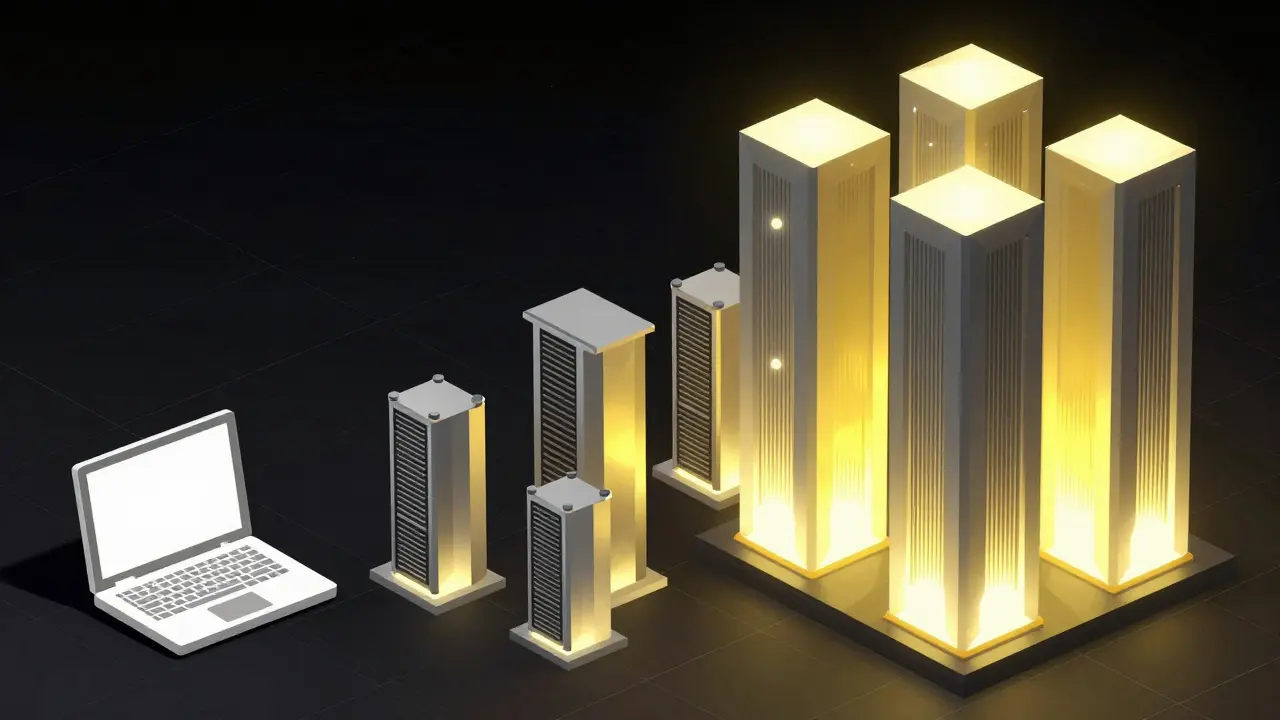
When Satoshi Nakamoto launched Bitcoin in 2009, the difficulty was 1. You could mine blocks with your laptop CPU. Back then, finding a valid hash was computationally trivial. There was very little competition.
As Bitcoin gained popularity, more people joined. First, they used Graphics Processing Units (GPUs), which were better at parallel processing. Then came Field Programmable Gate Arrays (FPGAs). Finally, we reached the era of ASIC Miners Application-Specific Integrated Circuits designed exclusively for cryptocurrency mining, offering vastly superior efficiency compared to general-purpose hardware.
ASICs changed everything. These chips do nothing but mine Bitcoin. They are thousands of times more efficient than GPUs. As these machines flooded the market, the hash rate exploded. So did the difficulty. By early 2024, Bitcoin's difficulty had surpassed 80 trillion. That is an increase of over 40,000% from the start.
This exponential growth shows that mining has evolved from a hobbyist activity to an industrial-scale operation. Today, mining farms consume terawatts of electricity globally. The difficulty metric reflects this massive shift in infrastructure.
Impact on Miners and Profitability
For individual miners, difficulty is the enemy of easy profits. As difficulty rises, your share of the network's total power shrinks unless you also upgrade your hardware. If you are running old equipment, you might stop finding blocks entirely, even though you are still spending money on electricity.
This leads to a phenomenon known as "miner capitulation." When the price of Bitcoin drops, revenue falls. At the same time, if difficulty remains high, costs exceed income. Marginal miners-those with inefficient setups or high electricity rates-are forced to turn off their machines. This causes the hash rate to drop. Eventually, the difficulty adjusts downward, making it profitable again for those with better margins to stay online.
Most solo miners now join Mining Pools groups of miners who combine their computational resources to increase their chances of finding blocks and share rewards proportionally. By pooling hash power, they smooth out the variance. Instead of waiting months for a single block, they receive small, frequent payouts based on their contribution. However, pool operators also adjust fees and payout structures based on difficulty trends.
Why Ethereum Changed the Game
In September 2022, Ethereum underwent a massive shift known as "The Merge." It moved from Proof of Work to Proof of Stake (PoS) a consensus mechanism where validators stake cryptocurrency as collateral to secure the network, eliminating the need for energy-intensive mining. This meant Ethereum no longer had mining difficulty. Miners had to switch to other coins like Ethereum Classic, Litecoin, or Dogecoin.
This exodus temporarily boosted the hash rates and difficulties of those alternative networks. It highlighted how interconnected the mining ecosystem is. When one major player leaves, the computational power redistributes, causing ripple effects across multiple chains. It also accelerated the conversation around environmental sustainability, as PoS consumes significantly less energy than PoW.
Practical Implications for Users
If you are not a miner, why should you care about difficulty? It affects transaction speeds and fees indirectly. While difficulty itself doesn't set fees, it influences the stability of block production. During periods of rapid difficulty adjustment or low hash rate, block times can become unpredictable. If blocks are taking longer to arrive, the mempool (the waiting area for unconfirmed transactions) fills up. Users then compete to pay higher fees to get their transactions included in the next available block.
Furthermore, difficulty is a health indicator. Consistent upward trends in difficulty suggest that miners are confident in the network's future profitability and security. Sharp declines might signal economic distress within the mining sector, which could theoretically impact network resilience in extreme scenarios.
Does higher mining difficulty mean Bitcoin is safer?
Yes, generally speaking. Higher difficulty usually correlates with a higher network hash rate. This means more computational power is protecting the ledger, making it exponentially more expensive and difficult for malicious actors to attempt a 51% attack or double-spend transactions.
Can mining difficulty ever go to zero?
No. The minimum difficulty is 1. Even if everyone stopped mining except one person, the difficulty would eventually lower to 1, allowing that single miner to produce blocks at the target speed. It never disappears completely because the network always needs to produce blocks.
How often does Bitcoin difficulty change?
Bitcoin difficulty adjusts every 2,016 blocks, which takes approximately two weeks given the 10-minute target block time. This regular schedule ensures stability while allowing the network to adapt to changes in global mining power.
Is it still profitable to mine Bitcoin at home?
For most individuals, no. Due to the extremely high difficulty and the dominance of ASIC miners, home mining with consumer-grade hardware like GPUs or CPUs is no longer profitable for Bitcoin. Some people mine smaller altcoins with GPUs, but the economics are tight and depend heavily on local electricity costs.
What happens if the hash rate drops suddenly?
If the hash rate drops, blocks will initially be mined slower than the target time. After the next difficulty adjustment cycle, the difficulty will decrease to compensate. This restores the target block time and helps retain the remaining miners by making their efforts more likely to succeed.