

What is Onyxcoin (XCN)? A Deep Dive into the Layer 3 DeFi Token
Have you ever seen a cryptocurrency ticker and wondered if it’s tied to a major bank? If you’ve looked at XCN, you might have assumed it was connected to JPMorgan Chase. It’s a common mix-up. But here’s the truth: Onyxcoin (XCN) is an independent Ethereum-based ERC-20 token that powers the Onyx Protocol, a modular Layer 3 blockchain for decentralized finance. It has zero affiliation with JPMorgan’s internal 'Onyx' system.
So, what is this coin actually doing? In short, XCN is the fuel for a financial-grade infrastructure designed to bring real-world asset tokenization and credit markets on-chain. It’s not just a speculative meme coin; it’s a utility token meant to handle transaction fees, governance, and access within a specific ecosystem. Let’s break down exactly how it works, where it came from, and whether it fits your portfolio in 2026.
From Chain to Onyx: The Rebranding Story
To understand Onyxcoin, you have to look back at its roots. The project didn’t start as Onyx. It began in 2021 under the name "Chain" with the ticker CHN. Back then, it focused on enterprise-grade blockchain infrastructure. As the crypto landscape shifted toward more specialized decentralized applications, the team decided a change was needed.
In early 2023, the rebranding happened. Major exchanges like Bittrex Global and KuCoin updated their listings from Chain (CHN) to Onyxcoin (XCN). This wasn’t just a cosmetic tweak. It signaled a pivot from general-purpose web3 services to a dedicated financial stack. The core technology remained an Ethereum ERC-20 token, but the narrative expanded to include cloud services, private networks, and eventually, the Layer 3 architecture we see today. For investors, this means the history of the token is continuous-the contract address stayed the same-but the utility evolved significantly.
How the Layer 3 Architecture Works
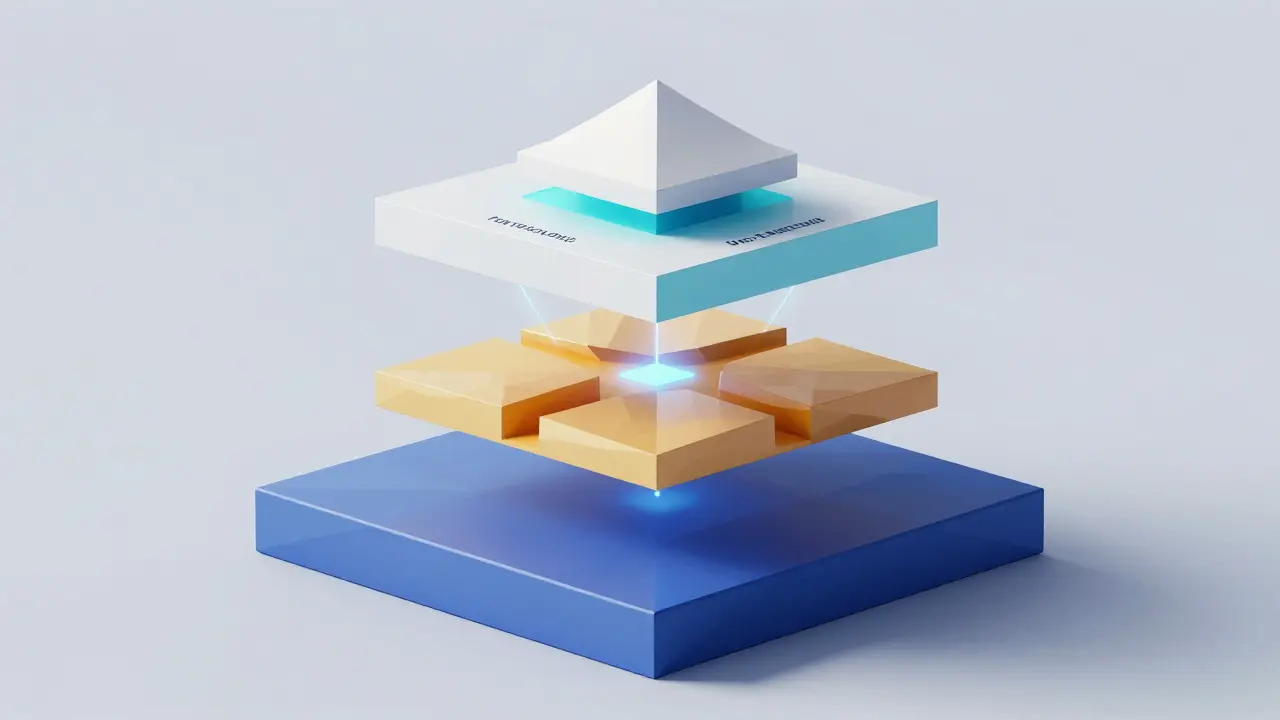
You’ve heard about Layer 1 (like Ethereum) and Layer 2 (like Arbitrum or Optimism). So, what is a Layer 3? Think of it as a specialized app-chain built on top of those lower layers. Onyx Protocol is a modular Layer 3 blockchain built using Arbitrum Orbit technology, settling transactions on Coinbase’s Base network.
This stack matters because it gives Onyx the security of Ethereum, the speed of Arbitrum-style scaling, and the low costs of Base. Why build it this way? Because Onyx aims to handle complex financial operations-like multi-asset lending and real-world asset (RWA) tokenization-that require high throughput and predictable fees.
Here is how the pieces fit together:
- Settlement Layer: Coinbase’s Base Network handles the final settlement, ensuring assets are secure.
- Execution Layer: Arbitrum Orbit technology provides the scalability needed for fast transactions.
- Application Layer: The Onyx Protocol itself runs the lending markets, credit systems, and smart contracts.
XCN acts as the native gas token here. When you interact with the Onyx protocol, you pay fees in XCN. This creates direct demand for the token based on usage, rather than just speculation.
Tokenomics: Supply, Burns, and Governance
If you’re looking at the numbers, XCN has a massive supply. The total supply is fixed at approximately 48.47 billion tokens. As of mid-2026, around 39 billion tokens are circulating. That’s a lot of coins, which is why the price per unit is in the fractions of a cent. Don’t let the low price fool you, though. Market cap tells the real story.
The tokenomics model is designed to be deflationary over time. How? Through EIP-1559 implementation. Similar to Ethereum, a portion of the gas fees paid in XCN is burned (destroyed) permanently. This reduces the circulating supply slightly with every transaction, theoretically increasing scarcity as network activity grows.
Governance is another key pillar. XCN isn’t just money; it’s a vote. Holders can stake their tokens to participate in the Onyx DAO. They vote on proposals called Onyx Improvement Proposals (OIPs). Recent examples include OIP-60, which introduced staking points and gas-free wallet features. If you hold XCN, you have a say in how the protocol evolves, including decisions on collateral factors, interest rates, and new asset listings.
Market Performance and Volatility
Let’s talk about the elephant in the room: price action. XCN has been volatile. At its peak in 2022-2023, it traded near $0.18. By late June 2026, it hovered around $0.0037 to $0.0041. That’s a drawdown of nearly 98% from its all-time high.
Why the drop? Crypto markets are cyclical, and many mid-cap DeFi tokens suffered during the bear market. However, recent months have shown signs of stabilization. Listings on major exchanges like Coinbase, Kraken, and Upbit have provided liquidity spikes. For instance, when Upbit listed XCN, trading volume jumped by over 1,700% in 24 hours. These events show that when institutional or regional interest picks up, the token responds quickly.
| Metric | Value |
|---|---|
| Price Range | $0.0037 - $0.0041 USD |
| Market Cap | ~$144 Million USD |
| Circulating Supply | ~39 Billion XCN |
| Total Supply | 48.47 Billion XCN |
| All-Time High | $0.1841 USD |
Traders often view XCN as a high-beta asset. This means it tends to move more sharply than Bitcoin or Ethereum. Some community members suggest accumulation zones below $0.01, while others warn of "scam pumps" followed by steep dumps. Always do your own research and never invest more than you can afford to lose.
Real-World Use Cases: Lending and RWA
So, what can you actually do with XCN besides holding it? The primary use case is within the Onyx Liquidity Protocol. This is a peer-to-peer lending platform. You can deposit supported tokens (like ETH or USDC) as collateral and borrow against them. Unlike traditional banks, there are no credit checks. Your collateral backs the loan.
But Onyx is pushing further into Real-World Assets (RWAs). This means tokenizing things like invoices, bonds, or other off-chain claims. By bringing these assets onto the Layer 3 chain, Onyx aims to bridge institutional finance with DeFi. If you’re a business, you could potentially tokenize an invoice and use it as collateral for instant liquidity. This is where the "financial-grade" promise comes into play.

How to Buy and Store XCN
Buying XCN is relatively straightforward since it’s listed on major centralized exchanges. Here’s a quick guide:
- Choose an Exchange: Coinbase, Kraken, KuCoin, and Bitget all support XCN trading pairs (usually XCN/USD or XCN/USDT).
- Create an Account: Complete the KYC (Know Your Customer) verification process required by these platforms.
- Fund Your Wallet: Deposit fiat currency via bank transfer or card.
- Purchase XCN: Search for the ticker XCN and place a buy order.
For storage, you have two main options. You can leave it on the exchange for easy trading, but for better security, consider a non-custodial wallet. MetaMask supports XCN on the Ethereum network, allowing you to buy directly within the app using debit cards or PayPal. For long-term holding, Ledger hardware wallets recommend securing XCN to protect against hacks. Remember, if you want to participate in governance or stake for rewards, you’ll need to move your tokens to a compatible wallet.
Regulatory Posture and Future Outlook
One area where Onyx stands out is its focus on compliance. In July 2025, the team announced Onyx V2, aiming for compliance with the CLARITY Act as a "Digital Commodity Token." This is significant because it positions XCN as a utility token rather than a security, which could open doors for broader institutional adoption in the US.
The roadmap includes continued expansion of the Layer 3 infrastructure, deeper integration of RWAs, and enhanced staking rewards. The community remains active, with holder counts growing steadily. While the price has struggled to regain its highs, the fundamental development continues. The success of XCN will likely depend on whether the Onyx Protocol can attract significant Total Value Locked (TVL) and prove that its Layer 3 solution is superior to existing DeFi alternatives like Aave or Compound.
Is Onyxcoin (XCN) affiliated with JPMorgan?
No. Onyxcoin (XCN) is completely independent of JPMorgan Chase. JPMorgan has its own permissioned blockchain called Onyx for institutional settlements, but it does not issue or back the public XCN cryptocurrency. This is a common point of confusion, but the projects are unrelated.
What is the total supply of XCN?
The total supply of Onyxcoin is fixed at approximately 48.47 billion tokens. As of mid-2026, roughly 39 billion tokens are in circulation, with the remainder held in reserve for grants, incentives, and treasury operations.
Can I stake XCN for rewards?
Yes. XCN holders can stake their tokens to earn rewards and participate in the Onyx DAO governance. Staking also allows you to vote on Onyx Improvement Proposals (OIPs) that shape the future of the protocol.
Where can I buy Onyxcoin?
You can buy XCN on major centralized exchanges such as Coinbase, Kraken, KuCoin, and Bitget. It is also available through decentralized interfaces and wallets like MetaMask, which allow direct purchases using fiat payment methods.
What makes Onyxcoin different from other DeFi tokens?
Onyxcoin operates on a modular Layer 3 blockchain built on Arbitrum Orbit and Coinbase Base. Its focus is on financial-grade applications, including real-world asset (RWA) tokenization and multi-asset lending, distinguishing it from generic smart contract platforms.


23 Comments
Rob Morton
June 27, 2026 at 18:38
It is fascinating to observe the semantic drift of 'Onyx' from a corporate internal ledger to a public ERC-20 token. The philosophical implication here is that value is not intrinsic but assigned by narrative consensus. We see this with every rebrand in crypto history.
nancy jarecki
June 29, 2026 at 13:30
Let us be clear about the fundamental inelegance of this proposal. A Layer 3 solution built on Arbitrum Orbit which itself sits on Base creates a latency stack that is theoretically inefficient for high-frequency trading. The EIP-1559 burn mechanism is merely a cosmetic deflationary gesture when one considers the massive circulating supply of nearly forty billion tokens. It is a classic case of dilution disguised as utility, and those who fail to recognize the structural flaws in such multi-layered dependencies are simply uneducated participants in the market.
Maurice Flynn
June 29, 2026 at 19:29
I just sit back and watch these narratives unfold. The rebrand from Chain to Onyx was smooth, I will give them that. Whether it works out remains to be seen.
Robert Hundley
June 30, 2026 at 06:23
This looks pretty solid! :D The integration with Coinbase Base is a huge plus for security. I am excited to see where this goes!
Melissa L
July 1, 2026 at 10:35
i dont get why everyone is so hyped about layer 3s. seems like too much tech jargon to me. maybe its good tho idk
Routh Middaugh
July 2, 2026 at 04:41
I think we should all consider the broader implications; specifically, how this modular architecture might influence future regulatory frameworks. It is important to remain open-minded; however, one must also acknowledge the risks associated with such complex dependency chains. Let us discuss this further, if anyone is interested? Perhaps we can find common ground in our understanding of decentralized finance?
Ryan Peters
July 2, 2026 at 13:00
Another American project trying to reinvent the wheel with 'financial-grade' buzzwords. The reality is that domestic innovation has stagnated while offshore entities exploit regulatory arbitrage. This XCN token is nothing more than a speculative vehicle for insiders to offload bags onto retail investors who believe the hype. Wake up.
ross harris
July 3, 2026 at 12:39
The existential dread of holding a token with a ninety-eight percent drawdown is palpable. It is a kaleidoscope of red candles and broken dreams, swirling into a vortex of despair. Yet, amidst this chaos, there is a strange beauty in the futility of human speculation. We chase the ghost of value, only to find ourselves hollowed out by the void of market cap.
Carl Belgrave
July 5, 2026 at 00:53
Listen up. If you are going to invest in this, make sure you understand the geopolitical risks. Crypto is becoming a battleground for national economic sovereignty. Do not let foreign interests dictate your financial future. Support projects that align with American values and infrastructure.
Fiona Ellis
July 6, 2026 at 00:20
I must say, the clarity regarding the JPMorgan distinction is refreshing 🌟 However, I wonder if the team has considered the environmental impact of their staking mechanisms? It feels personal to ignore such critical aspects of modern sustainability. 🌿
Nicole Woessner
July 6, 2026 at 19:15
Interesting perspective on the cultural shift towards RWA tokenization. In many parts of the world, access to credit is limited so this could be transformative. I hope the community embraces this diversity of use cases
Jon Milton
July 8, 2026 at 06:44
While the technical stack is impressive, we must confront the harsh reality that most Layer 3 solutions fail to gain traction due to fragmented liquidity. The aggressive marketing push is evident, but substance often lags behind style. Let us not be blinded by the shiny new architecture.
Sajjad Ghorbani Moghaddam
July 8, 2026 at 20:38
Hey folks, just wanted to share that the governance aspect is actually quite engaging if you take the time to read the OIPs. It is a great way to learn about DeFi mechanics without needing to be an expert. Welcome to the conversation!
Rebecca Shoniker
July 10, 2026 at 11:03
I am utterly exhausted by the repetitive nature of these promotional posts. The lack of genuine engagement is suffocating. One wonders if the authors have any substantive insights to offer beyond regurgitating whitepaper summaries. It is truly disheartening to witness such intellectual laziness.
Jay Sharma
July 10, 2026 at 19:03
Don't trust the official narrative. The rebranding was a cover-up for something shady happening in the backend. They are tracking your transactions through the Layer 3 settlement. Stay woke.
Scott Miller
July 12, 2026 at 11:44
You gotta keep pushing forward! Even if the price is down, the technology is real. Don't let the bears win. Accumulate and hold strong!
Abby Martin
July 14, 2026 at 07:40
It is morally questionable to promote a token that has lost so much value without warning people about the risks. People are losing money because of this kind of hype. You should feel ashamed for not being more transparent.
Mélanie Boulay
July 15, 2026 at 09:25
I have been following the development of the Onyx Protocol for some time now, and I find the approach to real-world asset tokenization particularly intriguing, especially considering the potential implications for small businesses in developing economies who currently lack access to traditional banking services, which could potentially revolutionize the way we think about global finance and inclusivity.
Carl Hanzel
July 15, 2026 at 09:34
Everything you said is wrong. The Layer 3 model is flawed, the tokenomics are a scam, and the team is incompetent. I hate this project. Burn it all.
Daniel J. Cox
July 16, 2026 at 16:35
Cool stuff. The mix of US and international perspectives is interesting. :) I think the RWA angle is key for mainstream adoption.
Emma Rémond
July 17, 2026 at 00:57
The pretension of claiming 'financial-grade' status for a token with such a volatile history is laughable. True sophistication lies in stability and institutional trust, neither of which this project possesses. It is a amateurish attempt at mimicking legacy finance.
ELNORA JEFFERSON
July 18, 2026 at 22:09
Boring post. Nothing new here. I am done reading this trash.
Carol @minaszilda
July 20, 2026 at 17:06
Keep learning. Every dip is a lesson.