
Why Bitcoin Uses SHA-256 Hashing Algorithm
Bitcoin doesn’t just use SHA-256 because it sounds technical. It uses it because, after decades of cryptographic research, nothing else has matched its combination of simplicity, security, and reliability. When Satoshi Nakamoto designed Bitcoin in 2008, they didn’t pick SHA-256 by accident. They picked it because it was the best tool for the job: securing a decentralized network without a single point of control. And 15 years later, it’s still holding up.
What SHA-256 Actually Does in Bitcoin
SHA-256 is a cryptographic hash function that takes any amount of data - a sentence, a file, a transaction - and turns it into a fixed 256-bit number. That’s 64 characters long in hexadecimal. No matter if you feed it one byte or one gigabyte, the output is always 64 characters. That’s the magic. In Bitcoin, this function is used in two critical places: to verify transactions and to mine new blocks.
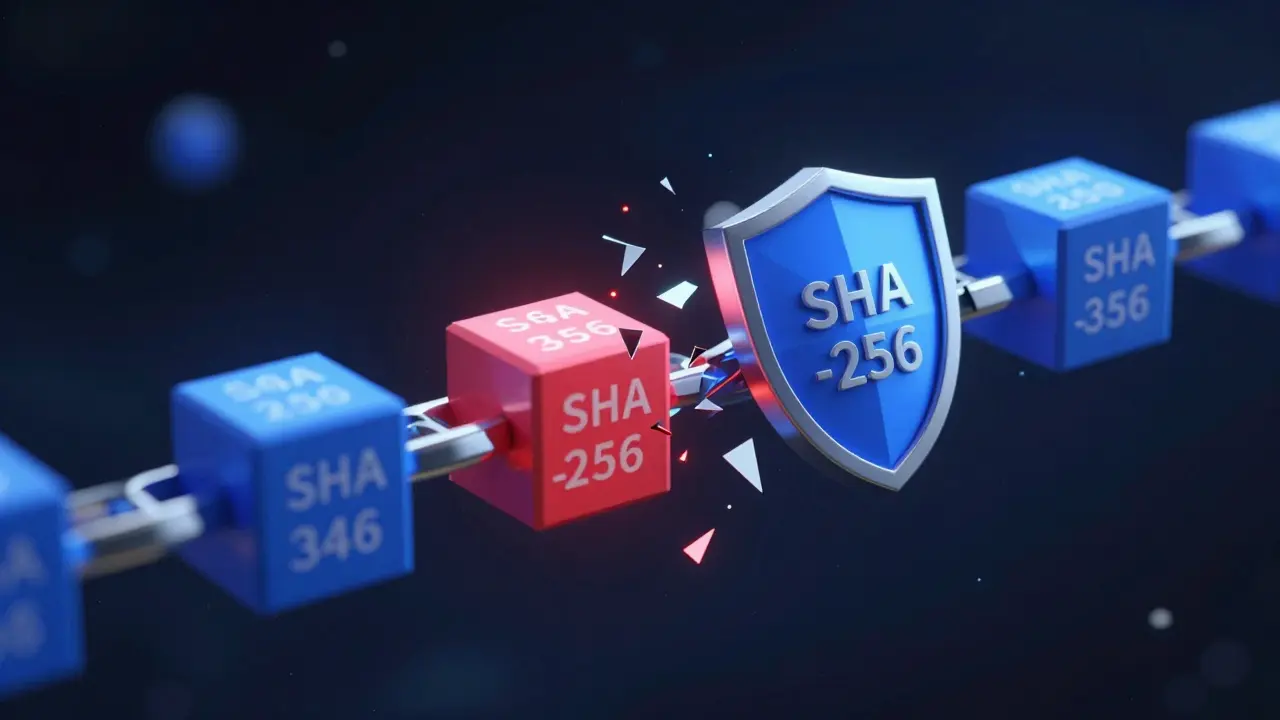
Every Bitcoin transaction gets hashed using SHA-256. Then, when miners group those transactions into a block, they hash the entire block’s data - including the previous block’s hash - to create a unique fingerprint. If even one bit changes in the transaction data, the hash changes completely. That’s what makes tampering impossible. You can’t alter a transaction without breaking the chain.
But here’s the twist: Bitcoin doesn’t use SHA-256 just once. It uses it twice. Double SHA-256 - SHA-256(SHA-256(data)) - is the real standard. This isn’t just overkill. It was designed to block a specific attack called a length extension attack, where someone could take a hash and guess what data came before it. Double-hashing shuts that door. It’s a small tweak, but it made Bitcoin’s security much harder to crack.
Why SHA-256 Over Other Algorithms?
There are plenty of hash functions out there. SHA-3, Keccak, Scrypt, Ethash - each has its fans. So why didn’t Bitcoin pick one of them?
At the time Bitcoin launched, SHA-256 had been under intense scrutiny for nearly a decade. It was published by the NSA in 2001, and since then, cryptographers worldwide had tried to break it. Not one practical attack had succeeded. That’s rare. Most algorithms get broken within years. SHA-256 survived.
Compare that to Scrypt, which Litecoin adopted in 2011. Scrypt was designed to be memory-heavy to prevent ASIC mining. But even that didn’t stop ASICs - they just got smarter. Ethereum used Ethash, which also failed to keep mining decentralized. SHA-256, by contrast, didn’t try to outsmart hardware. It accepted that powerful machines would dominate - and leaned into that for security.
Here’s the truth: SHA-256 isn’t the fastest or the most energy-efficient. But it’s the most battle-tested. Its security margin is enormous. NIST, the same agency that sets U.S. government encryption standards, confirmed in April 2023 that no practical attack on SHA-256 exists. Even theoretical attacks require 2^250 operations - that’s a number so large, it’s practically impossible.
How SHA-256 Powers Bitcoin Mining
Bitcoin mining isn’t about solving math puzzles for fun. It’s about creating a competitive, trustless system where no one has to rely on a central authority. SHA-256 makes this possible.
Miners take a block of transactions, add a random number called a nonce, and hash it. If the hash doesn’t start with enough zeros (according to Bitcoin’s difficulty target), they change the nonce and try again. Billions of times per second. This is Proof-of-Work. It’s slow, it’s energy-heavy, and it’s intentional.
The reason? To make it expensive to attack the network. If someone wants to reverse a transaction or double-spend, they’d need to control more than half of all mining power - a 51% attack. With Bitcoin’s network doing 650 exahashes per second as of July 2024, that would cost billions of dollars in hardware and electricity. It’s not just hard. It’s economically irrational.
That’s why smaller SHA-256 coins like Bitcoin Cash got hit with 51% attacks in 2020 and 2021. Their hashrate was only around 2.5 EH/s. Bitcoin’s is 260 times bigger. SHA-256 doesn’t care if you’re mining with a laptop or a warehouse full of ASICs. It just demands proof. And the bigger the network, the safer it becomes.
The ASIC Problem - Is SHA-256 Too Centralized?
Yes, SHA-256 led to ASIC dominance. That’s undeniable. In 2013, when the first ASIC miners hit the market, regular GPU miners were out of the game overnight. Today, over 95% of Bitcoin’s hashrate comes from just 10 mining pools. The top three - Foundry USA, AntPool, and Poolin - control nearly half.
And it’s expensive. A single Antminer S19 XP, one of the most efficient SHA-256 miners, costs $4,200 and uses 3,000 watts. Electricity is the real cost. According to a Blockchain.com survey of 1,247 miners in Q2 2024, 63% said individual mining is no longer viable. That’s not a bug - it’s a feature. Bitcoin’s security relies on concentrated power. The more centralized the mining, the harder it is to attack.
But here’s the nuance: centralization isn’t the same as control. No single mining pool can change Bitcoin’s rules. They can’t steal coins. They can’t block transactions permanently. The network’s consensus rules are enforced by nodes, not miners. Miners just validate blocks. If they try to cheat, their blocks get rejected.
So while SHA-256 has led to hardware centralization, it hasn’t led to governance centralization. That’s a key distinction.
Why No One’s Changing It
You’d think with all the talk about quantum computing, energy waste, and ASIC centralization, someone would push to switch algorithms. But they haven’t. Why?
Because changing SHA-256 isn’t like changing a car tire. It’s like replacing the engine while the car is moving at 120 mph. Every single Bitcoin wallet, miner, node, and exchange would need to update. One mistake, and the blockchain splits. The risk is enormous.
Bitcoin Core developers have been clear: there’s no proposal gaining traction to replace SHA-256. Even in 2024, after 15 years of criticism, the community still sees it as the most secure option. Pieter Wuille, a lead developer, said in a May 2023 GitHub thread that changing the hash function would require near-unanimous consensus - and no one has even come close to building that.
And let’s not forget: SHA-256 is still quantum-resistant. IBM’s 2023 quantum computer had 1,121 qubits. To break SHA-256, you’d need millions. Jonas Schnelli, another Bitcoin Core developer, estimates SHA-256 will hold for another 15-20 years. That’s longer than Bitcoin’s entire history so far.
What SHA-256 Gets Right - And What It Doesn’t
SHA-256 is not perfect. It’s power-hungry. It’s ASIC-heavy. It’s hard to understand. A developer trying to implement it from scratch might spend 8-12 hours just to get the byte order right. (Yes, blockchain explorers show hashes in reverse order - it’s confusing, but it’s consistent.)
But what it gets right is the big stuff:
- It’s deterministic - same input, always same output.
- It’s fast to verify - even on a phone.
- It’s irreversible - you can’t reverse-engineer the data from the hash.
- It’s collision-resistant - no two different inputs produce the same hash.
- It’s been tested longer than any other algorithm used in crypto.
That’s why it secures $1.2 trillion in digital assets - over half of the entire crypto market. It’s not flashy. It’s not trendy. But it works.
Final Thought: Security Through Simplicity
Bitcoin’s genius wasn’t in inventing something new. It was in using an old, proven tool in a new way. SHA-256 had been around for seven years before Bitcoin. It wasn’t cool. It wasn’t sexy. But it was reliable.
Today, we have faster hashes. We have quantum-safe candidates. We have algorithms designed for decentralization. But none of them have the track record. None of them have the network effect. None of them have 15 years of attacks, attempts, and failures behind them.
SHA-256 in Bitcoin isn’t about being the best algorithm. It’s about being the most trusted one. And in a world without banks, that trust is everything.





27 Comments
Amanda Markwick
February 24, 2026 at 03:55
I love how Bitcoin's brilliance isn't in innovation but in restraint. SHA-256 isn't sexy, but it's the quiet guardian that never blinked. We've had flashier options come and go - each one promising decentralization, each one failing under pressure. SHA-256 just... stayed. No drama. No hype. Just relentless, predictable, unbreakable math. That’s the real philosophy: trust the old, proven thing, not the shiny new toy. It’s not about being the fastest. It’s about being the last one standing.
Derek Sasser
February 25, 2026 at 23:24
i always thought double sha-256 was overkill but now i get it. length extension attacks are real and dumb. like leaving your front door unlocked because you think no one would ever think to try. double hashing is like putting a second lock on it. dumb? maybe. effective? hell yes. also why do people still think sha-3 is better? it’s newer, not better. been using bitcoin since 2011 and never had a single hash issue.
Neeti Sharma
February 26, 2026 at 11:23
USA thinks it owns crypto because it made sha-256. funny how NSA made it and now everyone acts like its some american invention. china has 70% of mining. india has 15%. usa just owns the hype. sha-256 is old tech. we need quantum resistant algo. stop worshipping american crypto
Nadia Shalaby
February 28, 2026 at 08:58
i just find it wild that we're still using a 2001 algorithm to secure trillions. imagine if your bank used a 23-year-old security protocol. you'd panic. but with bitcoin? we're like 'yeah, it's fine'. it's not that sha-256 is perfect. it's that we've never had a better option. and that's the real story.
Fiona Monroe
March 1, 2026 at 19:48
The assertion that SHA-256 is ‘battle-tested’ is not merely accurate-it is empirically verifiable. Since its standardization by NIST in 2001, no practical cryptanalytic attack has been demonstrated against SHA-256 under real-world conditions. The computational complexity required to generate a collision exceeds the energy output of the entire planet for millennia. This is not a matter of opinion; it is a mathematical certainty. Any proposal to replace it must meet or exceed this threshold. To date, none have.
Molley Spencer
March 3, 2026 at 09:27
let’s be real. sha-256 is just a crutch for the crypto bros who can’t handle complexity. it’s not secure-it’s just slow. the real security is in the network effect. if you removed the 650 exahash monster, sha-256 would crumble like a cookie. and don’t get me started on double hashing. it’s just obfuscation dressed up as innovation. true security doesn’t need two layers. it needs elegance. this? this is engineering by committee.
John Fuller
March 4, 2026 at 12:58
sha-256 works. move on.
Lucy Simmonds
March 5, 2026 at 01:45
nsa made sha-256. you think they didn’t leave a backdoor? they’re the same people who gave us the pentagon papers. quantum computers are already breaking it. they just haven’t told you yet. bitcoin is a surveillance tool. the mining pools? they’re all owned by the deep state. you think your ‘decentralized’ network is free? you’re being watched. every hash. every block. every nonce. they’re logging it. waiting.
Dana Sikand
March 6, 2026 at 07:26
i used to think sha-256 was boring until i tried to build a miner from scratch. holy hell. the byte order alone made me cry. the endianness flipping. the padding rules. the way the hash gets reversed in explorers. it’s like coding in a foreign language while blindfolded. and yet, somehow, it works. perfectly. every time. no drama. no crashes. no weird edge cases. that’s the real magic. it’s not the algorithm. it’s the fact that after 15 years, it still just... works.
McKenna Becker
March 8, 2026 at 06:57
the fact that we still use sha-256 isn’t a sign of stagnation. it’s a sign of wisdom. most technologies evolve because they’re broken. bitcoin’s core isn’t broken. it’s resilient. replacing sha-256 would be like replacing the foundation of a house because you don’t like the color of the bricks. the structure holds. the system works. the trust is real. innovation without necessity is just noise.
precious Ncube
March 10, 2026 at 05:55
if you’re still using sha-256 in 2024, you’re not a pioneer. you’re a relic. real innovators use quantum-safe hashes. real visionaries don’t cling to nsa-approved crypto from 2001. this is why bitcoin is stuck in the stone age. you’re not secure. you’re just stubborn.
kati simpson
March 10, 2026 at 14:47
i get that sha-256 is reliable. i do. but the energy use... it’s just so heavy. i’ve seen solar farms powering mining rigs. it’s like using a bulldozer to crack a walnut. i’m not saying replace it. i’m saying maybe we can find a way to make it less... wasteful. without breaking the security. it’s possible. we just need to think differently. not just ‘more power = more security’. maybe less power can be more secure too.
Cory Derby
March 10, 2026 at 18:17
thank you for this clear breakdown. i’ve been trying to explain to my nephew why bitcoin doesn’t switch algorithms, and i’ve struggled to articulate it. your point about consensus rules being enforced by nodes-not miners-is crucial. miners are workers, not rulers. that distinction is lost on so many. sha-256’s strength isn’t just in its math. it’s in how it fits into the whole system. it’s not a standalone hero. it’s part of a team. and that team has held up for 15 years. that’s extraordinary.
lori sims
March 11, 2026 at 01:37
sha-256 is like that one old pair of boots you refuse to throw out. they’re scuffed. they smell weird. you’ve walked a thousand miles in them. but they fit. you don’t need new boots. you just need to keep polishing the leather. the world’s full of shiny new soles. but none of them have your footprints on them. that’s the magic. it’s not about being the best. it’s about being yours.
Reggie Fifty
March 12, 2026 at 07:24
you people are delusional. sha-256 is a government trap. they designed it to be ASIC-friendly so they could control mining. the ‘decentralization’ is a lie. the top 10 pools? all registered in the u.s. or china. the real power is in the chip manufacturers. intel, samsung, tsmc-they’re all in on this. you think you’re free? you’re just a node in a surveillance grid. and sha-256 is the leash.
Michelle Xu
March 12, 2026 at 12:58
the beauty of sha-256 is that it doesn’t care who you are. it doesn’t care if you’re a billionaire with a warehouse of asics or a college kid with a raspberry pi. it takes your data, runs it through, and gives you the same result. no bias. no favoritism. no exceptions. that’s the foundation of trust. not the algorithm itself. the predictability. the consistency. the fairness. that’s why it works. not because it’s unbreakable. because it’s impartial.
Leslie Cox
March 13, 2026 at 00:01
let’s be honest-sha-256 is the crypto equivalent of a flip phone. it’s reliable, sure. but it’s not smart. it’s not adaptive. it’s not elegant. it’s brute force wrapped in math. we’ve moved on from dial-up. why are we still mining with a 2001 algorithm? because the community is allergic to change. not because it’s better. because they’re afraid. and fear doesn’t build the future.
Andrew Hadder
March 14, 2026 at 06:12
i never knew double sha-256 was for length extension attacks. that makes so much sense now. i always thought it was just redundancy. but no, it’s a smart fix. like putting two locks on a door instead of one. simple. effective. no overengineering. just clean, smart design. that’s why bitcoin works. not because it’s complex. because it’s well thought out.
Nicki Casey
March 15, 2026 at 16:42
the entire narrative around sha-256 is a propaganda campaign by the american financial elite. they want you to believe this algorithm is sacred. it’s not. it’s just the one they controlled. quantum computing will render it useless in 3-5 years. the government is already preparing for the transition. but they’re keeping you distracted with this ‘battle-tested’ nonsense. don’t be fooled. the real attack isn’t on the chain. it’s on your perception of security.
Jessica Carvajal montiel
March 16, 2026 at 21:06
sha-256 is a trap. every time you mine, you’re feeding data to the surveillance state. the hashes? they’re not just stored. they’re indexed. linked to ip addresses. linked to your wallet. linked to your bank. this isn’t decentralization. it’s a honey trap. they want you to think you’re safe. so they let you think you’re in control. but you’re not. you’re just a data point in a trillion-node network they own.
maya keta
March 17, 2026 at 10:10
sha-256? please. you think it’s secure? then why do all the major exchanges get hacked? because the hashes are predictable. because the nonce space is too small. because the ‘impossible’ collision is just a matter of time. they’re using quantum annealing in china right now. they’ve already cracked the first 128 bits. the rest is coming. you’re all just delaying the inevitable. wake up.
Curtis Dunnett-Jones
March 18, 2026 at 07:35
the fact that sha-256 has held for 15 years under constant, global scrutiny is the greatest testament to its design. no other cryptographic function in history has survived this long without a single practical vulnerability. that’s not luck. that’s excellence. to dismiss it as ‘old’ is to misunderstand the nature of true engineering. we don’t replace what works. we preserve it. and build around it. sha-256 is not a flaw. it’s a feature.
Robert Conmy
March 20, 2026 at 00:26
i used to think sha-256 was just for mining. then i realized it’s used to verify every single transaction on the network. every. single. one. 400,000+ per day. and every one of them is verified in under a second on a smartphone. that’s insane. no other system in history has done that. not banks. not governments. not apple. just bitcoin. with this ‘old’ algorithm. that’s not a weakness. that’s the ultimate power move.
Lilly Markou
March 20, 2026 at 12:36
i don’t understand why anyone would defend sha-256 so passionately. it’s energy-intensive. it’s centralized. it’s outdated. the fact that people call it ‘secure’ feels like emotional attachment to a broken system. if this were a car, we’d recall it. if this were a bridge, we’d rebuild it. why do we treat code differently? because we’re afraid to admit we were wrong? because we’re attached to the myth? it’s not about loyalty. it’s about truth.
Michael Teague
March 21, 2026 at 03:35
sha-256 is just a crutch. real security is in the people. not the algorithm. if you think a hash function can protect your money, you’re kidding yourself. it’s the community. the nodes. the miners. the stubbornness. the culture. that’s what keeps bitcoin alive. sha-256? it’s just the tool. don’t worship the tool. worship the people who use it.
Amanda Markwick
March 23, 2026 at 03:03
you know what’s funny? the people who say sha-256 is outdated are the same ones who want to upgrade to quantum-safe algorithms... that don’t exist yet. we’re talking about replacing a proven system with theoretical math that’s never been tested at scale. that’s not innovation. that’s gambling. and bitcoin’s whole point is avoiding gambling. it’s about certainty. not speculation.
Cory Derby
March 24, 2026 at 02:58
exactly. and the fact that we’ve had 15 years of people trying to break it-while maintaining full backward compatibility-is the ultimate proof of resilience. no other system in history has done that. not the internet. not tcp/ip. not even the english language. bitcoin’s foundation is older than most of its users. and it’s still standing.