

Cost of Blockchain-as-a-Service in 2026: Pricing Models, Hidden Fees & ROI
You want to build a decentralized application or digitize your supply chain, but the price tag for Blockchain-as-a-Service is a cloud-based solution that enables businesses to build, host, and manage blockchain applications without developing infrastructure from scratch (BaaS) looks confusing. One vendor quotes you $30 an hour; another demands a $50,000 upfront fee. Is it worth it? The short answer is yes, if you know where the money actually goes. In 2026, BaaS isn’t just about renting servers-it’s about buying speed, security, and compliance. But without a clear breakdown of costs, you risk budget overruns that can sink a project before it launches.
This guide cuts through the marketing jargon. We’ll look at real pricing models from major providers, break down hidden operational costs like transaction fees and maintenance, and show you how to calculate your actual return on investment. Whether you are a startup testing a proof-of-concept or an enterprise scaling a global network, understanding these numbers is critical.
The Core Cost Structure of BaaS
When you ask "how much does BaaS cost?", there is no single number because the model depends entirely on your needs. Generally, costs fall into three buckets: development services, platform subscription fees, and ongoing operational expenses.
1. Development Services (Labor)
If you hire a specialized BaaS provider to build your smart contracts and integrate them with your existing systems, you pay for labor. Rates vary significantly by expertise and region. For example, firms like Rapid Innovation charge between $30 and $60 per hour, while specialized financial blockchain experts like Paystand command $50 to $70 per hour. Enterprise-grade consultants often exceed $100 per hour. This cost covers architecture design, smart contract coding, and initial deployment.
2. Platform Subscription (SaaS Model)
Many platforms operate on a monthly subscription basis. Kaleido, for instance, offers consumption-based pricing starting at $250 per month for basic networks. However, as you scale-adding more nodes, increasing storage, or handling higher transaction volumes-this can jump to $15,000+ per month. This model provides predictability but can become expensive if traffic spikes unexpectedly.
3. Operational & Transaction Costs
This is the hidden killer. Even if your development is cheap, every action on the blockchain (a transfer, a data update) costs gas or transaction fees. On Ethereum mainnet, this can range from $1.50 to $5.00 per transaction during normal times, spiking much higher during congestion. Cheaper alternatives like Solana, Polygon, or Arbitrum offer fees as low as $0.0001 to $0.05. Choosing the right underlying blockchain network is a massive cost decision.
Breakdown by Project Size and Complexity
To give you a realistic budget, let’s look at typical project scopes based on industry data from 2025 and early 2026.
- Proof of Concept (PoC): A simple test to see if blockchain works for your use case.
Cost: $50,000 - $150,000.
Timeline: 2-3 months.
Focus: Basic smart contracts, minimal integration, small user base. - Mid-Market Implementation: A functional application for internal use or limited external partners.
Cost: $150,000 - $500,000.
Timeline: 4-6 months.
Focus: API integrations, role-specific access controls, moderate transaction volume. - Enterprise-Scale Network: A robust, multi-party consortium network with high security and compliance.
Cost: $500,000 - $2,000,000+.
Timeline: 6-12 months.
Focus: Complex smart contract ecosystems, legacy system integration, regulatory compliance (GDPR, MiCA), high availability.
Note that private or consortium networks typically cost 15-25% less than public implementations because they require less computational power for consensus and have lower transaction fees. Proof-of-Stake (PoS) mechanisms are also generally 30% cheaper to run than older Proof-of-Work (PoW) systems due to energy efficiency.
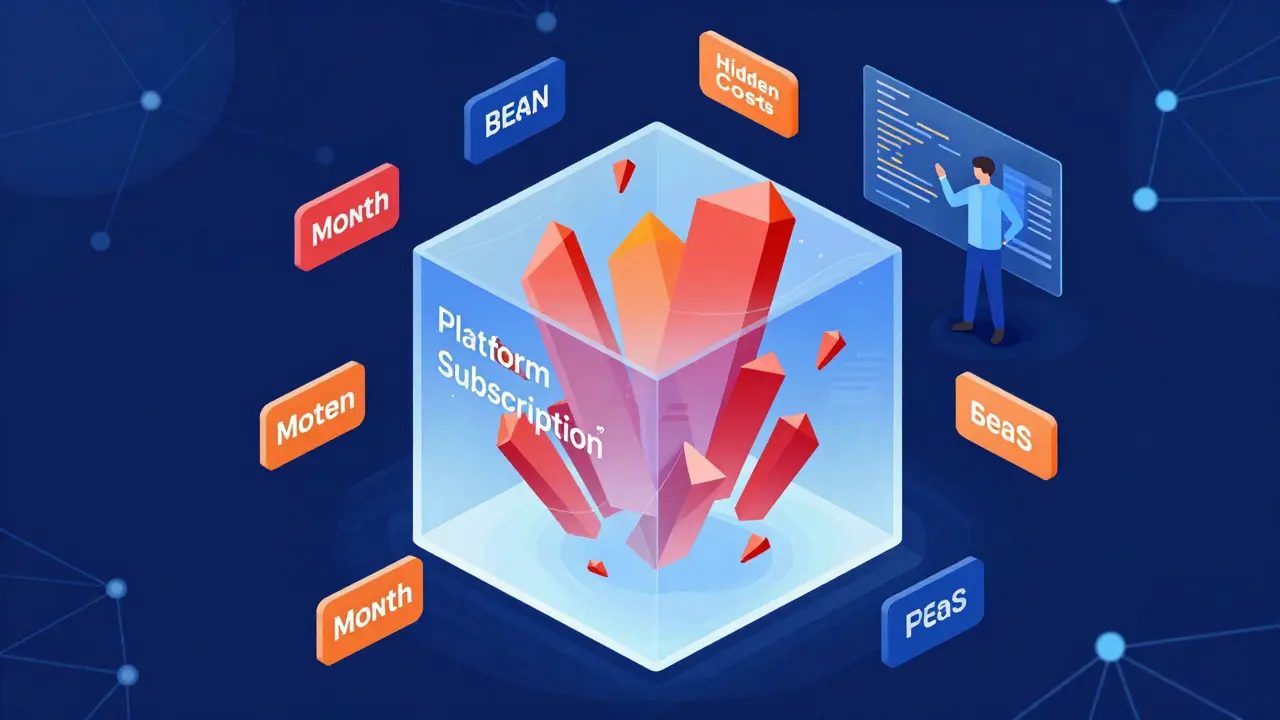
Hidden Costs That Blow Up Budgets
Most companies underestimate the total cost of ownership (TCO). Here are the sneaky expenses that catch leaders off guard:
- Maintenance and Support: Blockchains don’t run themselves. Expect to pay 15-20% of your initial implementation cost annually for updates, security patches, and node management. If you choose a managed service, this is included in your subscription, but it’s still a recurring line item.
- Integration Complexity: Connecting blockchain to your old ERP or CRM systems is hard. Each additional API integration can add $3,000 to $8,000 to your project. Legacy systems often require custom middleware, which increases development time by 20-30%.
- Regulatory Compliance: If you operate globally, laws matter. The EU’s MiCA framework, for example, can add 12-18 months to your timeline and 15-25% to your costs due to legal consultations and audit requirements. In contrast, jurisdictions with progressive sandboxes like Singapore may reduce implementation time by 20-30%.
- Smart Contract Audits: Never skip this. A bug in your code can lead to millions in losses. Professional audits cost between $10,000 and $50,000 depending on complexity. Remember the fintech startup that saved money on development only to lose $2.3 million in an exploit? They paid $185,000 just to fix the mess.
- Transaction Fee Volatility: If you build on a public chain like Ethereum, fees fluctuate. You need a contingency budget of 10-15% to cover peak usage periods. Some providers now offer fixed-fee plans to mitigate this risk.
Comparing Major BaaS Providers
Not all providers are created equal. Your choice affects both upfront costs and long-term flexibility. Here is how some key players stack up in the current market:
| Provider | Pricing Model | Hourly Rate / Monthly Base | Best For | Key Limitation |
|---|---|---|---|---|
| Rapid Innovation | Hourly + Fixed Scope | $30 - $60 / hr | Cost-efficient Web3 development, AI-driven optimization | Less brand recognition than hyperscalers |
| Paystand | Hourly | $50 - $70 / hr | Fintech, financial compliance-heavy projects | Higher cost for non-financial apps |
| Kaleido | Consumption-Based | $250 - $15,000+ / mo | Enterprises wanting predictable billing, easy scaling | Costs escalate rapidly with high transaction volume |
| Blockstream | Custom Quote | $75+ / hr | Bitcoin-centric enterprise solutions | Limited smart contract functionality compared to Ethereum |
| AWS Managed Blockchain | Usage-Based | Variable (Compute + Storage) | Companies already deep in the AWS ecosystem | Complex pricing structure, potential vendor lock-in |
Vendor Lock-In Warning: Experts like Dr. Sarah Chen from Gartner warn that while BaaS saves time, it can create dependency. If your provider raises prices or shuts down a feature, migrating away can be costly and time-consuming. Always ensure your smart contracts are portable and your data can be exported easily.
How to Reduce Your BaaS Costs
You don’t have to accept the highest quote. Here are practical strategies to keep your budget in check:
- Choose the Right Consensus Mechanism: Avoid Proof-of-Work unless necessary. Proof-of-Stake (PoS) and Delegated Proof-of-Stake (DPoS) are faster and cheaper to run. Networks like Algorand or Cardano offer lower operational costs.
- Use Layer-2 Solutions: If you need Ethereum’s security and developer community but hate the fees, use Layer-2 networks like Arbitrum or Polygon. They reduce transaction costs by 97-99% while settling on the main Ethereum chain.
- Start Small with Team Augmentation: Instead of hiring a full external team, augment your internal staff with 2-3 specialists for critical phases. ScienceSoft data shows this can save 25-35% compared to full outsourcing while keeping control in-house.
- Negotiate Fixed-Fee Plans: Ask providers like Kaleido for capped monthly plans if your transaction volume is predictable. This protects you from volatility.
- Optimize Smart Contracts: Efficient code costs less to execute. Invest in rigorous auditing and optimization during development to save on gas fees forever.

Return on Investment: Is It Worth It?
Let’s talk results. Why do companies spend hundreds of thousands on BaaS? Because the alternative-in-house blockchain development-is slower, riskier, and often more expensive in the long run.
Consider a manufacturing client documented in recent case studies. They spent $78,500 to implement a supply chain dApp on a BaaS platform. The result? Fraud incidents dropped by 37%, and reconciliation time fell from 14 days to just 4 hours. They achieved full ROI in under 8 months.
Generally, enterprises adopting BaaS see 40-60% faster deployment times compared to building from scratch. If your business relies on trust, transparency, or automated payments, the efficiency gains usually outweigh the costs within the first year. However, if your use case doesn’t strictly require decentralization, you might be better off with a traditional database. Don’t use blockchain just because it’s trendy.
Future Trends Impacting Costs in 2026 and Beyond
The BaaS landscape is shifting. By 2027, we expect 65% of implementations to include multi-chain support, automatically routing transactions to the cheapest available network. This will further drive down operational costs.
However, new risks are emerging. Quantum computing poses a threat to current encryption standards. The World Economic Forum estimates that quantum-resistant upgrades could add 15-25% to long-term BaaS costs by 2030. Choose providers who are actively researching post-quantum cryptography to future-proof your investment.
Also, expect consolidation. Major cloud platforms like AWS and Microsoft Azure are acquiring smaller specialized providers. This may lead to standardized pricing but could reduce niche innovation. Stay informed about market mergers to avoid being stuck with a suboptimal provider.
What is the average cost of implementing a Blockchain-as-a-Service solution?
The average cost varies widely based on scope. A basic proof-of-concept starts around $50,000, while mid-market implementations range from $150,000 to $500,000. Large-scale enterprise networks can exceed $2,000,000. Hourly rates for developers typically range from $30 to $70, depending on specialization.
Are there hidden costs in BaaS subscriptions?
Yes. Common hidden costs include transaction fees (gas), API integration charges ($3,000-$8,000 per integration), annual maintenance (15-20% of initial cost), and regulatory compliance consulting. Always ask for a Total Cost of Ownership (TCO) estimate, not just the monthly subscription fee.
Which BaaS provider is the most cost-effective?
For pure cost efficiency in development, Rapid Innovation offers rates between $30-$60/hour. For predictable operational costs, Kaleido’s consumption-based model starting at $250/month is attractive for small networks. However, "cost-effective" depends on your specific tech stack and volume needs.
How do transaction fees impact BaaS costs?
Transaction fees are a recurring operational cost. On Ethereum, this can be $1.50-$5.00 per transaction, adding up quickly. Using Layer-2 solutions like Polygon or Arbitrum, or networks like Solana, can reduce these fees to fractions of a cent ($0.0001-$0.05), significantly lowering long-term expenses.
Can I migrate my blockchain app from one BaaS provider to another?
It is possible but difficult. Vendor lock-in is a major risk. To facilitate migration, ensure your smart contracts are written in standard languages (like Solidity) and avoid proprietary APIs. Migrating data and state can take weeks and incur significant engineering costs.





16 Comments
Patrick Pat
August 13, 2026 at 10:49
Another day, another article telling us that blockchain is the savior of supply chains while quietly charging us an arm and a leg for the privilege. The 'hidden fees' section is just corporate speak for 'we will nickel and dime you until you cry.' I've seen these models before. They promise transparency but deliver a bill that looks like it was written in hieroglyphics. You want speed? Pay up. You want security? Double it. It's not BaaS, it's Bait-and-Switch-as-a-Service.
Claudio Perrone
August 13, 2026 at 13:03
i mean its kinda crazy how much they charge for basically renting space on a computer thats already online. why do we need all this tech when a simple spreadsheet could do the job? the whole point of decentralization was to get rid of middlemen but now we have new middlemen who are even more expensive. its like paying a toll to drive on a road that used to be free. makes my head spin trying to figure out if its worth it or just hype.
Aaron Morrissey
August 14, 2026 at 02:32
Oh, the sheer audacity of the modern enterprise architecture! To think that one might require a digital ledger for mere transactional integrity is quaint, isn't it? No, no, we must pay Kaleido fifteen thousand dollars a month to witness our own data being stored. It is a tragedy of epic proportions, where the pursuit of efficiency leads only to a labyrinth of subscription tiers. One wonders if the 'blockchain' itself is merely a metaphor for the endless void of corporate expenditure. We are building cathedrals of code on foundations of sand, all while singing hymns to ROI.
Patrick Quairoli
August 14, 2026 at 08:27
its all a scam designed to keep the little guys out. the big banks love this because they can control the narrative and charge whatever they want. look at the prices jump every year. its not about technology its about power. they want you locked into their ecosystem so you cant leave. i bet the audits are fake too just to scare you into paying more. wake up people its just another way to steal your money under the guise of innovation.
Amor Jordan
August 14, 2026 at 23:08
I really appreciate how this post breaks down the costs so clearly. It’s easy to feel overwhelmed by all the jargon and numbers, but seeing the breakdown from PoC to Enterprise helps put things in perspective. I’ve been hesitant to dive into blockchain for my small business because I was afraid of hidden surprises. Knowing that maintenance is usually around 15-20% annually gives me a bit more confidence to plan ahead. It’s comforting to know there are strategies to reduce costs, like using Layer-2 solutions. Thank you for sharing this valuable information!
Nick Darring
August 16, 2026 at 10:11
Look, I get that everyone loves to hate on the cost, but let’s be real here, if you’re running a global supply chain and you’re losing millions to fraud and inefficiency, spending half a million on a robust system is actually a bargain, isn’t it? People always complain about the price tag without looking at the alternative, which is usually chaos and manual errors that cost way more in the long run. Plus, if you’re smart enough to negotiate fixed-fee plans and use cheaper networks like Polygon, the costs drop significantly. It’s not rocket science, it’s just basic business math, but sure, let’s pretend that paying for reliability is some kind of conspiracy against the working man.
Eden Tadesse
August 18, 2026 at 10:04
i totally agree with nick. people forget that cheap solutions often end up costing more later due to bugs or security issues. its better to invest in quality upfront.
Eric Zehr
August 20, 2026 at 02:51
This is a fantastic overview of the current BaaS landscape. I particularly liked the emphasis on Total Cost of Ownership rather than just the initial development cost. Too many companies fall into the trap of choosing the cheapest developer only to suffer from poor code quality and high gas fees later. The point about regulatory compliance adding 15-25% to costs is crucial for anyone operating in the EU. MiCA is no joke, and budgeting for legal consultations early on can save headaches down the line. Great read!
Namrata Mapgaonkar
August 21, 2026 at 14:27
In India, we are seeing a lot of startups trying to adopt blockchain but struggling with these costs. The hourly rates mentioned seem very high for our market. However, the tip about team augmentation is really helpful. Maybe hiring local talent and combining it with international expertise could balance the cost. Also, Layer-2 solutions are becoming more popular here because gas fees on mainnet are prohibitive for small transactions. Hope to see more affordable options soon :)
Rita Dutta
August 21, 2026 at 15:59
The philosophical implication of paying for 'trust' via a service is quite profound, don't you think? We are essentially outsourcing the concept of truth to a corporation. If the provider goes bankrupt, does the truth disappear? The article mentions vendor lock-in, which is a form of digital serfdom. We bind ourselves to the platform in exchange for convenience. It is a Faustian bargain where we trade sovereignty for speed. The 'hidden costs' are not just financial but existential. Are we building a decentralized future or just a centralized monopoly with a fancy name?
Paul Smith
August 22, 2026 at 16:13
Great insights! 🚀 I’ve been following the rise of BaaS closely, and the shift towards multi-chain support by 2027 sounds exciting. It’s good to see providers thinking about interoperability. For those just starting out, don’t forget to check out community-driven resources and open-source tools that can help reduce initial dev costs. Keep learning and stay curious! 💡
Rodmun Tarnowski
August 23, 2026 at 01:33
Indeed; the article provides a comprehensive analysis of the financial implications of Blockchain-as-a-Service. It is imperative that stakeholders consider not only the immediate expenditures but also the long-term operational sustainability. The distinction between Proof-of-Work and Proof-of-Stake is particularly relevant, given the environmental and economic factors at play. Furthermore, the caution regarding vendor lock-in is well-founded. Organizations must prioritize portability and standardization in their architectural decisions. A prudent approach involves rigorous due diligence and continuous monitoring of market trends. Well articulated.
Matthew Smith
August 24, 2026 at 10:00
We live in a time where morality is compromised by profit margins. The fact that companies hide fees behind complex pricing models speaks to a lack of ethical grounding. Why should a business bear the burden of volatility when the provider profits from stability? It is unjust. We demand transparency not as a luxury but as a right. Until then we remain victims of a system designed to exploit our ignorance. Choose wisely but know that the game is rigged.
Prudence Flemming
August 25, 2026 at 20:28
the epistemological crisis of trust in distributed ledgers is mirrored in the economic structures imposed by baas providers. when we outsource consensus we outsource agency. the jargon of roi masks the ontological shift from ownership to access. gas fees are not just costs they are taxes on existence within the network. layer 2s offer a phenomenological reduction of friction but do they solve the underlying alienation? probably not but hey at least its cheaper.
Carl Michaud
August 26, 2026 at 09:06
Let’s cut through the noise. The average joe doesn’t need blockchain. This is a solution looking for a problem, engineered by elitists who want to monetize complexity. The 'hidden fees' are just the entry ticket to a walled garden. AWS and Azure are buying up these niche players to consolidate power, creating a duopoly that will dictate the terms of digital interaction. Quantum resistance is a red herring to sell more upgrades. Stay away unless you have infinite capital and a death wish for your budget.
Matt Kay
August 26, 2026 at 20:45
boring. too much text. just tell me if its worth it or not.