
Digital Rights Management Using Blockchain: How It Works & Benefits
Imagine selling a digital song and waiting six months to get paid. Now imagine getting that money in seven days, with a clear record of exactly who bought it and how much you earned. That is the promise of Digital Rights Management (DRM) using blockchain, which uses decentralized ledgers to track ownership and automate payments without middlemen. For creators, this means less administrative headache and more transparency. For businesses, it means fewer disputes over who owns what. But does it actually work in practice? The short answer is yes, but with some important caveats about cost and complexity.
Why Traditional DRM Fails Creators
Most people know DRM from their streaming apps or e-books. These systems lock content behind centralized servers controlled by big tech companies like Apple or Google. While effective for preventing piracy, they create a black box for creators. You don't see the data; you just get a statement at the end of the quarter if you're lucky. According to IBM's 2022 survey, 43% of content creators lose revenue simply because they can't track rights effectively. When a song goes viral on a platform you didn't sign a direct deal with, chasing royalties becomes a legal nightmare. Traditional systems also suffer from security breaches. Between 2018 and 2022, major centralized DRM servers experienced 14 significant security incidents, exposing user data and weakening trust in the system.
How Blockchain Changes the Game
Blockchain flips the model on its head. Instead of one central server holding all the records, thousands of computers across a network keep copies of the same ledger. This creates an immutable trail of ownership. Once a transaction is recorded, it cannot be altered or deleted. For DRM, this means every time a piece of content is sold, licensed, or streamed, the event is logged permanently. If a dispute arises, you have irrefutable proof of when and where the rights were transferred. Dr. Jane Smith from MIT Media Lab notes that this timestamping reduces copyright dispute resolution time by up to 92%. It turns ownership from a matter of opinion into a matter of fact.
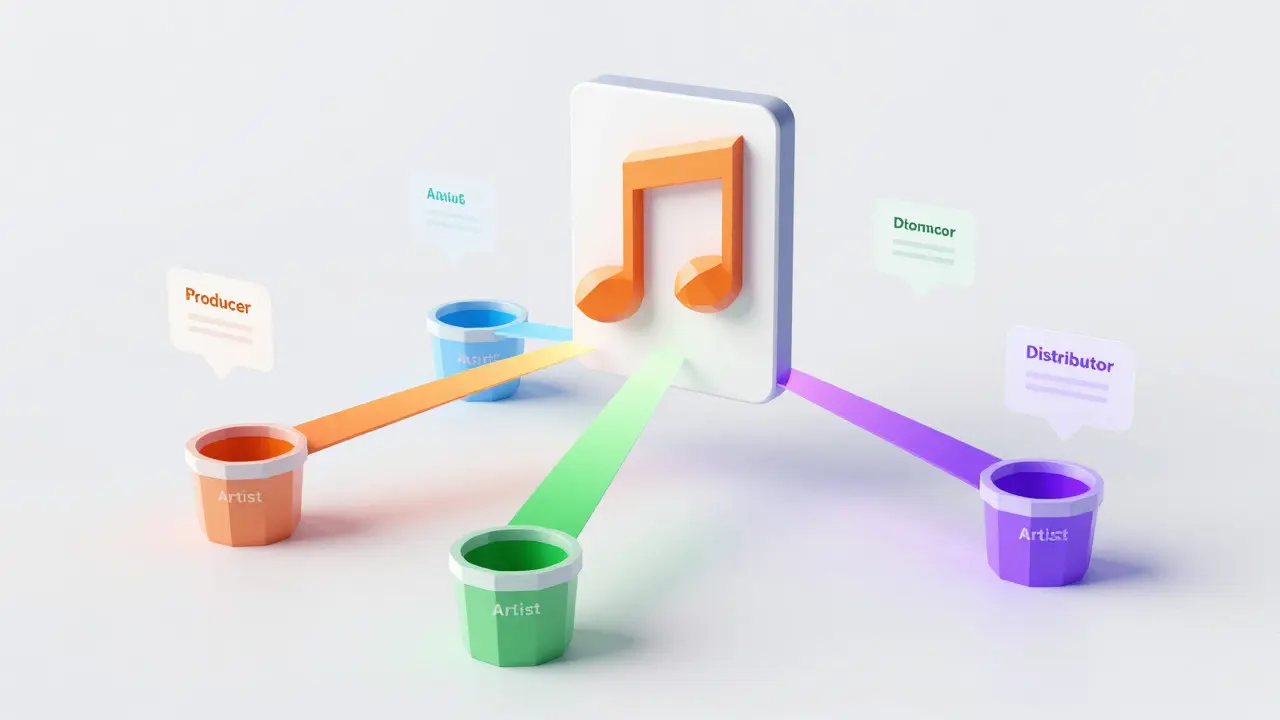
The magic happens through smart contracts. These are self-executing agreements written in code. For example, a musician can write a rule that says, "Every time my song is played, 50% of the fee goes to me, 30% to the producer, and 20% to the distributor." The moment the stream happens, the smart contract triggers and moves the funds automatically. No invoices, no delays, no arguments. Ujo Music, a platform built on this logic, reduced royalty processing time from six months to just seven days for independent artists.
Key Components of a Blockchain DRM System
Building or using these systems involves several technical pieces working together. Understanding them helps explain why adoption has been slow but steady.
- Cryptography: Uses algorithms like SHA-256 to secure transactions. This ensures that only the right people can unlock or transfer rights.
- Decentralized Storage: Often uses IPFS (InterPlanetary File System) to store the actual files off-chain, while the blockchain stores the metadata and ownership proofs. This keeps the main chain fast and cheap.
- Consensus Mechanisms: Networks use Proof of Stake or Proof of Work to agree on the validity of transactions. Since Ethereum switched to Proof of Stake in late 2022, energy consumption dropped by 99.95%, making it more sustainable for large-scale DRM use.
- Identity Verification: Self-Sovereign Identity (SSI) allows users to prove who they are without revealing everything. A creator can show they own a specific asset without sharing their entire personal history.
Costs and Performance: The Real Numbers
Let's talk money, because that's usually the dealbreaker. Traditional DRM setups are expensive. Gartner reports that initial setup costs range from $250,000 to $500,000, plus 15-20% annual maintenance fees. Blockchain DRM is cheaper upfront, averaging $180,000 to $350,000, with lower ongoing maintenance at 8-12%. Why the difference? Fewer intermediaries mean fewer fees. However, performance varies by platform. Public chains like Ethereum handle about 15-30 transactions per second, which can feel slow during peak times. Enterprise platforms like Hyperledger Fabric can process 1,500-2,000 transactions per second, making them suitable for large media companies. If you're an individual creator, gas fees on public networks can eat into profits. One film producer reported losing 22% of his micro-revenue to high gas fees during network congestion. To avoid this, many now use Layer 2 solutions like Polygon, which offer near-zero fees and faster speeds.
| Feature | Traditional DRM | Blockchain DRM |
|---|---|---|
| Initial Cost | $250k - $500k | $180k - $350k |
| Royalty Processing Time | 3 - 6 Months | 7 Days or Less |
| Transparency | Low (Black Box) | High (Public Ledger) |
| Security Model | Centralized Server | Decentralized Network |
| User Awareness | 89% | 22% |
Real-World Success Stories
It’s not just theory. The Norwegian Grammy Awards implemented blockchain DRM in 2022. The result? Royalty distribution errors dropped from 12% to just 0.3%, and payment times slashed from nine months to 14 days. Independent musicians love platforms like Audius, where one user reported a 37% increase in royalty payments and an 80% reduction in admin time. On the enterprise side, Adobe Creative Cloud is integrating blockchain verification for 200 million users through the Content Authenticity Initiative, proving that even giants see value in transparent provenance.

Challenges and Pitfalls to Avoid
Don’t expect perfection. The biggest hurdle is interoperability. There are currently 17 major blockchain DRM platforms, and many don’t talk to each other well. If your content is on Platform A and your buyer uses Platform B, you might hit a wall. Also, blockchain solves verification, not enforcement. If someone steals your file and uploads it to a non-compliant site, you still need legal action to stop them. WIPO data shows 41% of blockchain-registered copyrights still require traditional legal steps for infringement. Finally, the learning curve is steep. 78% of creators need 20-40 hours of training just to understand cryptographic keys and wallet management. Start small, test with low-value assets, and ensure your platform supports APIs that connect to tools you already use.
Frequently Asked Questions
Is blockchain DRM better than traditional DRM?
For complex royalty splits and long-term ownership tracking, yes. It offers higher transparency and faster payments. However, for simple, immediate content locking, traditional DRM may still be faster and easier for end-users to access.
How much does it cost to implement blockchain DRM?
Enterprise implementations typically range from $180,000 to $350,000 initially. Individual creators can start with lower-cost platforms, but should budget for potential gas fees on public networks or subscription costs for managed services.
Do I need to be a developer to use it?
Not necessarily. Most platforms provide user-friendly interfaces for managing assets. However, understanding basic concepts like wallets and private keys is essential. Expect to spend 20-40 hours learning the basics if you are new to crypto technology.
Which blockchain is best for DRM?
Ethereum remains popular due to its large ecosystem, but Polygon is preferred for low fees and speed. For large enterprises, permissioned chains like Hyperledger Fabric offer higher throughput and privacy controls.
Will blockchain replace all traditional DRM?
Probably not entirely. Hybrid models are emerging where blockchain handles rights and royalties, while traditional methods handle immediate access control. IDC predicts blockchain will handle 35% of digital content transactions by 2026, indicating a significant but partial shift.