How to Provide Liquidity and Earn Fees: A Step-by-Step DeFi Guide
You want your crypto to work for you. Instead of letting Bitcoin or Ethereum sit idle in a wallet, you can deposit them into liquidity pools is smart contract-based reservoirs of funds that enable decentralized trading without traditional order books. By doing so, you become a liquidity provider (LP) and earn a cut of the transaction fees generated by traders using those pools.
This isn't just theoretical. In 2024, over $50 billion was locked in these protocols. But here is the catch: it is not risk-free. If you do not understand the mechanics, specifically something called impermanent loss, you could end up with less money than if you had simply held your coins. This guide breaks down exactly how to provide liquidity, where to find the best opportunities, and how to protect your capital.
Understanding How Liquidity Pools Work
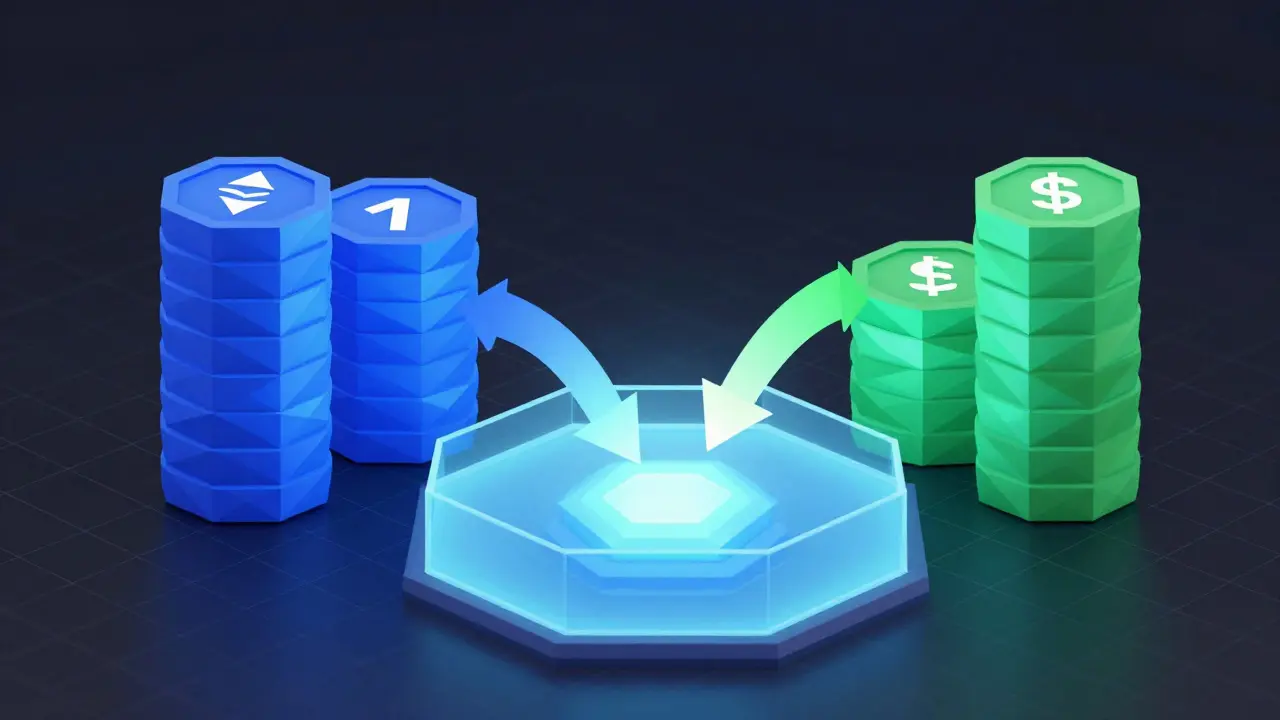
To earn fees, you first need to understand what you are funding. Traditional exchanges like Coinbase use an order book, matching buyers and sellers directly. Decentralized exchanges (DEXs) use Automated Market Makers (AMMs). Think of an AMM as a vending machine. You put money in, you get tokens out, and the price adjusts automatically based on supply and demand.
Uniswap is the largest decentralized exchange protocol, pioneering the automated market maker model since its launch in 2018. When you provide liquidity, you are essentially stocking that vending machine. You must deposit two assets in equal value. For example, if you want to join an ETH/USDC pool, and ETH is worth $3,000, you must deposit $3,000 worth of USDC alongside one ETH.
In return, you receive LP tokens. These are receipts proving your share of the pool. As traders swap ETH for USDC, they pay a fee-typically 0.3% on standard pools. That fee is distributed among all LPs proportional to their share. If you own 1% of the pool, you get 1% of the fees. It sounds simple, but the math behind the pricing curve ensures the pool never runs out of stock, even during volatile markets.
Step-by-Step: How to Start Providing Liquidity
Getting started requires a few technical steps. Do not rush this process. One wrong click can drain your wallet. Follow this sequence carefully.
- Set Up a Compatible Wallet: You need a non-custodial wallet. For Ethereum and Layer 2 networks, MetaMask is a browser extension and mobile app that allows users to interact with blockchain applications securely is the industry standard. For Solana, use Phantom. Ensure you have backed up your seed phrase offline.
- Fund Your Wallet: Buy the two tokens you intend to pair. Let's say you choose ETH and USDC. Transfer both to your MetaMask wallet. Make sure you have extra ETH or SOL in your wallet to pay for gas fees (transaction costs).
- Connect to a DEX: Navigate to a reputable platform like Uniswap, SushiSwap, or Raydium. Click "Connect Wallet" and approve the connection request in your wallet interface.
- Select the Pool: Go to the "Pool" or "Liquidity" section. Search for the token pair you hold (e.g., ETH-USDC). Check the fee tier. Standard pairs usually charge 0.3%, while stablecoin pairs might charge 0.05%.
- Add Liquidity: Enter the amount of one token. The platform will auto-calculate the required amount of the second token to maintain a 50/50 value split. Review the details. Confirm the transaction in your wallet. You may need to sign multiple transactions (approve spending for each token, then add liquidity).
- Receive LP Tokens: Once confirmed, you will see your position in the dashboard. You now own a slice of that pool. Your LP tokens will appear in your wallet or the platform’s interface.
Note that on Ethereum mainnet, gas fees can range from $5 to $50+ depending on network congestion. This makes small deposits unprofitable. Many users opt for Layer 2 solutions like Arbitrum or Polygon, where fees are often under $0.10.
The Hidden Risk: Impermanent Loss Explained
If there is one concept that separates successful LPs from those who lose money, it is impermanent loss (IL). This is not a bug; it is a feature of how AMMs work. IL occurs when the price ratio of the two tokens in your pool changes compared to when you deposited them.
Imagine you deposit $1,000 of ETH and $1,000 of USDC. Total value: $2,000. Now, imagine ETH doubles in price to $6,000, while USDC stays at $1. An AMM algorithm rebalances the pool to keep the product of reserves constant. It sells some of your appreciating ETH to buy more depreciating USDC. When you withdraw, you have fewer ETH than you would have if you just held them, and more USDC.
Mathematically, if one asset doubles in price relative to the other, you face approximately 5.7% impermanent loss. If the asset triples, the loss grows to about 11%. This loss is "impermanent" because if prices revert to your entry point, the loss disappears. However, if you withdraw while the divergence remains, the loss becomes permanent.
| Price Change Ratio | Value if Held | Value in LP Pool | Impermanent Loss % |
|---|---|---|---|
| 1x (No Change) | $2,000 | $2,000 | 0% |
| 2x (One Asset Doubles) | $3,000 | $2,828 | 5.7% |
| 5x (One Asset Quintuples) | $6,000 | $5,099 | 15% |
| 10x (One Asset 10x's) | $11,000 | $8,485 | 23% |
To mitigate this, many providers stick to correlated assets. For example, pairing ETH with wstETH (liquid staked Ethereum) minimizes IL because their prices move almost in lockstep. Similarly, stablecoin pairs like USDC/DAI have near-zero IL but also lower fee potential due to low volatility.

Choosing the Right Platform and Strategy
Not all pools are created equal. Your choice of platform and token pair dictates your risk-reward profile.
- Uniswap V3: Introduces concentrated liquidity. Instead of spreading your capital across all possible prices, you specify a range (e.g., ETH between $2,800 and $3,200). This boosts capital efficiency and fee earnings significantly but requires active management. If the price exits your range, you stop earning fees and face higher IL risk.
- Curve Finance: Specializes in stablecoins and pegged assets. Fees are lower (often 0.04%), but IL is minimal. Ideal for conservative investors seeking steady yields with added governance token rewards (CRV).
- SushiSwap & Balancer: Offer diverse pools. Balancer allows multi-token pools (up to 8 assets) with customizable weights, providing flexibility but increased complexity.
- Solana-Based Pools (Raydium, Orca): Attract users with sub-cent transaction fees. High volatility and high volume can lead to substantial fee income, but smart contract risks remain higher on newer ecosystems.
When selecting a pool, look at Total Value Locked (TVL) and daily volume. A pool with high TVL but zero volume earns nothing. Conversely, a new pool with low TVL might offer huge percentages but carries higher rug-pull or smart contract risk. Use tools like DefiLlama to compare APYs across chains objectively.
Maximizing Returns: Advanced Tactics
Once you are comfortable with basic provision, consider these strategies to boost yields.
Yield Farming: Some protocols incentivize liquidity by rewarding LPs with additional governance tokens. You can stake your LP tokens in a "farm" to earn these rewards. This can double or triple your effective APY. However, remember that the reward token itself has a market price. If the token crashes, your overall return may turn negative despite high nominal APY.
Automated Compounding: Platforms like Yearn Finance allow you to deposit assets into vaults that automatically harvest fees and reinvest them. This removes the manual effort of claiming and restaking, optimizing for compound interest. Be aware of the extra layer of smart contract risk introduced by the vault manager.
Diversification Across Chains: Don't put all your capital on Ethereum. Spread liquidity across Arbitrum, Optimism, and Base. These Layer 2 networks offer similar security guarantees with drastically lower fees, allowing for smaller position sizes and more frequent rebalancing.
Common Pitfalls to Avoid
New providers often make costly mistakes. Here is what to watch out for.
Ignoring Gas Costs: On Ethereum mainnet, entering and exiting a pool can cost $50-$200 in gas. If your expected monthly fee income is only $20, you are losing money. Always calculate net profit after gas.
Chasing Highest APY: A pool offering 1,000% APY is likely unsustainable or highly risky. It may rely on inflationary token emissions rather than real trading fees. Stick to pools with transparent fee structures and established track records.
Neglecting Security: Only interact with official URLs. Bookmark Uniswap.io, Curve.fi, etc. Phishing sites mimic these interfaces to steal your private keys. Never share your seed phrase. Use hardware wallets like Ledger or Trezor for large positions.
Holding Volatile Pairs Too Long: If you provide liquidity for a meme coin paired with ETH, expect massive swings. Monitor your position daily. Set alerts for price movements. Exit if the divergence exceeds your risk tolerance.
Tax Implications and Compliance
Earning fees is taxable income in most jurisdictions. In Ireland, for instance, profits from cryptocurrency trading and staking may be subject to Capital Gains Tax or Income Tax depending on activity frequency. Each time you claim fees or rebalance your pool, it may trigger a taxable event. Keep detailed records of every deposit, withdrawal, and fee accrual. Tools like Koinly or CoinTracker can help automate this reporting. Consult a local tax professional to ensure compliance with current regulations.
What is the minimum amount needed to provide liquidity?
There is no strict minimum set by protocols, but practical minimums depend on gas fees. On Ethereum mainnet, depositing less than $500-$1,000 is often unprofitable due to high transaction costs. On Layer 2 networks like Arbitrum or Polygon, you can start with as little as $50-$100 since fees are negligible.
Can I lose my entire investment in a liquidity pool?
While rare, yes. If one of the tokens in the pool drops to zero (due to a hack, scam, or market collapse), your value plummets. Additionally, smart contract vulnerabilities can lead to exploits where funds are drained. Always audit the protocol and avoid obscure, unaudited projects.
How do I calculate my potential earnings?
Earnings depend on your share of the pool and the total fees generated. Formula: (Your Deposit / Total Pool Value) * Total Fees Collected. Use calculators on DefiLlama or the platform’s dashboard to estimate annual percentage yield (APY) based on historical volume. Remember, past performance does not guarantee future results.
Is providing liquidity better than staking?
It depends on your risk appetite. Staking offers predictable, lower yields with minimal risk (mostly slashing risks). Liquidity provision offers potentially higher returns through fees and incentives but carries impermanent loss and smart contract risks. Diversifying between both strategies is often wise.
What happens if I want to withdraw early?
You can withdraw anytime by removing liquidity from the platform. You will receive your proportional share of the underlying tokens. However, you will incur gas fees for the transaction, and any impermanent loss realized at that moment becomes permanent. Plan your exit strategy before entering.