SynFutures v3 Review: Is the Decentralized Derivatives Platform Worth Your Trust in 2026?
Remember when trading futures meant trusting a centralized giant with your life savings? Those days are fading fast. SynFutures v3 is one of the platforms leading that charge, promising to bring the power of institutional-grade derivatives trading directly to your wallet without the middleman. But does it actually deliver on that promise, or is it just another shiny new protocol in the crowded DeFi space?
We’re going to cut through the hype. This isn’t just about price predictions for the $F token. It’s about whether SynFutures v3 is safe enough to trade with, efficient enough to not bleed you dry in gas fees, and liquid enough to actually execute your trades. If you’re looking for a deep dive into this specific platform, you’ve come to the right place.
The Core Problem: Why We Needed SynFutures v3
Traditional financial markets have long dominated derivatives trading. You had CME Group, Binance Futures, and other giants controlling the flow. For years, decentralized finance (DeFi) struggled to replicate this. Early attempts were either too slow, suffered from massive slippage, or required locking up enormous amounts of capital just to get started.
SynFutures v3 was launched in December 2024 to solve exactly these friction points. It represents the third major iteration of the platform, built specifically to handle high-frequency trading and complex synthetic assets. The goal? To create a permissionless environment where anyone can trade futures on almost anything-cryptos, NFTs, real-world assets-without needing approval from a bank or an exchange.
But here’s the catch: decentralization often comes at the cost of efficiency. Does SynFutures v3 manage to balance speed, security, and accessibility? Let’s break down the architecture that makes it tick.
Under the Hood: The oAMM V3 Engine
The secret sauce of SynFutures v3 isn’t just its interface; it’s the engine running underneath. Most decentralized exchanges rely on standard Automated Market Makers (AMMs), like Uniswap’s constant product formula. These work fine for simple swaps but fall apart when you try to trade leveraged derivatives.
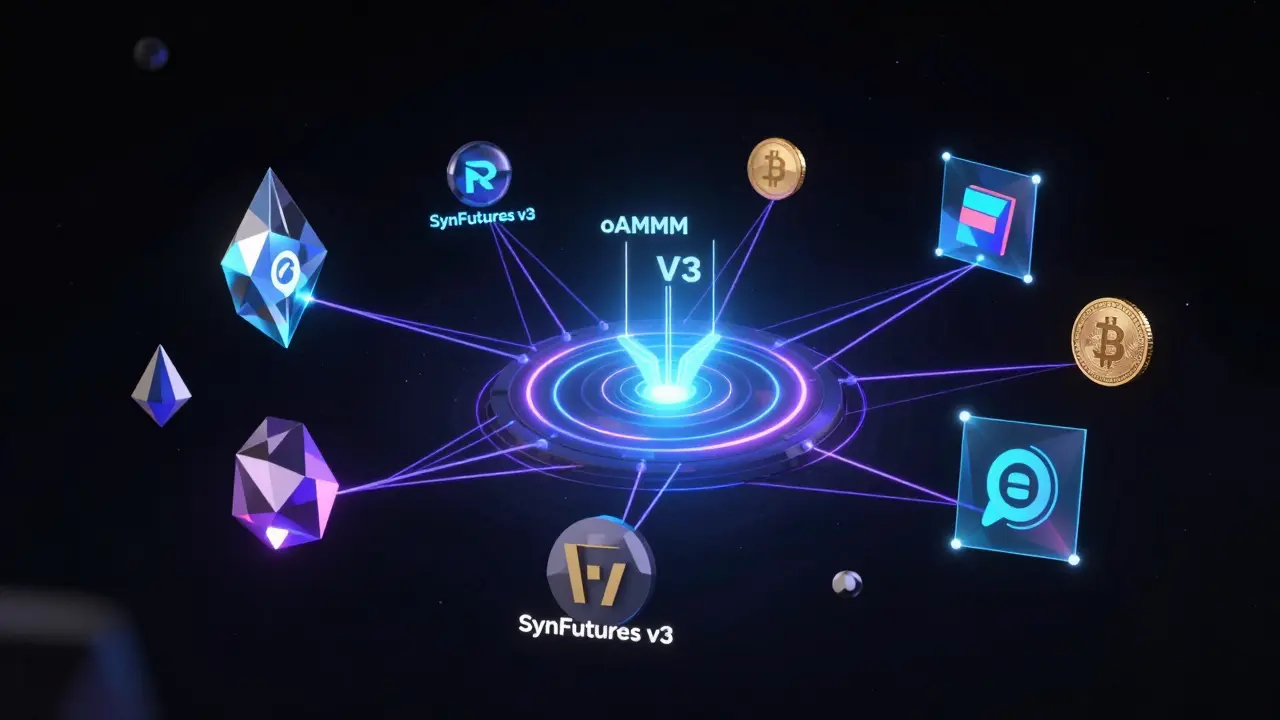
SynFutures uses a proprietary model called Oyster Automated Market Maker (oAMM) V3. Think of it as a hybrid beast. On one side, you have the traditional AMM liquidity pools providing baseline stability. On the other, there’s a fully on-chain order-matching engine. This combination allows for better price discovery and tighter spreads compared to pure AMM models.
- On-Chain Order Matching: This mimics traditional limit orders, allowing traders to set specific entry and exit points.
- Liquidity Efficiency: By combining AMM and order book mechanics, liquidity providers earn fees from both passive trading and active matching.
- Asset Flexibility: The system supports synthetic assets, meaning you can trade exposure to Bitcoin without holding Bitcoin, or even speculate on the price of an NFT collection.
This technical setup is significant because it reduces the "impermanent loss" risk for liquidity providers while offering traders deeper liquidity than typical DEXs. However, complexity brings risk. Smart contracts are only as secure as their code, and bugs in such a sophisticated engine could be costly.
The $F Token: Utility vs. Speculation
You can’t talk about SynFutures without talking about its native currency, the $F token. As of early 2026, the token has seen wild swings, reflecting the broader volatility of the crypto market. But beyond the charts, what does it actually do?
The $F token is an ERC-20 token on the Ethereum mainnet with a capped supply of 10 billion. It serves three primary functions:
- Governance: Holders vote on protocol upgrades, fee structures, and new asset listings. This ensures the platform evolves according to community needs rather than corporate whims.
- Staking Rewards: Users can stake $F to earn rewards, which helps secure the network and incentivizes long-term holding.
- Fee Discounts: Trading with staked tokens often results in reduced fees, making it cheaper for active traders to operate.
Market performance data shows the $F token trading around $0.012 to $0.07 depending on the timeframe and volatility spikes. Analysts remain divided. Conservative estimates suggest potential growth to $0.30-$0.50 by late 2025 if adoption holds steady. Bullish scenarios project higher peaks, but these depend heavily on broader DeFi adoption and regulatory clarity. Keep in mind that past performance doesn’t guarantee future results, especially in a sector as unpredictable as crypto derivatives.
Security and Backing: Who’s Behind the Curtain?
In DeFi, trust is earned through transparency and backing. SynFutures v3 hasn’t gone unnoticed by the big players. The platform has secured funding from heavyweight venture capital firms including Pantera Capital, Polychain Capital, and Dragonfly Capital.
Why does this matter? These firms don’t throw money at projects lightly. Their involvement suggests rigorous due diligence was conducted on the team, the technology, and the business model. It also provides a layer of credibility that smaller, anonymous projects lack. If things go wrong, there are established entities with reputations to protect.
However, no amount of VC backing eliminates smart contract risk. SynFutures operates on Ethereum, which means users are exposed to gas fees and potential network congestion. While the platform itself aims for security, users must still manage their own private keys and interact with wallets like MetaMask or Ledger. One mistake in address copying or phishing link clicking can wipe out your account instantly.
How It Compares: SynFutures v3 vs. The Competition
SynFutures doesn’t exist in a vacuum. It competes with other decentralized derivatives platforms like dYdX, GMX, and Perpetual Protocol. So, how does it stack up?
| Feature | SynFutures v3 | dYdX | GMX |
|---|---|---|---|
| Core Technology | oAMM V3 + On-Chain Matching | CLOB (Central Limit Order Book) | GLP Liquidity Pool |
| Asset Variety | Crypto, NFTs, RWAs | Primarily Crypto Pairs | Major Crypto Assets |
| Network | Ethereum Mainnet | dYdX Chain (App Chain) | Arbitrum/Avalanche |
| Governance | $F Token Holders | dYdX Token Holders | GMX Token Holders |
| Key Advantage | Hybrid Liquidity Model | High Speed/Low Fees | Simple UX & High APY |
SynFutures v3 stands out with its ability to tokenize virtually any asset, including non-fungible tokens (NFTs) and real-world assets (RWAs). This flexibility is unmatched by most competitors who focus strictly on major cryptocurrencies. However, this breadth also introduces complexity. dYdX offers a smoother experience for pure crypto traders due to its dedicated app chain, while GMX simplifies the process further with its single-pool model.
Risks and Pitfalls: What Could Go Wrong?
No investment is without risk, and DeFi derivatives are among the highest-risk instruments available. Here’s what you need to watch out for when using SynFutures v3:
- Smart Contract Vulnerabilities: Despite audits, bugs can exist. A critical flaw in the oAMM engine could lead to fund loss.
- Regulatory Uncertainty: Governments worldwide are still figuring out how to regulate derivatives. New laws could restrict access or impose heavy compliance burdens.
- Liquidity Risks: During extreme market volatility, liquidity pools may drain, leading to high slippage or failed trades.
- Gas Fees: Operating on Ethereum means transaction costs can spike during busy periods, eating into profits for small trades.
- Token Volatility: The $F token’s value fluctuates wildly. Staking rewards might not offset losses if the token price crashes.
Always start with small amounts. Never invest more than you can afford to lose. And never share your private keys or seed phrases with anyone-not even customer support.
Is SynFutures v3 Right for You?
If you’re a seasoned DeFi user comfortable with managing risks, understanding order books, and navigating Ethereum gas fees, SynFutures v3 offers a compelling toolkit. Its hybrid model provides depth and flexibility that pure AMMs can’t match. The backing from top-tier VCs adds a layer of confidence.
However, if you’re new to crypto or prefer simplicity, this might be too complex. Consider starting with simpler platforms like GMX or centralized exchanges until you’re ready for the nuances of decentralized derivatives. Always do your own research (DYOR). Read the whitepaper, check recent audit reports, and monitor community sentiment before committing funds.
The future of finance is becoming increasingly decentralized. SynFutures v3 is betting big on that shift. Whether it wins depends on execution, adoption, and the ever-changing regulatory landscape. Stay informed, stay cautious, and trade wisely.
What is SynFutures v3?
SynFutures v3 is a decentralized derivatives trading platform launched in December 2024. It allows users to trade futures contracts on various assets, including cryptocurrencies, NFTs, and real-world assets, using a hybrid oAMM V3 engine on the Ethereum blockchain.
How does the oAMM V3 engine work?
The Oyster Automated Market Maker (oAMM) V3 combines traditional liquidity pools with an on-chain order-matching engine. This hybrid approach improves price discovery and reduces slippage compared to standard AMMs, making it suitable for leveraged trading.
What is the $F token used for?
The $F token is the native governance and utility token of SynFutures. Holders can vote on protocol decisions, stake tokens to earn rewards, and receive discounts on trading fees. It has a fixed supply of 10 billion tokens.
Who backs SynFutures v3?
SynFutures has received funding from prominent venture capital firms including Pantera Capital, Polychain Capital, and Dragonfly Capital, indicating strong institutional support and credibility.
Is SynFutures v3 safe to use?
While backed by reputable investors and built on secure Ethereum infrastructure, all DeFi platforms carry smart contract and market risks. Users should conduct thorough research, start with small amounts, and never share private keys.
Can I trade NFTs on SynFutures v3?
Yes, one of the unique features of SynFutures v3 is its ability to create and trade synthetic assets based on NFTs, allowing speculation on their value without owning the underlying digital art.
What are the main risks of trading on SynFutures?
Key risks include smart contract vulnerabilities, regulatory changes, liquidity shortages during volatile markets, high Ethereum gas fees, and the inherent volatility of the $F token itself.
How does SynFutures compare to dYdX?
SynFutures uses a hybrid oAMM/order-book model on Ethereum, supporting diverse assets like NFTs. dYdX runs on its own app chain for faster speeds but focuses primarily on major crypto pairs. SynFutures offers more asset variety, while dYdX offers lower latency.
When was SynFutures v3 launched?
SynFutures v3 was officially launched in December 2024, marking the third major update to the platform’s technology and feature set.
What is the total supply of the $F token?
The total supply of the $F token is capped at 10 billion tokens, distributed to incentivize community participation, staking, and platform development.