Underground Crypto Market Premiums in Banned Jurisdictions
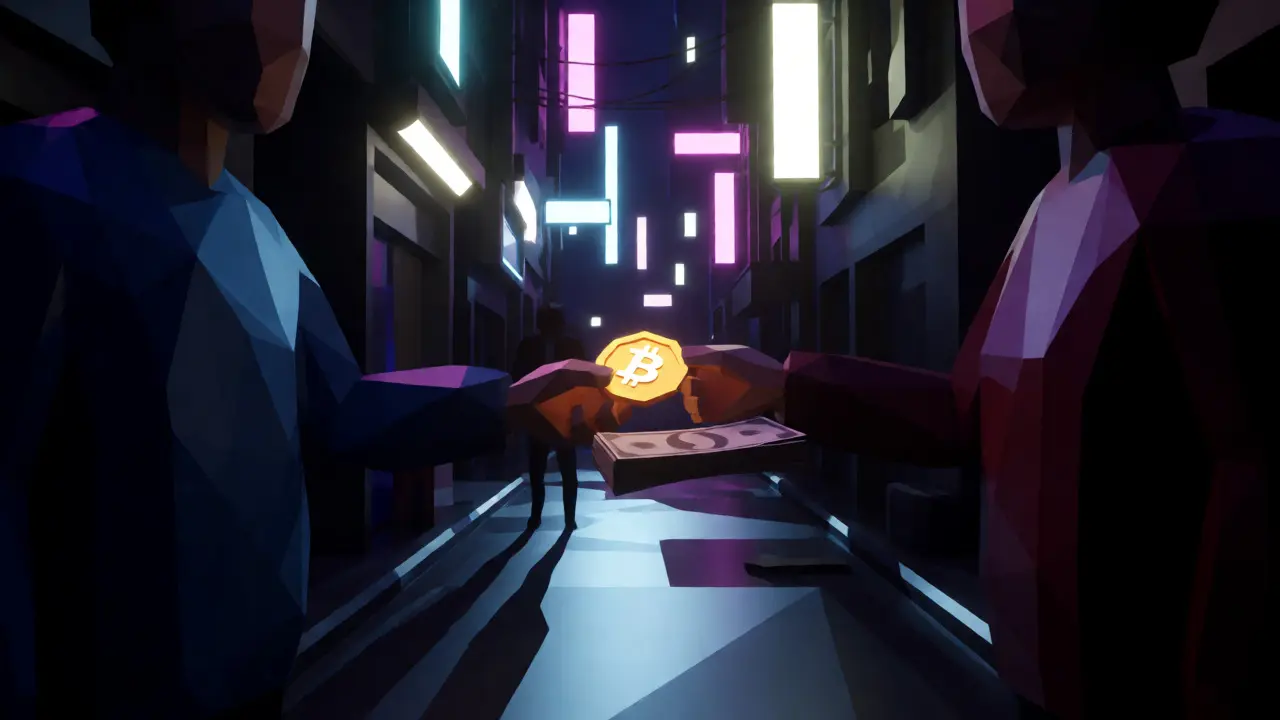
Imagine you want to buy Bitcoin. In New York or London, you click a button, pay the spot price plus a tiny fee, and your wallet updates in seconds. But what if you live in a country where holding that same Bitcoin is a crime? You can’t just open an app. You have to find a person who trusts you, agree on a price that covers their risk of going to jail, and hope no one snitches. That extra cost isn’t just a fee; it’s a premium. It’s the price tag for freedom in a world where digital money is illegal.
This article breaks down why these underground markets exist, how big the price gaps actually get, and which countries are currently driving this shadow economy. We aren’t just talking about theoretical economics here. We’re looking at real-world data from China, Afghanistan, Egypt, and emerging markets where regulation has turned simple transactions into high-stakes gambles.
The Economics of Fear: Why Prices Spike Underground
Why does Bitcoin cost more in a banned country than in a free one? It comes down to three things: risk, liquidity, and access. When a government bans crypto, they don’t delete the blockchain. They just make it hard for regular people to touch it. This creates a supply squeeze. If you can’t walk into a regulated exchange, you have to go through a middleman who takes on all the legal danger. That middleman charges a premium to cover their back.
Think of it like buying alcohol during Prohibition. The liquor itself didn’t change, but the price did because the seller had to dodge police raids. In crypto, the "police" are financial surveillance units and central banks. The "liquor" is Bitcoin or stablecoins. The premium reflects the operational costs of staying off the grid. According to economic principles, when legitimate channels close, the black market price rises to compensate for the increased probability of seizure, arrest, or asset confiscation.
China: The Massive Shadow After the Ban
China represents the most extreme case study in recent history. As of May 30, 2025, Beijing passed sweeping legislation that didn’t just ban trading-it criminalized personal ownership. Before this, mining was already out. Now, holding Bitcoin privately is technically illegal. The state is betting everything on its Central Bank Digital Currency (CBDC), the digital yuan. But humans are stubborn. Despite the crackdown, underground activity persists.
In cities like Shenzhen and Shanghai, peer-to-peer (P2P) trades still happen, often via encrypted messaging apps rather than public exchanges. While exact premium data is scarce due to the covert nature of these deals, anecdotal evidence suggests premiums ranging from 10% to 25% over global spot prices. Why so high? Because every transaction carries the threat of bank account freezes. If you use a linked bank card, the People’s Bank of China might flag the flow of funds. To avoid this, traders use cash or complex layering techniques, both of which add friction and cost.
Afghanistan: Religious Bans and Hard Cash
If China’s ban is bureaucratic, Afghanistan’s is ideological. Since 2022, the Taliban regime has declared cryptocurrency "haram" under Sharia law. Da Afghanistan Bank (DAB) enforces this strictly, shutting down exchanges and arresting traders. Yet, in a country with limited banking infrastructure and high inflation, digital assets remain attractive for savings and remittances.
The premium here is driven by isolation. With few cross-border payment options, Afghans turn to crypto to move value. However, because there are no licensed venues, every trade is a handshake deal. Reports indicate premiums can spike above 30% during periods of heightened enforcement. The lack of institutional liquidity means sellers hold all the power. If you need USDT to pay for imports, you pay whatever the guy with the coins demands. It’s a classic seller’s market created by artificial scarcity.
The Middle East and Africa: Enforcement vs. Adoption
Outside of total bans, many countries maintain partial restrictions that still drive activity underground. Take Egypt. The central bank maintains a blanket ban on crypto trading, yet arrests of individuals for violations continue-112 people were detained in 2025 alone. This suggests a vibrant, albeit risky, market exists beneath the surface. Young Egyptians, facing currency devaluation, view Bitcoin as a hedge. They accept the higher entry costs because the alternative-holding Egyptian pounds-is losing value daily.
Nigeria presents a different dynamic. The Economic and Financial Crimes Commission (EFCC) seized $38 million in crypto assets in 2024, a 27% increase from the previous year. Nigeria didn’t ban crypto outright but imposed strict regulations that pushed many operators offshore or underground. The result? A fragmented market where compliance-heavy platforms lose volume to informal P2P networks. These informal networks charge premiums not just for risk, but for speed. In a system where bank transfers can take days to clear international wires, paying a 5-10% premium for instant settlement is worth it for merchants.
Emerging Markets: The Gray Zone Premium
It’s not just about total bans. Strict compliance rules in emerging markets create similar pressures. India’s Financial Intelligence Unit fined non-compliant platforms $9.5 million in 2024. South Africa suspended licenses for 12 firms for failing Anti-Money Laundering (AML) checks. The Philippines blacklisted 20 exchanges, freezing $150 million in funds.
These actions don’t kill crypto; they push it sideways. Users who can’t meet KYC (Know Your Customer) requirements-perhaps due to lack of formal ID or privacy concerns-turn to decentralized exchanges (DEXs) or OTC (Over-The-Counter) desks. Here, the premium is smaller, often 2-5%, but it’s consistent. It’s the cost of bypassing bureaucracy. For small businesses in Brazil or Colombia, avoiding the 22% rise in ICO fraud enforcement actions means dealing with less scrutinized partners, again, at a price.
| Jurisdiction | Ban Type | Est. Premium Range | Primary Driver |
|---|---|---|---|
| China | Total Ownership Ban | 10-25% | Criminal penalties & CBDC push |
| Afghanistan | Religious/Absolute Ban | 20-30%+ | Lack of infrastructure & Sharia law |
| Egypt | Trading Ban | 15-20% | Enforcement risks & currency hedging |
| Nigeria | Strict Regulation | 5-10% | Compliance avoidance & speed |
| India | Tax/FIU Pressure | 2-5% | KYC barriers & tax evasion |

Technology as the Escape Valve
How do people actually execute these trades without getting caught? Technology plays a huge role in shaping the size of the premium. Decentralized Exchanges (DEXs) allow users to swap tokens directly from their wallets, bypassing centralized order books. Privacy coins like Monero (XMR) and Zcash (ZEC) command even higher premiums in these regions because they offer anonymity features that Bitcoin doesn’t.
Consider a user in a banned jurisdiction wanting to send value abroad. Sending Bitcoin on-chain leaves a trail. Using Monero obscures it. Sellers know this. So, if you want XMR, you’ll pay more than the global rate because fewer people are willing to sell it anonymously. Cross-border arbitrage also helps flatten these curves slightly. Traders buy cheap in unrestricted zones and sell high in restricted ones, though moving the physical cash or digital keys across borders adds logistical costs that keep premiums elevated.
Measuring the Invisible: Challenges in Data Collection
You might wonder why we talk about ranges instead of exact numbers. That’s because underground markets don’t publish receipts. There is no Bloomberg terminal for black market Bitcoin. Researchers rely on proxies: P2P platform spreads, merchant acceptance rates, and anecdotal reports from expats and locals. The Financial Action Task Force (FATF) notes that 99 jurisdictions have passed crypto legislation as of mid-2025, creating a patchwork that makes standardized comparison difficult.
Moreover, enforcement inconsistency skews data. In some regions, bribes can lower the effective risk, reducing the premium. In others, aggressive surveillance raises it. Without transparent reporting, the true depth of the underground market remains partially obscured. However, the trend is clear: as long as governments restrict access, a parallel price will exist.
What This Means for Investors and Users
If you operate in or interact with these markets, understand that the sticker price is rarely the real cost. If you’re buying crypto in a restrictive environment, budget for a 10-20% buffer. If you’re selling, recognize that your buyers are paying for convenience and safety, giving you leverage. For global investors, these premiums signal unmet demand. High premiums in a specific region suggest strong local adoption potential once-or if-regulations ease.
Also, consider the asset type. Stablecoins like USDT often see lower premiums than volatile assets because they serve as a direct substitute for the local fiat currency. In hyperinflationary environments within restricted zones, USDT is money first, crypto second. The premium is simply the cost of accessing dollar-equivalent stability.
Why do cryptocurrencies cost more in banned countries?
Cryptocurrencies cost more in banned countries due to the "risk premium." Sellers charge extra to compensate for the legal dangers of operating illegally, such as fines, asset seizure, or imprisonment. Additionally, reduced liquidity and the lack of regulated exchanges force buyers to use informal channels, which naturally carry higher transaction costs and wider bid-ask spreads.
Which countries currently have the highest crypto premiums?
As of 2025, jurisdictions with absolute bans like Afghanistan and comprehensive ownership bans like China tend to have the highest premiums, estimated between 10% and 30%. Countries with strict but not total bans, such as Egypt and Nigeria, see moderate premiums of 5-20%. The exact figure fluctuates based on the intensity of local enforcement operations.
Do privacy coins have higher premiums than Bitcoin in restricted areas?
Yes, privacy-focused cryptocurrencies like Monero (XMR) and Zcash (ZEC) typically command higher premiums than Bitcoin in banned jurisdictions. Their enhanced anonymity features make them harder to trace, increasing their utility for users trying to evade surveillance. This scarcity of anonymous liquidity drives up their price relative to global averages.
How do underground crypto markets operate without exchanges?
They primarily operate through Peer-to-Peer (P2P) networks and Over-The-Counter (OTC) deals. Users connect via encrypted messaging apps (like Telegram or Signal) or specialized P2P platforms that may be accessible despite local bans. Transactions often involve cash settlements or bank transfers that are carefully structured to avoid triggering automated anti-money laundering flags.
Can I arbitrage the price difference between banned and free markets?
Arbitrage is theoretically possible but practically difficult. Moving capital into a banned jurisdiction is hard due to capital controls, and moving profits out requires converting crypto back to local fiat, which may face withdrawal limits or scrutiny. The costs of transfer, conversion, and risk often eat up most of the arbitrage margin, making it viable only for large-scale, professional operators.