
Honeyswap Review 2026: Low Fees, Low Liquidity, or Niche Gem?
Imagine trying to buy a single coffee with Bitcoin on the Ethereum mainnet in 2021. You’d likely pay more in gas fees than the coffee costs. That specific pain point is exactly why Honeyswap exists. It isn't trying to be the biggest exchange in the world. Instead, it serves a very specific purpose: enabling cheap, fast trades on the Gnosis Chain (formerly xDai Chain).
In this review, we’re cutting through the hype to see if Honeyswap is still worth your time in late 2026. We’ll look at its actual trading costs, how much money is actually locked in the system, and whether its community-driven model holds up against giants like Uniswap.
What Is Honeyswap?
Honeyswap is a decentralized exchange (DEX) launched in September 2020 as a fork of Uniswap V2, specifically optimized for the Gnosis Chain ecosystem. If you’ve used Uniswap, you already know how Honeyswap works. The interface looks familiar because it *is* familiar-it’s built on the same codebase but deployed on different infrastructure.
The key difference lies in the network. While Uniswap primarily operates on Ethereum (and now various Layer 2s), Honeyswap was born to solve the high-fee problem on the Gnosis Chain. This chain uses a Proof-of-Stake consensus mechanism that keeps transaction costs incredibly low-often fractions of a cent. For traders who want to move small amounts of crypto without getting eaten alive by network fees, this is a game-changer.
Governance is handled by the 1Hive DAO, which uses the HNY token to let users vote on protocol changes. This means there’s no central company running the show. The community decides where the platform goes next, which aligns perfectly with the ethos of decentralized finance.
Trading Costs and Fee Structure
Let’s talk about the numbers, because that’s usually why people choose a DEX. Honeyswap charges a standard swap fee of 0.30%. Here is how that money gets split:
- 0.25% goes directly to the liquidity providers (the people who put their money into the pool so you can trade).
- 0.05% goes to the protocol fund.
Within that protocol portion, there’s a unique distribution mechanism. A fraction of these fees supports the global Honey token ecosystem, while another part rewards local liquidity on specific chains via "Comb" tokens. This dual-token incentive model tries to balance global governance power with local trading activity.
Compared to Ethereum mainnet swaps, which can cost $5 to $50+ depending on congestion, a Honeyswap swap might cost you less than $0.01 in gas. Even compared to other Layer 2 solutions, the Gnosis Chain remains one of the cheapest options available today. However, keep an eye on slippage. Because liquidity is lower here than on major exchanges, large trades can suffer from higher price impact.
Liquidity and Market Depth: The Reality Check
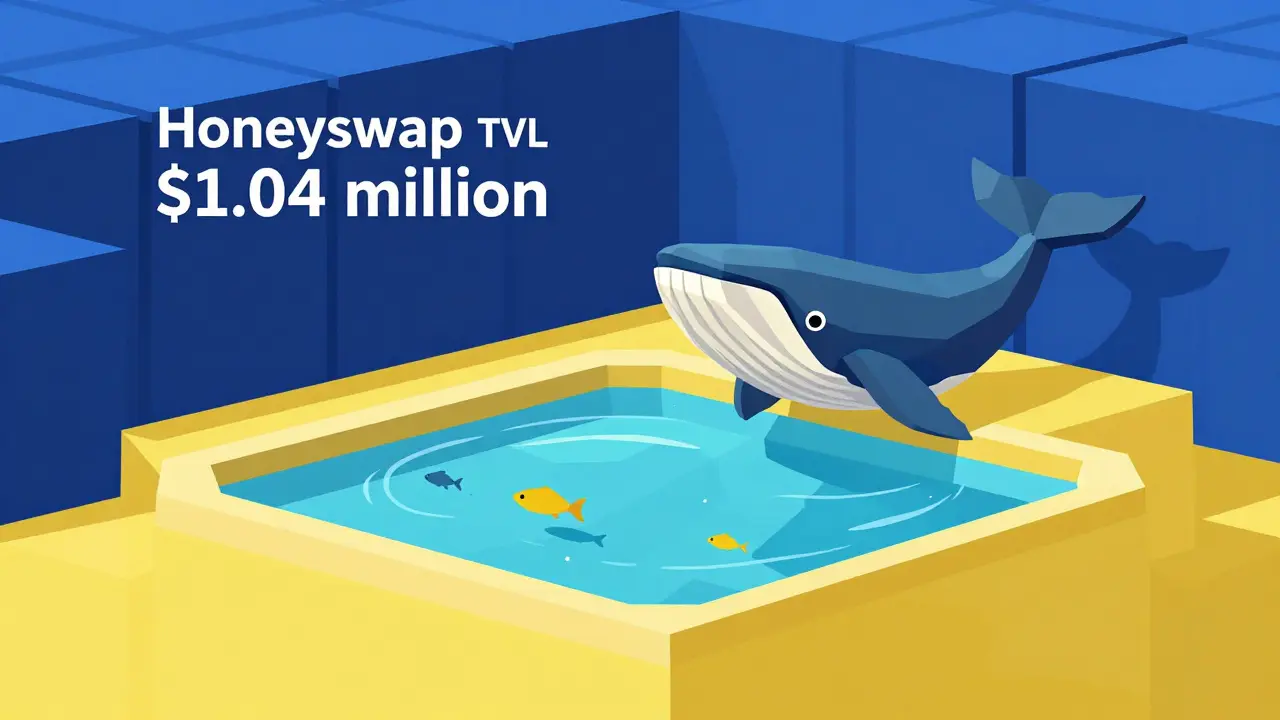
Here is the hard truth: Honeyswap is not a volume monster. As of mid-2026, the Total Value Locked (TVL) sits around $1.04 million. To put that in perspective, Uniswap locks billions. This makes Honeyswap a niche player rather than a market leader.
| Metric | Honeyswap | Uniswap (Aggregate) |
|---|---|---|
| Total Value Locked (TVL) | ~$1.04 Million | Billions |
| Daily Volume | ~$31,000 - $32,000 | Billions |
| Primary Network | Gnosis Chain / Polygon | Ethereum / L2s |
| Gas Fees | Negligible (<$0.01) | Variable ($0.10 - $50+) |
| Token Selection | ~26 Coins / 40 Pairs | Thousands |
This limited liquidity means Honeyswap is perfect for micro-transactions or swapping stablecoins and major assets like GNO or HNY. But if you try to dump $50,000 worth of a lesser-known token into a pool, you will experience significant slippage. Users have reported slippage issues above 2% for trades over $5,000. It’s simply not designed for whale-sized movements.
User Experience and Security
Using Honeyswap requires a compatible Web3 wallet like MetaMask, WalletConnect, or Fortmatic. The setup process involves adding the Gnosis Chain network to your wallet manually if it isn’t pre-configured. Once connected, the interface is clean and intuitive. There are no KYC requirements, no account creation forms, and no customer support chatbots. You are anonymous, and you are responsible for your own security.
Security-wise, the smart contracts have been audited by CertiK, a leading blockchain security firm. This provides a baseline level of trust. However, remember that audits are snapshots in time. New vulnerabilities can emerge, especially as the platform expands to new networks like Polygon and potentially Arbitrum in the coming years.
The user rating on independent platforms hovers around 3.0 out of 5. Why so low? Mostly due to expectations mismatch. Users expecting the depth and speed of a centralized exchange like Binance get frustrated by the thin order books. But users who understand they are accessing a specialized, low-fee environment tend to rate it higher for its intended use case.

Who Should Use Honeyswap?
Honeyswap isn't for everyone. Here is a quick breakdown of who benefits and who should look elsewhere:
- Use Honeyswap if: You hold assets on the Gnosis Chain and need to swap them quickly without paying high fees. You are interested in the 1Hive ecosystem and want to participate in its governance. You are making small-to-medium trades where gas efficiency matters more than maximum liquidity.
- Avoid Honeyswap if: You are moving large sums of capital (over $10k). You need access to thousands of exotic tokens. You prefer the instant execution and deep liquidity of centralized exchanges.
The Future of Honeyswap
The roadmap for 2026 includes deeper integration with Polygon and potential expansion to Arbitrum. The goal is to become a multi-chain aggregator within the EVM-compatible space. However, sustainability remains a question mark. With annual protocol revenues estimated at only ~$20,000, funding long-term development is challenging. The project relies heavily on community passion and the broader success of the Gnosis Chain itself.
If Ethereum Layer 2 solutions continue to mature and reduce fees further, Honeyswap’s primary advantage-cheap transactions-might face stiffer competition. But for now, it remains the default gateway for DeFi activities on Gnosis Chain, offering a transparent, community-owned alternative to corporate-controlled exchanges.
Is Honeyswap safe to use?
Yes, Honeyswap has undergone security audits by CertiK. However, as with any decentralized exchange, you are responsible for your own wallet security. Always verify contract addresses before interacting with them to avoid phishing scams.
What is the minimum amount to trade on Honeyswap?
There is technically no minimum set by the protocol, but practical limits exist due to liquidity. Trades under $10 may result in poor exchange rates due to slippage. It is best suited for trades ranging from $50 to $5,000.
Does Honeyswap require KYC?
No. Honeyswap is a non-custodial decentralized exchange. You connect via a Web3 wallet like MetaMask, and no personal information or identity verification is required.
How do I get HNY tokens?
You can acquire HNY by swapping other tokens on Honeyswap, providing liquidity to earn trading fees, or participating in yield farming opportunities within the 1Hive ecosystem.
Why is the liquidity so low compared to Uniswap?
Honeyswap focuses on the Gnosis Chain niche rather than the entire Ethereum ecosystem. While this keeps fees low, it also means fewer users and less capital are concentrated in its pools compared to industry giants.